I am planning a zirconia bridge restoration for a patient in the anterior region. Should I choose layered zirconia or multilayer zirconia? My patient’s primary concern is aesthetics, but I am not entirely clear about the risks associated with a layered zirconia bridge. Have you ever had the same question?
This guide helps you understand what a layered zirconia bridge is, how it provides natural esthetics, how it’s produced, its risk factors, and its best clinical applications.
At the end of this guide, you should be able to select the right zirconia bridges for the case, understand the most important manufacturing process of Layered zirconia bridge fabrication, and learn how to express your requests to dental labs.
1. What Is a Layered Zirconia Bridge?
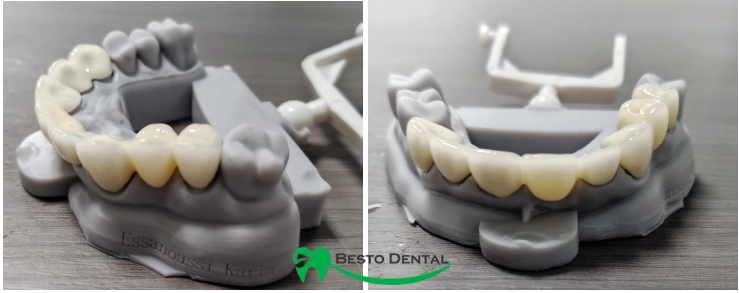
A layered zirconia bridge is a fixed dental prosthesis comprising a zirconia structure as a supporting device and an outer layer of porcelain for appearance. The coping is also known as the framework, and it holds up the bridge. The shape, color, and optical effects are provided by the porcelain veneer. The connectors are responsible for the connection of the units and the transmission of occlusal load. Porcelain is not a thin surface paint. It is a real, thick ceramic structure that is built up, sintered, and shaped.
In a nutshell, the zirconia structure takes the work. It provides strength to the bridge and helps to maintain the shape of the bridge structure. The porcelain on top mimics the look of natural teeth to ensure the restoration looks more natural and doesn’t stand out from the other teeth as a solid block of white ceramic. Each unit on the bridge is connected by the connector, which determines the bite-handling qualities of the entire bridge.
Let’s see the advantages of a multi-layered zirconia bridge:
- Multi-layered porcelain: Using one block of zirconia to recreate the esthetic depth of a tooth is a challenge.
- Better color matching: Porcelain can be made in various colors so that the bridge is produced to blend from the gum line to the chewing surface.
- Excellent masking: The porcelain layer can aid in masking the discolored or dark colour of the abutment teeth.
- Custom optical effects: Different porcelain powders can be used to include the optical effects of incisal translucency, opalescence, and fluorescence.
- Reliable support: Zirconia framework is reliable, particularly in the area that bears strong biting forces.
- The flexible amount of porcelain: The amount of porcelain can be adjusted according to the visibility of the bridge and the amount of load it will include.
- Repairable in some situations: In some cases, a small porcelain chip is found and can be repaired using a composite material, but larger failures may need a remake.
The use of layered zirconia bridges is very common in dentistry in esthetic anterior cases, in posterior cases where patients value a more natural appearance, and in cases where the bridge is supported by implants and appearance is important.
2. Structure of Layered Zirconia Bridges
A layered zirconia bridge consists primarily of three structural components.
| Structure | function |
| Zirconia Framework / Coping | Provides the primary structural support for a dental bridge |
| Porcelain Veneer | Forms the external shape, color, and optical characteristics of the teeth |
| Connector | Connects the individual units of the dental bridge and transmits occlusal loads |
It is important to note that the glazing ceramics of the Layered Zirconia Bridge are not simply a surface coating, but a ceramic structure of a certain thickness that requires stacking, sintering, and shaping.
3. Types of Layered Zirconia Bridges
Layered zirconia bridges follow the same classification system as other types of dental bridges. Based on the method of support, they are categorized into tooth-supported and implant-supported bridges. In terms of structure, they are classified as either 3- or 4-unit bridges or long-span bridges. We have already covered in detail Zirconia Dental Bridges Explained. Here, we will focus specifically on the “extent of veneering porcelain coverage,” which can be categorized as follows:
| Type | Main Characteristics | What to Keep in Mind |
|---|---|---|
| Full Veneering | The zirconia framework is covered by porcelain that covers most of the visible and often proximal surfaces | It has a high esthetic potential, but the more porcelain surface area, the more opportunities there are for chipping |
| Facial / Buccal Veneering | Layering is primarily done on the facial or buccal side in the case of porcelain. Lingual and occlusal surfaces stay as monolithic zirconia | It offers an esthetic and low-risk solution for functional surfaces. Clearly articulate with the lab where porcelain should end up |
| Incisal Cutback Veneering | Porcelain is primarily added at the incisal edge to enhance translucency and colour depth | It is less common. It is applied where the incisal edge is the most important esthetic component and the rest of the bridge might be more conservative |
In our practice, full veneering and facial veneering are the most commonly requested. Incisal cutback veneering is a specialized option. A less common request is a mix of facial veneering with a small incisal cutback on the same bridge, usually for a single visible anterior unit.
4. Esthetics of Layered Zirconia Bridges
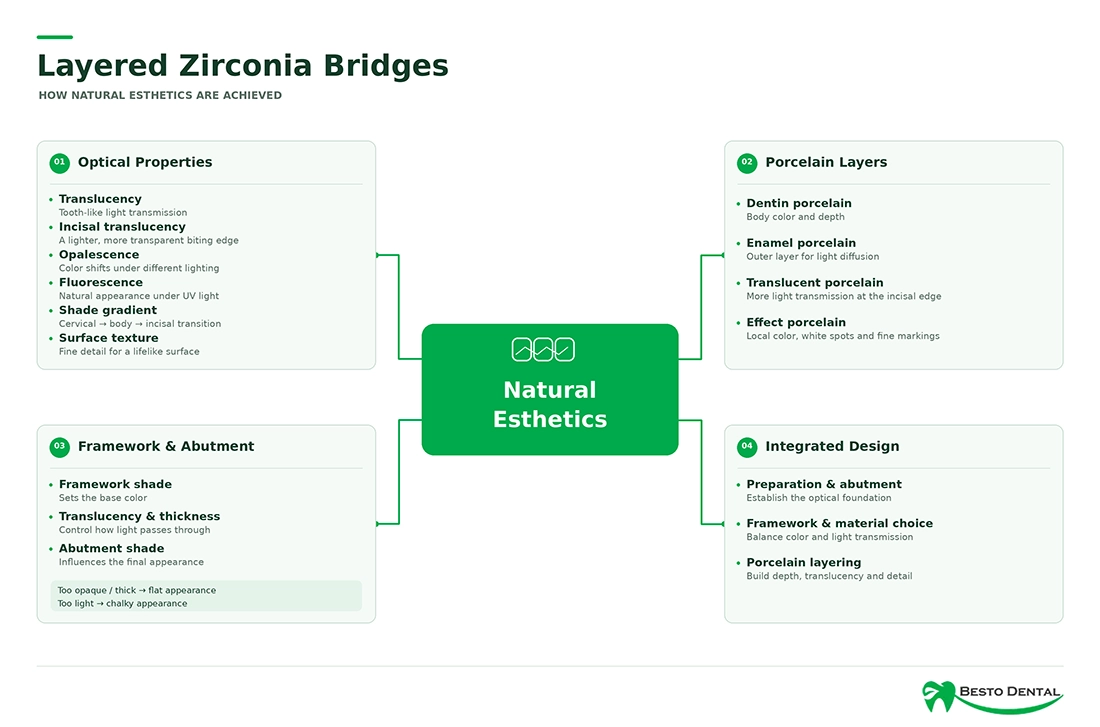
Layered zirconia bridges are made and are characterized by several important optical properties that create natural esthetic results. All of these behaviors simulate a portion of the tooth structure and combine to provide a lifelike appearance in different lights.
| Aesthetic Parameter | Function |
| Translucency | Lets light pass through the restoration in a way that resembles natural tooth structure |
| Incisal Translucency | Creates a lighter, more transparent look at the biting edge |
| Opalescence | Mimics the way natural teeth shift color under different lighting |
| Fluorescence | Helps the restoration look right under UV light |
| Shade Gradient | Allows a smooth transition from the cervical area to the body to the incisal edge |
| Surface Texture | Adds the fine details that make a restoration look alive |
Lab technicians create these effects by using various combinations of dentin, enamel, translucent, and effect porcelains. The color depth and light transmission vary for each layer:
- The body color is typically used to be dentin porcelain.
- The outer layer is made of enamel porcelain, which enhances light diffusion.
- Where more light is desired, translucent porcelain can be used, usually near the incisal edge.
- Effect porcelain can create a slight texture, including white spots, crack lines, and warmer hues in the area of the neck.
To fabricate aesthetic restorations with different color depths and optical effects, for example, in anterior aesthetic restorations, combinations of Dentin, Enamel, Translucent, and Effect Porcelain can be used.
The final esthetic outcome is not solely dependent on the porcelain, however. The appearance of the restoration is affected by the color of the zirconia framework, translucency, thickness, and color of the underlying abutment. Either an overly opaque or thick frame will obstruct light and will cause a flat appearance to the porcelain.
5. Fabrication Process of Layered Zirconia Bridges
We list the overall workflow for a layered zirconia bridge:
| Stage | What Happens | What to Keep in Mind |
|---|---|---|
| Digital Impression / Model Scanning | The lab gets an intraoral scan or scans a physical model, taking the preparation, opposing arch, and bite | Scan quality and margin definition are the groundwork for all the other things |
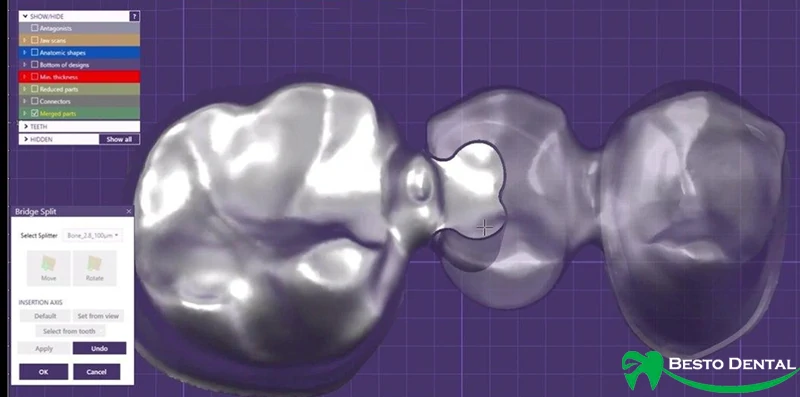
| CAD Framework Design | The zirconia framework and connectors are designed by the technician, and the space to fill with porcelain layering | The framework should not be too thin and should allow sufficient room for porcelain. Connector size is critical |
| Zirconia Milling | The framework is milled from a presintered zirconia disc | The framework is milled oversized to compensate for sintering shrinkage |
| Sintering | The framework is sintered to full density according to the manufacturer’s program | Sintering parameters affect strength and fit. Large frameworks may need support |
| Porcelain Layering | The technician builds up dentin, enamel, and effect porcelains on the framework | This step determines the final color and optical effects. Layering thickness must be controlled |
| Porcelain Firing | Multiple build/fire cycles and firing in the porcelain system program are normally used for the layered porcelain | Porcelain density and its bond strength are influenced by the firing temperature and cycles |
| Contour & Glazing | Surface is glued or polished, shaping is done, contacts and occlusion are adjusted | The porcelain may be adversely impacted by overheating during glazing. Occlusion has to be reviewed |
| Quality Inspection | The finished bridge is checked for margin fit, connector integrity, occlusion, porcelain integrity, color, and contour | This is the last chance to catch problems before delivery |
During production, there are two steps that need to be paid special attention. The first is the design of the CAD framework. As a rule, the more room a framework has to accommodate porcelain, the better the outcome will be.
6. Common Risks of Layered Zirconia Bridges
However, the main danger connected with using layered zirconia is chipping of porcelain, but there are also such dangers as framework fractures, delamination of the veneering porcelain, marginal fit problems, and occlusal problems.
| Clinical Risk | Description | Common Causes |
|---|---|---|
| Porcelain Chipping | A fragment of the surface porcelain comes off, and the zirconia framework may remain intact | Insufficient porcelain support, too thick porcelain, and heavy occlusal load |
| Veneer Delamination | Fractionation of porcelain from zirconia framework in a localized or larger area | Bonding issues at the interface, residual thermal stress, improper fabrication |
| Framework Fracture | The zirconia framework or connector breaks | Undersized connectors, excessive span, high occlusal load |
| Marginal Discrepancy | There is a poor fit between the bridge margin and the abutment | Scan error, design or milling error, seating issues |
| Occlusal Problems | The occlusion is too high; there are premature contacts or poor force distribution | Inaccurate bite record, poor design, insufficient clinical adjustment |
| Aesthetic Mismatch | The color, translucency, or shape is different from the tooth’s natural color | Framework shows through, wrong porcelain shade or thickness |
| Hygiene Difficulties | It is difficult to clean the area in between the teeth or under the pontic | Poor pontic contour or gingival embrasure design |
The framework may stay intact despite the fact that chipping and fracture of veneering porcelain may take place because of occlusal loads and stress concentration. It is possible to minimize the risks of complications with this material, according to the laboratory practice at BestoDental, with proper design of frameworks, control of the thickness of the veneering porcelain, sufficient support of the veneering porcelain, and correct occlusal contacts.
7. Clinical Applications of Layered Zirconia Bridges
In the cases we handle, the most frequent use of layered zirconia is for an esthetic anterior case; however, it’s also been seen in posterior and implant cases where a more natural appearance than what monolithic zirconia can give the patient is desired.
| Specific Clinical Situation | How the Product Is Used | Main Considerations |
|---|---|---|
| Anterior missing teeth | When the anterior teeth are missing, a layered zirconia bridge restores the tooth to a color and translucency that match the natural teeth | The framework color and thickness may create a difference in color. When it comes to incisal effects, layering is important |
| Posterior missing teeth with high esthetic demand | The bridge is used to replace the posterior teeth, but the visible portion of the bridge is layered to give a more natural esthetic appearance | The occlusal surface can also be monolithic, if that is wanted to minimize chipping risk. The veneering coverage must be planned |
| Implant-supported bridge | The layered bridge is supported by implants, often for multiple missing teeth or a full arch | The design is influenced by the position of the implant, the way the screw is accessed, and how it is held. The framework must fit the porcelain layering |
| Multi-unit bridge in the esthetic zone | The bridge spans several teeth in the smile line, and the patient is looking for a natural look | Shade matching in multiple units is difficult. The framework design needs to enable the uniform thickness of porcelain |
The anterior esthetic bridge case is the one that raises the most questions. While the shade selection is a key part of the process, the shade and thickness of the zirconia framework are also important aspects that clinicians might not be aware of. The more opaque or thick the framework is, the less translucency the porcelain will have.
Therefore, at BestoDental, I inform clients before the case begins that the framework may affect the final tooth color, but we will use specialized masking materials and electroplating during the fabrication process.
8. Layered Zirconia Bridge FAQs
There are several common questions about Layered Zirconia Bridges. We’ll take them up one by one.
1) Is a layered zirconia bridge more likely to fracture than a monolithic zirconia bridge?
The zirconia framework itself does not have a higher risk of fracture. The difference is that a layered bridge is finished with a porcelain veneer that can chip, whereas a monolithic bridge is not. Thus, the risk of a visible failure may be increased, but the risk of catastrophic failure of the framework may not be increased.
2) Can layered zirconia bridges be used in the posterior region
Yes, but the occlusal and lingual surfaces are usually all zirconia and don’t tend to chip as much. The porcelain may be limited to the facial or buccal side. This will provide a natural appearance in the visible area with good strength of the functional surface.
3) How do I decide between full veneering and facial veneering?
It will rely on the extent of the restoration that is exposed and on the load that it will receive. Full veneering gives the most esthetic (presentation) but has larger porcelain surfaces. In the posterior and/or mixed dentition zones, a good option is facial veneering, which allows for superior esthetic results without the addition of porcelain to the occlusal surface of the tooth.
4) Are layered zirconia bridges suitable for patients with bruxism?
These may be considered, but the design must be modified. The occlusal surface is also often maintained in the form of monolithic zirconia, which is capable of handling the high load. A night guard is typically needed to safeguard the restoration. Evaluation of the patient’s bruxism pattern and the occlusal scheme must be considered prior to decision-making.
5) What should I check before sending a case to the lab for a layered zirconia bridge?
Confirm the shade, veneering coverage desired, and zirconia type. Be sure that scan data is legible and that the margins are present. Be sure to communicate if there are esthetic needs such as incisal translucency or a specific surface texture. All these details are easier to deal with in the design phase rather than during construction.
8. Conclusion
In this article, we have covered the definition, structure, aesthetic properties, and clinical applications of layered zirconia bridges, as well as some frequently asked questions. We hope this information will help you make more informed decisions when outsourcing the fabrication of layered zirconia bridges. If you would like to learn more about the outsourcing process, please check out our other article: Zirconia Dental Lab Outsourcing Guide.