Zirconia is a material used in the field of restorative dentistry for some time. Can be applied to dental crowns, dental bridges, inlays, onlays, and various restorations. In this article, we are going to discuss zirconia crowns, types of zirconia, zirconia materials, fabrication of zirconia crowns, and clinical applications.
If you are a dental practitioner who reviews treatment options, a dental technician or lab manager who needs to select materials, or a patient who wishes to gain more understanding of the different types of zirconia crowns, it is crucial to be well-versed in the different varieties of zirconia crowns.
By the end of this article, you will have systematic information on zirconia crowns, classifications, manufacturing process, indications, and clinical use. You will also learn the differences, advantages, and disadvantages of various kinds of Zirconia crowns to choose the appropriate one based on esthetic, functional, and budget considerations.
1. What is a zirconia crown?
The zirconia crown is a tooth-shade dental restoration that is mainly fabricated for zirconia dioxide ceramic material and is positioned on a prepared natural tooth or positioned over an implant abutment to reconstruct the shape, strength, look, and chewing function of a natural tooth. Zirconia crowns can be used like a PFM crown, but they do not need a metal coping because they are structurally strong.
The zirconia crown serves as a new functional and visible surface of the tooth, in simple terms. It is finished with the required anatomy, occlusion, and shade from a digitally designed zirconia blank to fit into the prepared tooth or implant abutment. The crown can be fabricated as a full-contour monolithic zirconia or be over-veneered with porcelain for more esthetic characterization based on the zirconia material and the restoration requirements.
Zirconia crowns offer several advantages, such as:
- High strength: Zirconia is a material that can resist high chewing forces, which is very beneficial for the use of restorations in load-bearing areas like molars.
- Natural appearance: Modern zirconia comes in various translucencies and shades, so that the restoration can be matched more closely with its neighbouring natural teeth.
- Dark metal margin-free: Zirconia is a metal-free construction, which means that it does not contain a conventional metal margin and can therefore not be visible with a PFM restoration.
- Biocompatibility: Zirconia is used as a dental restorative material and shows good biocompatibility.
- Appropriate for digital manufacturing: CAD software can be used to design zirconia crowns, and they can be precisely milled from prefabricated blocks.
- Variations in material formulations and manufacturing methods make zirconia suitable for various types of restorations where strength, esthetics, or a combination of the two are required.
However, zirconia crowns are used very frequently in practice for the restoration of damaged, fractured, heavily filled, and root canal treated teeth which need full coverage restorations. High-strength zirconia is commonly used for posterior crowns and locations under high occlusal load, whereas more translucent zirconia may be used for anterior restorations that are more visible. Zirconia may also be used in implant-supported crowns, depending on the position of the implant, the aesthetic demands, space limitations, and functional loading demands, and may be selected for certain types of bridge work.
2. Why Choose Zirconia Crowns?
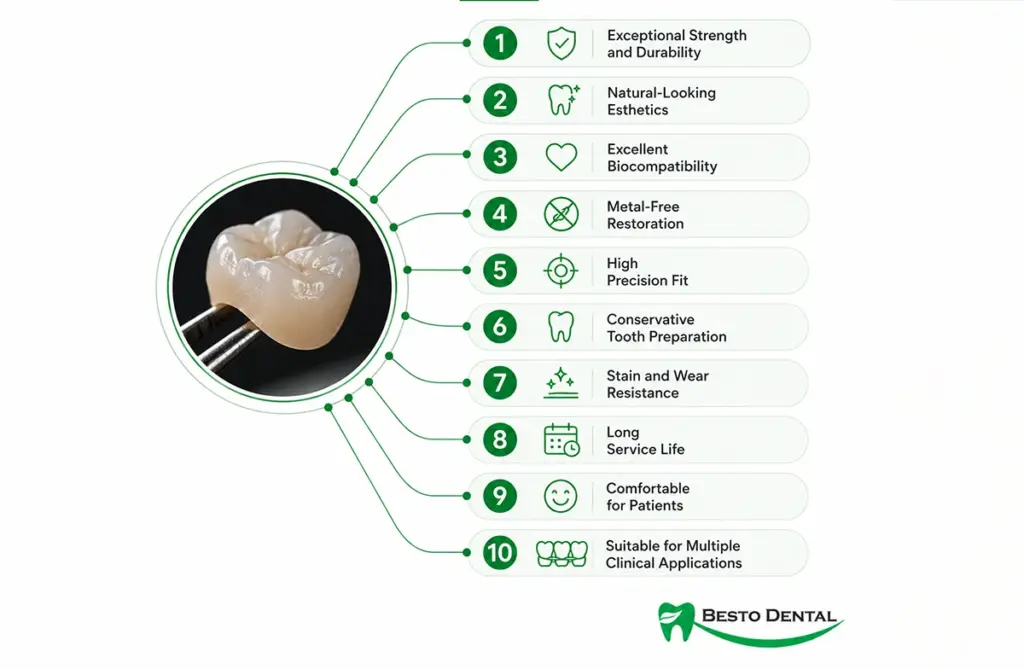
Today, one of the best available restorations in dentistry is zirconia crowns. Zirconia Crowns possess several unique advantageous characteristics over traditional metal crowns or porcelain-fused-to-metal (PFM) crowns, such as strength, esthetics, biocompatibility, and longevity. Thus, they are frequently used in anterior, posterior, and implant-supported restorations.
1) Exceptional Strength and Durability
One of the most durable all-ceramic materials in use today is zirconia. It is highly resistant to fractures, chipping, and wear, and thus very reliable even in the posterior regions when subjected to high loading.
Zirconia may be a more reliable material than some other ceramics for patients with high occlusal forces, patients with bruxism, and patients with bridge restorations.
2) Natural-Looking Esthetics
The color gradient and translucency of natural teeth can be closely reproduced with modern multilayer zirconia and layered zirconia, resulting in highly esthetic restorations.
Unlike metal-based crowns, zirconia crowns will not result in a dark line at the gum line or a metal shadow effect and is ideal for esthetic zone restorations.
3) Excellent Biocompatibility
Zirconia is a very biocompatible material and will not irritate adjacent gum tissues and encourages normal soft tissue reactions.
Zirconia isn’t made from metal, either, so it’s also a great option for people who are allergic to metals or want a wholly metal-free smile.
4) Metal-Free Restoration
Over time, the margins of the PFM may begin to reveal the restorations with gum recession, which may impact the restoration’s aesthetics.
Zirconia crowns are metal-free, and they avoid such problems as a corroded, darkened gingival margin, metal exposure, or darkening of the crown, ensuring a natural look for years.
5) High Precision Fit
CAD/CAM digital design and milling technology are commonly used to produce zirconia crowns.
By combining digital scanning, computer-aided design, and precision milling, zirconia restorations can be designed to attain outstanding marginal integrity and internal fit, which minimizes chairside adjustments and enhances comfort and long-term clinical success.
6) Conservative Tooth Preparation
Because zirconia is a very strong material, it is often possible to get enough restoration space without having to remove much healthy tooth structure.
Zirconia crowns may provide more of preservation of the natural tooth tissue than some traditional restorative materials, which can benefit patients over the long-term.
7) Stain and Wear Resistance
Zirconia exhibits a very high resistance to stains and does not stain from coffee, tea, red wine, tobacco or other outside sources.
Properly polished and glazed, zirconia also provides good wear resistance, which helps to preserve its function and appearance over time.
8) Long Service Life
With proper oral hygiene and routine care by your dentist, zirconia crowns can typically last for 10 years or more, and in many instances surpass the mark of 15 years.
They are an excellent long-term restorative material with excellent mechanical properties and material stability.
9) Comfortable for Patients
Compared to metal-based restorations, the thermal conductivity of zirconia is relatively low, which will not conduct hot or cold sensations as easily.
This means that patients will be more comfortable eating hot or cold foods and beverages.
10) Suitable for Multiple Clinical Applications
The zirconia crowns are not only indicated for single-tooth restoration, but are applicable to multiple-tooth restorations as well. However, they are also extensively used in dental bridges, implant-supported crowns, full-arch restorations, and complex full-mouth rehabilitation cases.
Zirconia is a material that is biocompatible, esthetic, and strong, and it is one of the most widely used fixed restorative materials in dentistry in both practices and laboratories around the world.
3. Types of Zirconia Crowns
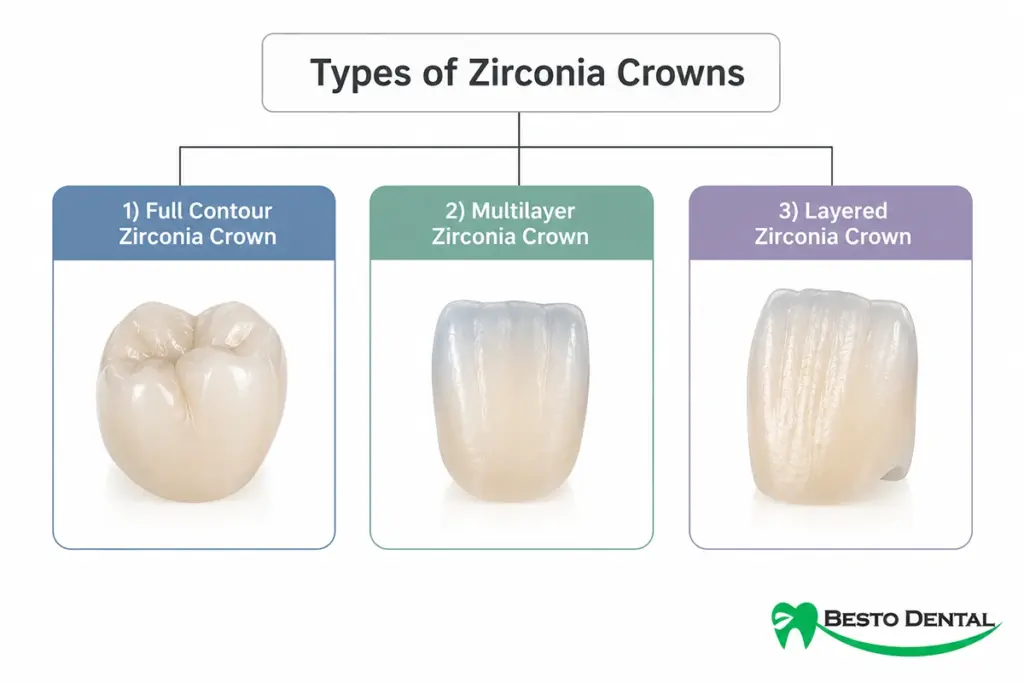
Today’s zirconia crowns can be categorized into several different types. All types provide different amounts of strength, esthetics and clinical indications and need to be chosen according to the treatment needs.
1) Full Contour Zirconia Crown
The full-contour zirconia crown is processed from a solid block of zirconia, without the need to apply a porcelain layering material. The main advantages are high strength, good wear resistance and minimal chipping, so it is often used in posterior restorations and in patients who have high occlusal forces.
Common Applications:
- Single posterior crowns
- Posterior bridge restorations
- Patients with bruxism
- Cases involving heavy occlusal loads
2) Multilayer Zirconia Crown
Multilayer zirconia crowns are made from colour- and translucency-graded zirconia discs. This enables the restoration to have a more natural transition from the cervical area to the incisal edge, and it mimics the natural structure of the teeth. Multilayer zirconia is also significantly more esthetic than conventional monolithic zirconia crowns and is also of high strength.
Common Applications:
- Anterior and posterior single crowns
- Patients with higher esthetic expectations
- Routine clinical restorative cases
3) Layered Zirconia Crown
A Zirconia crown is a multi-layered construction that combines the Zirconia coping with a layer of hand-layered porcelain. The translucency, surface texture and colour characterization of the porcelain layer gives it high degree of lifelikeness. This is often the type of restoration that is needed when there is a need for better esthetic results.
Common Applications:
- Anterior restorations
- Esthetic zone restorations
- Smile design cases
- Premium cosmetic rehabilitation
The 3 types of zirconia crowns described above are commonly used as conventional zirconia restorations in everyday clinical cases. When enhanced esthetics and higher translucency are required, high-translucency zirconia materials can be selected to achieve a more natural appearance and improved light transmission.
In addition, when zirconia crowns are used in implant cases, such as implant-supported single crowns, anterior implant restorations, or posterior implant restorations, they are commonly referred to as implant zirconia crowns.
4. Zirconia Crown Materials
Although all zirconia crowns are made from zirconium dioxide, not all zirconia materials offer the same performance. Over the years, dental materials have evolved from first-generation high-strength zirconia to current and newer zirconia materials that offer a balance of strength and esthetics.
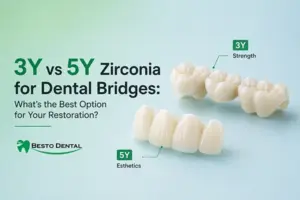
The zirconia materials commonly available in the market today are primarily 3Y zirconia, 4Y zirconia and 5Y zirconia. The main distinction between them is in the ratio of strength to translucency.
The more translucent zirconia is, the more esthetic and tooth-like it will look. But there is an inverse relationship between translucency and material strength. As a result, various types of zirconia materials can be used for various clinical applications.
1) 3Y Zirconia
The flexural strength of 3Y zirconia is on average 1000–1200 MPa, or even higher, and is one of the strongest dental zirconia materials on the market today.
Due to its excellent mechanical properties, 3Y zirconia is commonly used for:
- Posterior single crowns
- Multi-unit bridge restorations
- Patients with heavy occlusal forces
- Full-arch implant-supported fixed restorations
However, compared with newer high-translucency zirconia materials, 3Y zirconia has relatively lower translucency, which may limit its use in highly esthetic anterior cases.
2) 4Y Zirconia
4Y zirconia is often considered a balanced option between strength and esthetics.
It is much more translucent than the traditional 3Y zirconia but has a high mechanical strength. Therefore, it can be used for a variety of anterior and posterior restorations.
If you prefer both an esthetic look and durability, 4Y zirconia may be the best option for you.
3) 5Y Zirconia
Zirconia provides greater translucency, making it more like natural enamel, than 5Y zirconia. It is often employed in anterior esthetic restorations, for this reason.
Common applications include:
- Anterior single crowns
- Veneer alternative cases
- Patients with high esthetic expectations
However, 5Y zirconia usually has lower strength than 3Y and 4Y zirconia. Therefore, its use in long-span bridges or high-load occlusal areas should be carefully evaluated.
So, how do you choose the right zirconia material? Based on 10+ years of dental restoration fabrication experience, BestoDental generally recommends high-strength zirconia for molar areas, posterior teeth, or restorations that must resist heavy occlusal forces. In anterior esthetic zones, high translucency zirconia might be the better choice.
In recent years, with the development of multilayer gradient zirconia materials, many dental laboratories can now achieve a better balance of strength and esthetics within a single zirconia disc, helping meet a wider range of clinical restoration needs.
Understanding zirconia materials is just one factor that contributes to a successful restoration. The quality of the dental lab itself, its work flow process, and quality control system play no less important role. In case you decide to outsource your zirconia crowns, read our Zirconia Dental Lab Outsourcing Guide: Price, Workflow & Lab Selection to learn how to evaluate laboratories and compare costs.
5. Manufacturing Process of Zirconia Restorations
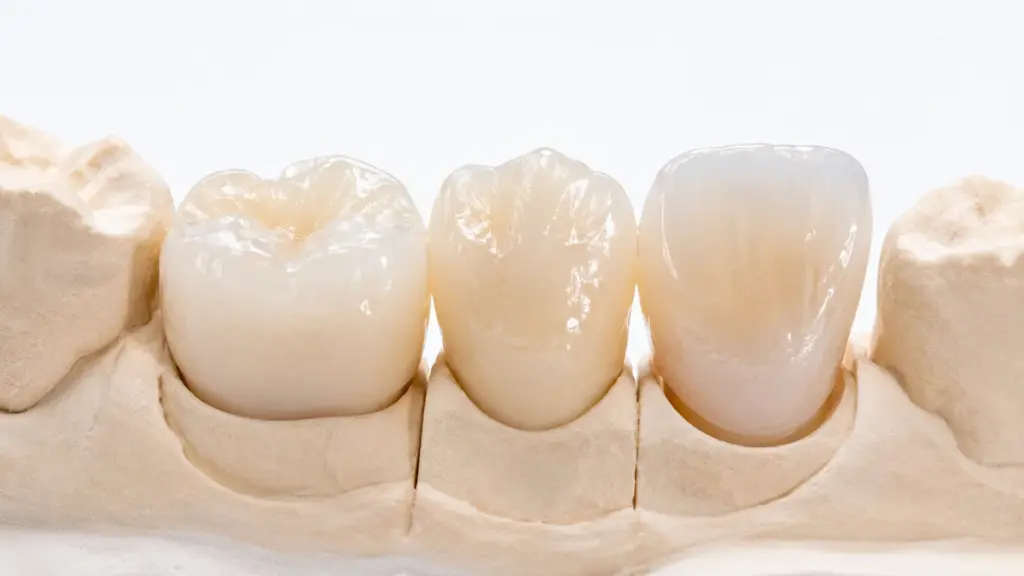
Zirconia crowns are not “hand-carved” restorations. They are manufactured with digital design, CAD/CAM milling, sintering, and end surface treatment. As a dentist and patient learn about this process, they will better understand the precision, cost, and turnaround time of zirconia crowns.
1) Digital Scan or Impression
The first step is to obtain accurate intraoral data from the patient. Dentists can capture a digital model using an intraoral scanner, or they can take a traditional impression, which is then poured into a model and scanned by the dental laboratory.
The accuracy of this data directly affects the crown’s marginal fit, proximal contacts, and occlusion.
2) CAD Design
Once the data is received, the dental lab can use CAD software to create the crown. This includes margin line confirmation, crown morphology, proximal contacts, occlusal surface design and thickness control of restorations.
For anterior or high-esthetic cases, the design may also need to consider the patient’s tooth shape, smile line, and shade requirements.
3) Zirconia Milling
After all the design is finished, the zirconia crown is typically milled out of a pre-sintered zirconia blank. Pre-sintered zirconia has relatively low hardness, and it is easy to mill.
Because of the shrinkage of zirconia during sintering, the software and milling systems are designed to create a larger design to be sure the final dimensions are correct.
4) Sintering
The zirconia crown is then milled and subsequently placed in a high-temperature sintering furnace, sometimes at temperatures exceeding 1400°C.
The final strength and density of the zirconia is obtained during the sintering stage and the dimensional shrinkage is completed. This process is a key step in the strength, fit, and stability of the crown.
5) Coloring, Glazing or Layering
Once the sintering is done, the technician stains, glazes, polishes or applies porcelain layering as needed in the clinical situation.
The aim of posterior restorations is to ensure strength and occlusal function rather than polishing or glazing. More detailed shade match, translucency control or porcelain layering might be needed for anterior restorations to produce a more esthetic finish.
6) Quality Control
After the zirconia crown is produced, it will be subjected to quality control, which involves assessing the fit of the marginal seal, the proximity of the teeth, occlusion, shade, the smoothness of the surface, and any cracks or manufacturing defects.
The insertion path and the passive fit must also be carefully examined for implant restorations or multi-unit bridges.
6. Clinical Applications of Zirconia Crowns
Zirconia crowns have been one of the most popular fixed dentistry all-ceramic restorations in recent times due to their strength, esthetics, and biocompatibility. Zirconia crowns can be applied in the following typical restoration clinical situations:
1) Severely Decayed Teeth
If a tooth has compromised structure from decay, a composite filling may not be sufficient to protect the tooth for the long-term. In this case, a crown can cover the entire tooth structure and restore its function and shape of chewing.
Zirconia crowns may be considered a sound choice for posterior teeth, where the forces are higher.
2) Root Canal Treated Teeth
A tooth that has undergone root canal therapy may have a lack of internal support due to part of the tooth being removed and will eventually become more susceptible to cracking or breaking over time.
Zirconia crowns have the ability to restore tooth morphology and occlusal relationships for fractured cusps, cracked teeth, and advanced tooth wear.
3) Fractured or Worn Teeth
For cracked teeth, fractured cusps, or severely worn teeth, zirconia crowns can help rebuild tooth morphology and occlusal relationships.
In patients with high bite forces or bruxism, high-strength zirconia materials can be more durable than some of the traditional all-ceramic materials.
4) Anterior Aesthetic Restorations
Consequently, zirconia crowns can be used for posterior restorations, thanks to the development of high-translucency zirconia and multilayer gradient zirconia.
In such cases, a high-translucency zirconia or layered zirconia restoration can be used in regions of anterior single crowns to create a more natural color transition and translucency, particularly in cases where strength and esthetics are required.
5) Posterior Crown Restorations
The posterior teeth have the primary load of chewing; therefore, restorative materials should be strong and stable.
The simple structure, high strength and good wear resistance of full-contour zirconia crowns have made it one of the most popular options for molar and premolar restorations.
6) Implant-Supported Crowns
Zirconia crowns are also widely used in implant restorations.
Whether used for screw-retained or cement-retained implant crowns, zirconia can provide good mechanical strength and esthetic results. In anterior implants, it could also minimize gray shadows around the gingival margin due to its metal-free design.
7) Multi-Unit Bridge Restorations
For patients missing one or more teeth, zirconia can also be used to fabricate fixed dental bridges.
High-strength zirconia is especially useful in posterior areas where bridge restorations require greater strength and long-term stability. However, the bridge span, connector design, and the patient’s occlusion still need to be carefully evaluated by the dentist.
7. Zirconia Crown FAQs
The following are some frequently asked questions and answers regarding zirconia crowns.
1. Can zirconia be used for dental bridges?
Yes. Single crowns and Multi-unit bridges can be fabricated using Zirconia. Higher-strength zirconia is sometimes selected for posterior bridges or for longer-span restorations, but the final design will depend on the span length, connector size, and bite force.
2. Can zirconia be used for implant restorations?
Yes. Zirconia is mainly used for implant-supported crowns, implant bridges and full-arch implant restorations. It is particularly beneficial when strength and aesthetics are both needed.
3. Can zirconia be used for veneers, inlays, or onlays?
In some cases, yes. While lithium disilicate is more prevalent for veneers, inlays, and onlays, zirconia might be an option if the area requires greater strength, such as a posterior tooth or a patient with higher bite force.
4. Can children use zirconia crowns?
Yes. In some cases of children’s teeth, it is necessary to restore the whole tooth, and zirconia crowns are used in children’s dental treatment. These are less metallic in appearance than a stainless steel crown but should be considered at the discretion of the dentist based on the condition of the child’s teeth, bite, and treatment plan.
5. Are zirconia crowns more expensive than traditional crowns?
Yes. The price of zirconia crowns is typically higher than the price of metal crowns or some PFM crowns. This is primarily due to the need for higher-technology equipment and lab work for the zirconia materials, CAD/CAM design, milling, sintering and finishing processes. For many patients, however, the enhanced strength, esthetics and longevity can make zirconia crowns a valuable consideration.
6. Are zirconia crowns suitable for all front tooth restorations?
Not always. Modern multilayer zirconia and layered zirconia can provide very good esthetic results, but in some highly demanding anterior cases, especially when maximum translucency is required, glass ceramics such as lithium disilicate may still be a better choice. The final material should be selected based on tooth position, shade requirements, remaining tooth structure, and the dentist’s clinical judgment.
7. Do zirconia crowns require precise design and manufacturing?
Yes. A zirconia crown is greatly dependent on several factors, such as accurate tooth preparation, digital scan or impression, CAD design, milling, sintering, staining, glazing, and quality control. If the design or manufacturing is faulty, the results could be a poor marginal fit, high occlusion, low contact forces, or an unnatural esthetic effect. This is why it is essential to be able to select the best dentist and a good dental lab.
8. Can zirconia crowns wear opposing teeth?
Properly polished zirconia is generally friendly to opposing teeth. However, if the surface is rough, poorly adjusted, or only glazed without proper polishing after chairside adjustment, it may increase wear on the opposing dentition. For this reason, any occlusal adjustment should be followed by careful polishing.
9. Can zirconia crowns chip or fracture?
Zirconia is strong but, in some instances, it is possible to experience chipping, especially within multi-layered zirconia crowns where it is the porcelain on the outside that chips. The full-contour zirconia crowns are constructed from a single zirconia structure, which significantly reduces the risk of the porcelain chipping. But there are circumstances that may still increase the risk of complications such as extreme biting force, inadequate thickness of materials, poor design or bruxism.
8. Conclusion
Zirconia reinvented how dentists restore and rebuild smiles, combining strength, biocompatibility, and enhanced aesthetics. This is a solution for anything from single crowns to full-arch implant solutions. Of course, no material is perfect, but durability, natural appearance, and long-term cost-effectiveness have made it an internationally popular option. And with progress continuously being made both in digital workflow development and materials science, the position that zirconia holds in dentistry will continue to grow stronger, providing patients with restorations they can trust well into the future.