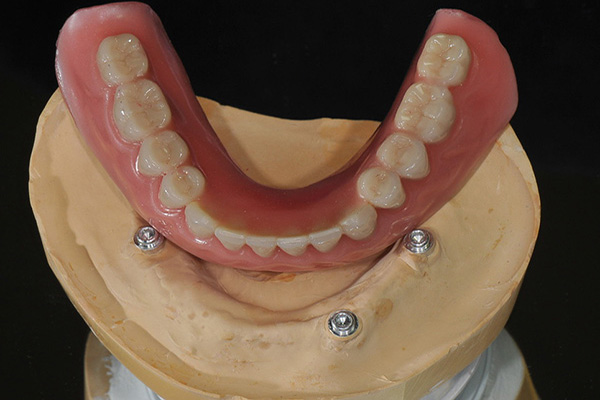
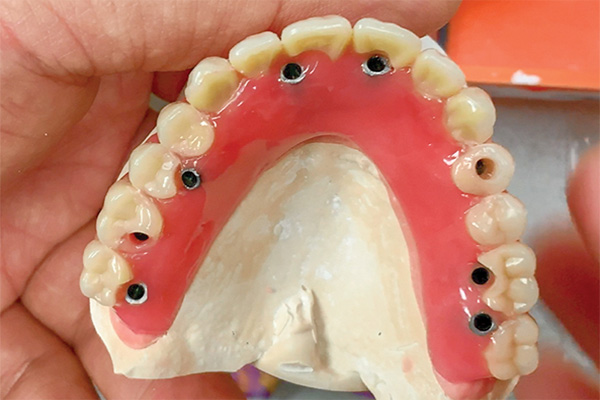
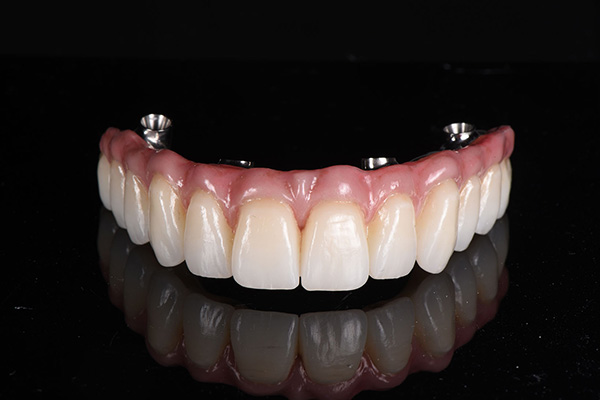
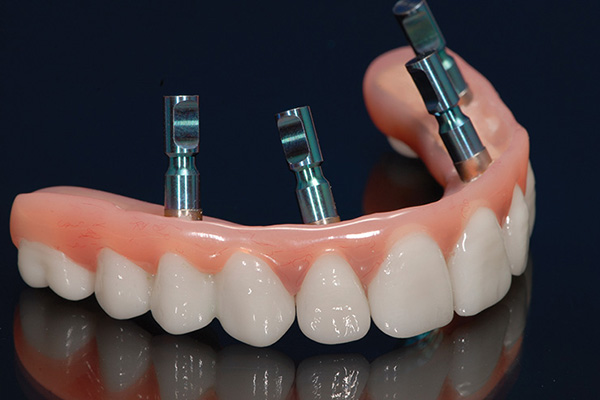
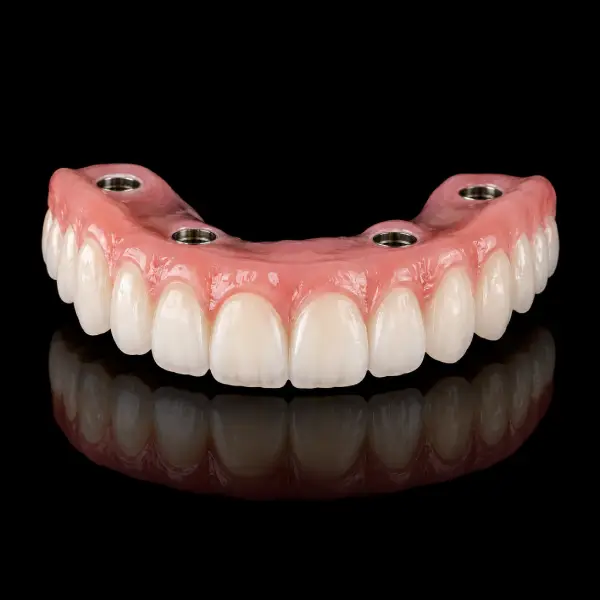
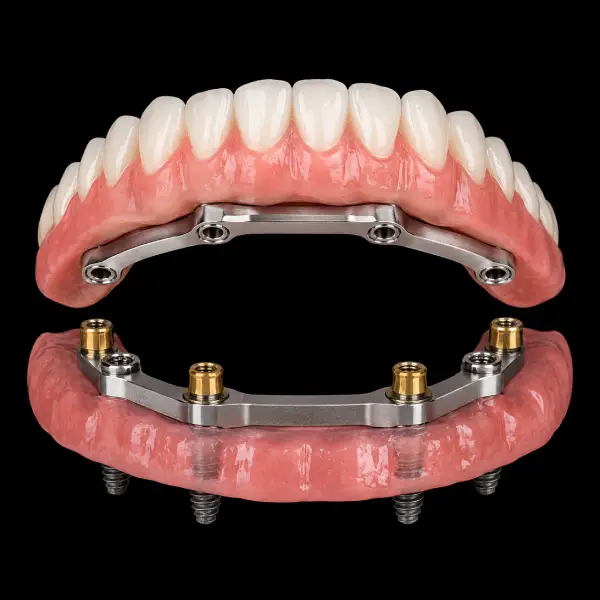
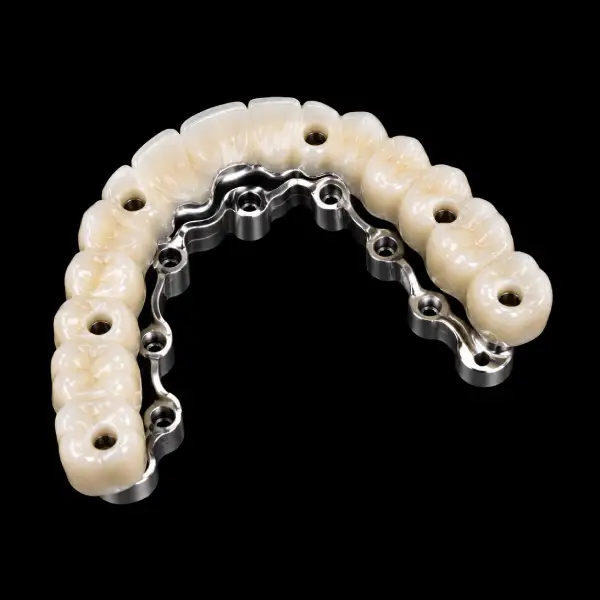
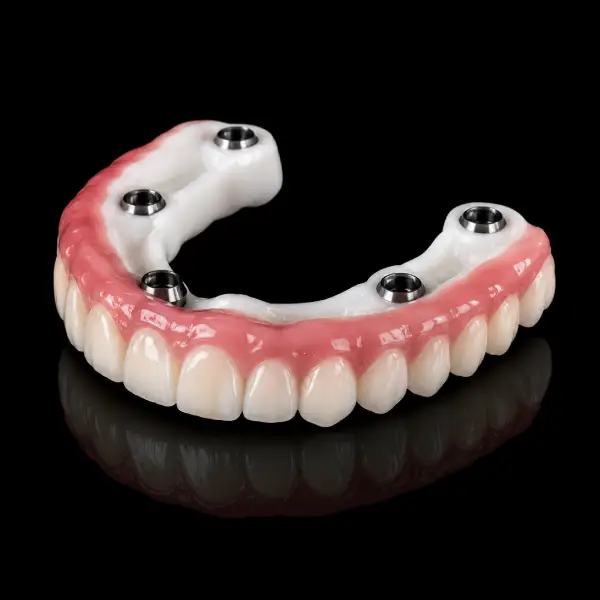
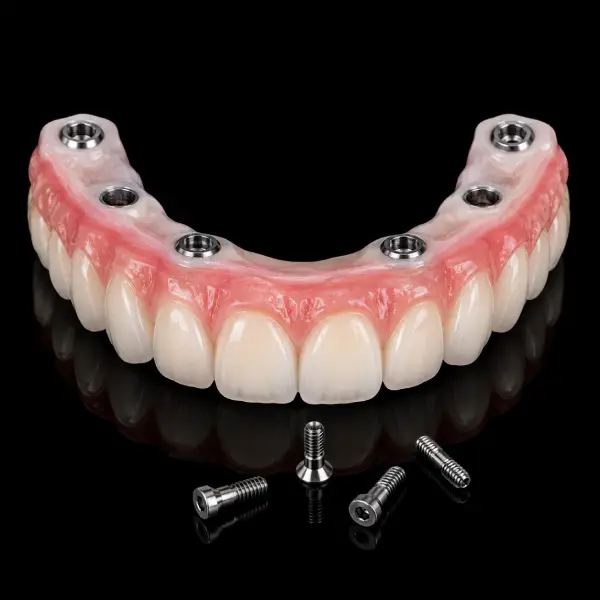
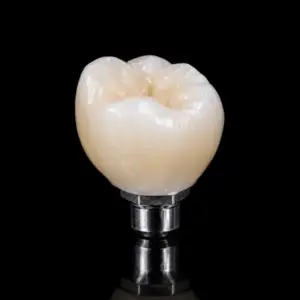
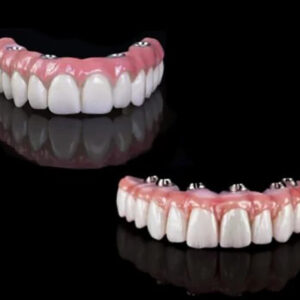
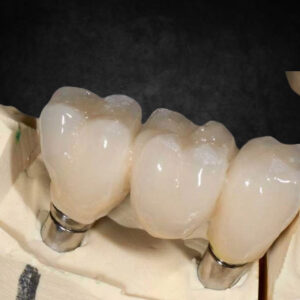
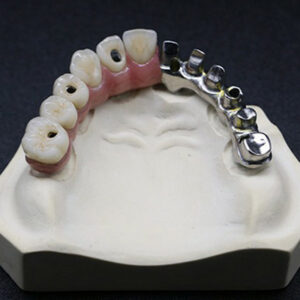
Though built on a strong foundation, the Implant Hybrid Denture serves those needing full-arch dental restoration through implanted support. Its structure pairs resilient base materials with artificial gums and teeth, resulting in reliable function and natural appearance. Because precision matters, BestoDental crafts these dentures using both traditional methods and digital processes. While durability is key, consistent performance over time remains central across diverse implant cases.
1. Indications
Our Implant Hybrid Dentures are Suitable For:
- Patient without any teeth needing complete arch restoration through implants
- All-on-4 and All-on-6 implant restoration cases
- Patients seeking fixed implant-supported full-arch prostheses
- Severe ridge resorption cases requiring prosthetic soft tissue replacement
- Full-mouth rehabilitation requiring enhanced stability and function
- Patients requiring improved chewing efficiency and prosthesis retention
- Maxillary and mandibular full-arch implant restorations
2. Technical Specifications
| Technical Parameter |
Specification |
| Restoration Type |
Full-arch implant-supported hybrid denture |
| Product Variants |
Standard Implant Hybrid Denture / Titanium Bar Hybrid Denture / Nano Ceramic Hybrid Denture / Zirconia Hybrid Denture / PEEK Hybrid Denture |
| Framework Options |
PMMA base, milled titanium bar, zirconia framework, or PEEK framework depending on restoration design |
| Tooth Material |
Acrylic teeth, composite teeth, nano ceramic restorative materials, or customized prosthetic teeth |
| Retention Type |
Screw-retained implant-supported restoration |
| Implant Configuration |
Compatible with All-on-4, All-on-6, and multi-implant full-arch treatment concepts |
| Framework Strength |
High-strength full-arch support designed for long-term functional loading |
| Load Distribution |
Optimized distribution of occlusal forces across supporting implants |
| Esthetic Options |
Standard, enhanced esthetic, nano ceramic, zirconia, and metal-free restorative solutions |
| Gingival Replacement |
Integrated gingival restoration for soft tissue and ridge contour replacement |
| Digital Workflow Compatibility |
Compatible with conventional and CAD/CAM full-arch implant workflows |
| Manufacturing Method |
Conventional laboratory fabrication, CAD/CAM milling, and digital implant design workflows |
| Biocompatibility |
Dental-grade materials designed for long-term intraoral use |
| Maintenance Requirement |
Periodic professional maintenance and screw-retention evaluation recommended |
| Clinical Application |
Fixed full-arch implant rehabilitation and implant-supported hybrid prostheses |
| Case Turnaround Time |
Approximately 5–10 working days depending on framework type and case complexity |
3. Aesthetics
Implant Hybrid Denture Aesthetics
1) Full-Arch Natural Esthetics
With implant-supported hybrid dentures, tooth loss joins gum tissue deficiency in finding a solution that looks real. A complete row of teeth gains shape again where emptiness once sat. Missing areas fill not just with artificial crowns but also underlying support mimicking gums. Structure returns beneath the surface while appearance lifts above it. Where volume faded over time, stability now anchors through titanium posts. The result holds firm yet moves like natural anatomy when seen up close.
2) Customized Gingival Characterization
A shape tailored to the gum area may reflect real soft tissue form through customized curves. While details are adjusted, they follow organic patterns found in actual gums. Custom shaping allows subtle variations that mirror biological structures. The design process considers how light interacts with surface textures. Rather than using standard molds, unique outlines emerge from patient-specific data. This approach results in a more lifelike look over uniform alternatives.
3) Premium Material Options
Zirconia, Nano Ceramic, along with PEEK hybrids, open new paths in lifelike dental prosthetics. Their blend supports appearances close to real teeth. Each material contributes distinct qualities behind visible results. Together, they meet demands for subtle color matching. Patients notice differences through smoother contours. These restorations respond well under changing light. Surface textures mimic organic patterns naturally. Strength does not come at the cost of visual softness. Subtle translucency enhances overall realism. Customization fits varied facial structures easily.
4) Facial Balance and Natural Smiles
Facial shape benefits when full-arch restorations are properly shaped. Lips gain subtle reinforcement through carefully placed structures. A harmonious smile emerges from thoughtful alignment of dental forms.
Order FAQs
1. Information Needed for Implant Hybrid Denture Submission?
Start by sharing the patient’s name along with details about the implant system used and where implants are placed. Include full arch scans in STL format for accurate modeling. A record of how the upper and lower teeth come together should also be sent. Show how the teeth meet when the jaw closes, using occlusion documentation. Mention any particular needs regarding tooth arrangement, appearance goals, or structural choices for support frameworks.
2. What implant systems work with your hybrid denture setups?
Most well-known implant brands work with our system – names like Nobel Biocare, Straumann, and Zimmer Biomet, along with Osstem, Dentium, and Megagen. BioHorizons, Hiossen, plus several others fit too. If needed, we can verify compatibility tailored to your setup.
3. Got a digital scan of your whole arch? We can work with that file.
Accepted formats include complete arch STLs captured via leading intraoral scanning systems. These cover devices like 3Shape and iTero, along with Medit models. Scans from Planmeca units also meet requirements. Systems built on Exocad platforms are supported too.
4. Typical Turnaround Time for an Implant Hybrid Denture?
Working time for most Implant Hybrid Dentures ranges from seven to ten days. The exact duration shifts based on how complex the situation is. Material choice plays a role, too. Instead of titanium bars, some opt for CAD/CAM milled structures. Others prefer designs built on zirconia. Each decision affects timing differently.
5. Are provisional as well as final hybrid dentures offered by your practice?
True. While some opt for a short-term solution, others move straight to permanent. One path suits urgent needs, the other targets lasting function. Temporary versions serve during healing; definite ones replace teeth fully. Each case guides which option fits best.
6. What records are recommended for full-arch implant cases?
When possible, include opposite arch scans along with bite records; implant-level imprints or digital scan bodies may also be needed. Facial photographs become useful in context. Shade references help clarify color choices. A diagnostic wax-up – or clear setup directions – adds value if accessible.
7. Is it possible to ask for a hybrid denture using a screw-retained setup?
Certainly. Most situations support screw-retained options, making them accessible when upkeep or adjustments arise over time. Retrieval becomes manageable, ensuring cleanliness stays maintained without complex procedures.
8. What is the difference between titanium bar and CAD/CAM milled hybrid dentures?
Starting with durability, titanium bar hybrids rely on a metallic structure to handle stress. On the flip side, those made through CAD/CAM milling follow digital models that boost accuracy and seating behavior. Whether one works better than the other comes down to how much force the area must bear and what clinicians favor in practice.