You’re planning a posterior multi-unit bridge for a 55-year-old patient with heavy bite force. The lab recommends 5Y zirconia for better aesthetics. But your clinical instinct says strength matters more in the posterior region. Which material do you choose?
This is a decision we see play out in restorative practices every week. And honestly? Most of the time, the answer is simpler than dentists think.
In this article, BestoDental helps you cut through the marketing claims around high-translucency zirconia and understand 3Y and 5Y zirconia from a practical clinical perspective. After reading this guide, you will know when to choose 3Y zirconia, when 5Y zirconia may be the better option, and how to make a more reliable material decision for each dental bridge case.
1. How Do 3Y and 5Y Zirconia Differ?
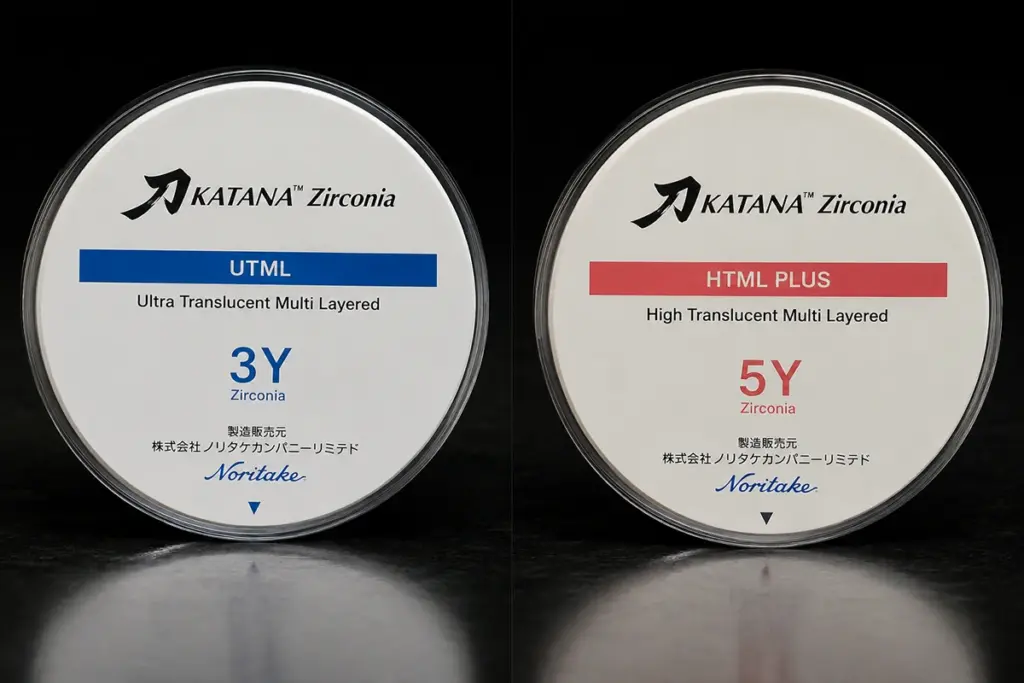
According to BestoDental’s professional dental knowledge, the fundamental difference between 3Y-TZP and 5Y-TZP lies in their crystalline structure, which is determined by yttria (Y₂O₃) content. The structure has an immediate impact on strength, translucency, and long-term clinical reliability.
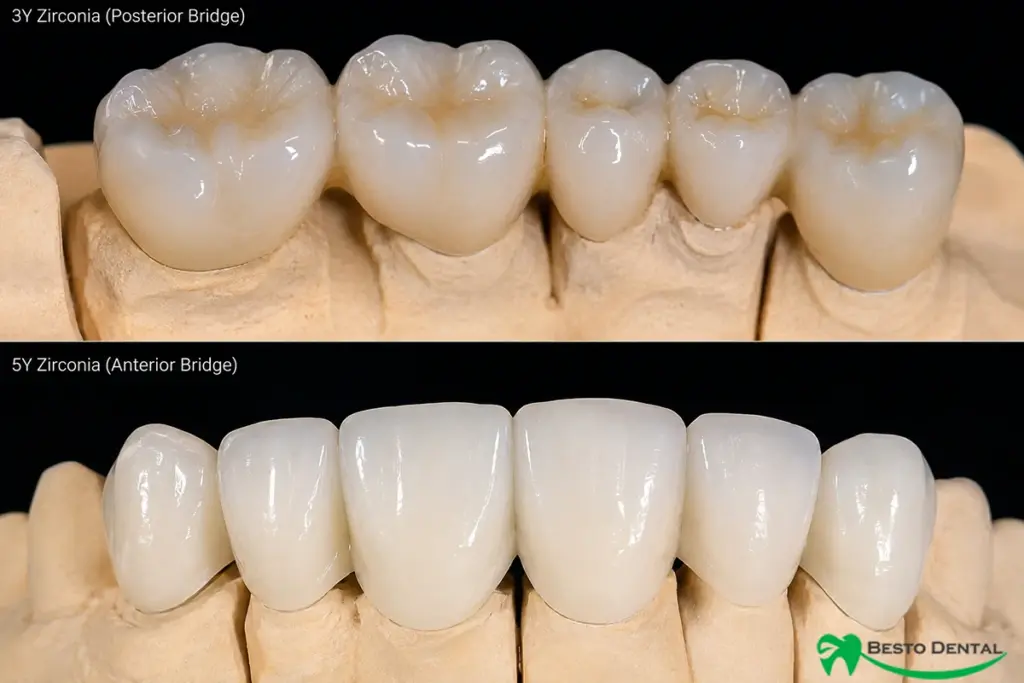
3Y-TZP has about 3 mol% yttria, and is made up primarily of the tetragonal-phase crystals. Its key advantage is transformation toughening. The tetragonal crystals can locally transform to form compressive stress around the crack tip which helps retard or arrest crack growth when a crack is beginning to form. That is why 3Y zirconia is deemed a load bearing material particularly in posterior bridges and implant supported restorations.
The 5Y-TZP has about 5 mol% yttria and has an increased amount of cubic phase crystals. The cubic crystals offer a greater light transmission, resulting in 5Y zirconia having greater translucency and a more natural look. Transformation toughening, however, is not the same for cubic crystals and there is a reduction in fracture resistance as compared with 3Y.
Put very simply: 3Y – Fracture Resistant, 5Y – Translucent. The two materials are not good or bad but rather are intended for different priorities in the clinical setting.
We also summarize a table for your reference.
| Property | 3Y-TZP | 5Y-TZP | Clinical Interpretation |
|---|---|---|---|
| Flexural Strength | 800–1,200 MPa | 500–800 MPa | 3Y provides nearly double the strength reserve, offering a greater safety margin under unexpected overloads. |
| Fracture Toughness (KIC) | >5 MPa√m (up to 9+) | ~3–4 MPa√m | 3Y actively resists crack propagation; 5Y, once cracked, is far more prone to catastrophic failure. |
| Translucency / Aesthetics | Low (opaque, whitish) | High (approaches natural dentin) | 5Y delivers superior optical performance in anterior zones and single crowns. |
| Long-Term Aging Behavior | Surface compressive stress increases with cyclic loading; excellent aging resistance | Lacks reinforcement mechanism; some formulations show accelerated degradation in vitro | 3Y has decades of clinical validation; 5Y does not yet have the same long-term track record. |
Key Evidence:
- In 2025, Kataoka et al. tested 3Y-TZP and 5Y-TZP in cantilever bridges with fracture loads of 5108 N and 2960 N, respectively, and reported that 3Y-TZP had a significantly higher fracture load than 5Y-TZP (p < 0.001).
- In fact, regardless of crown height (8-12 mm), 3Y exhibits significantly greater fracture strength than 5Y (p<0.001) which is an important parameter in a worn dentition with restricted vertical space.
- The independent testing reveals that 3Y-TZP has higher fatigue reliability than higher yttria, for a simulated number of years of service.
2. Typical Clinical Applications of 3Y and 5Y Zirconia
Although 3Y and 5Y zirconia share the same base material, they are designed for different clinical priorities. At BesoDental, our technicians select materials for cases based on functional requirements and aesthetic expectations. Before we dive into specific clinical scenarios, if you also like a comprehensive overview of zirconia crown types, materials, and manufacturing processes, we recommend reading our complete guide: Zirconia Crowns Guide: Types, Materials, Manufacturing & Clinical Uses.
1) 3Y Zirconia: Designed for High-Load Restorations
3Y zirconia is the preferred choice whenever strength and long-term durability are the primary concerns. BestoDental recommends it for:
- Posterior multi-unit bridges
- Implant-supported bridges and full-arch restorations
- Patients with heavy occlusal force or bruxism
- Long-span bridges and cantilever restorations
- Cases with limited restorative space where higher strength is required
These restorations are subjected to greater functional stress over time, making fracture resistance more important than maximum translucency.
2) 5Y Zirconia: Designed for High-Esthetic Restorations
5Y zirconia is primarily used when achieving a natural appearance is the main objective. Typical indications include:
- Anterior single crowns
- Short-span anterior bridges
- Premolar restorations with normal occlusal loading
- Patients with high esthetic expectations and low functional risk
Its improved translucency allows restorations to blend more naturally with adjacent teeth, making it particularly suitable for the esthetic zone.
It is important to remember that these are general clinical guidelines rather than fixed rules. Many bridge cases fall between these two categories, where factors such as bridge span, occlusal force, implant support, and restorative space ultimately determine whether 3Y or 5Y is the more appropriate choice.
3. Clinical Challenges and Solutions of 3Y and 5Y Zirconia
When we sit down to plan a case, the question isn’t “which material is better”; it’s “which material is better for this specific challenge.” Here’s how we make that call at BestoDental for the most common clinical scenarios.
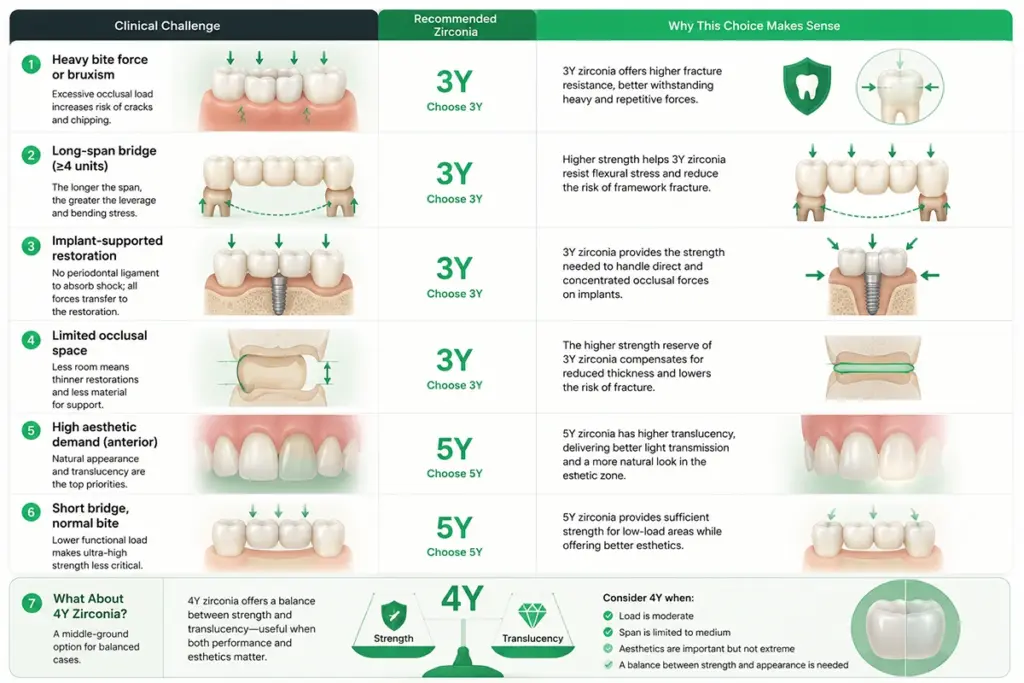
1) Challenge 1: Heavy bite force or bruxism
For these patients, 3Y is the only material we trust. The reason is simple: 5Y’s enhanced translucency comes at the cost of reduced fracture toughness. In a bruxer, that trade-off isn’t worth the risk. We’ve seen too many 5Y posterior crowns fail in high-load patients—not because the restoration was poorly fabricated, but because the material simply wasn’t designed for that environment.
2) Challenge 2: Long-span bridge (≥4 units)
With each additional unit, the mechanical demands on the restoration multiply. A 4-unit or longer bridge undergoes significant flexure under load, and the connectors bear the brunt of that stress. 3Y’s higher flexural strength makes it the obvious choice here—it resists the bending forces that would put a 5Y bridge at risk of connector fracture. If you’re planning a long-span case and choosing 5Y for aesthetics, you’re trading long-term survival for short-term appearance, and that’s a trade we don’t recommend.
3) Challenge 3: Implant-supported restoration
Unlike natural teeth, implants have no periodontal ligament to absorb and distribute occlusal forces. Every bit of load transfers directly to the restoration, creating stress concentrations that can lead to fracture. For implant-supported crowns and bridges, we always reach for 3Y. 5Y may look better, but in our experience, the increased fracture risk isn’t justified—especially when the restoration is in the posterior region where aesthetics are less critical.
4) Challenge 4: Limited occlusal space
When vertical dimension is restricted, you’re forced to fabricate a thinner restoration. Thinner restorations have less material to resist fracture, so you need a material with higher inherent strength to compensate. 3Y allows you to go thinner without compromising structural integrity. With 5Y, you’d be walking a fine line—it might hold up, but why take that chance when 3Y gives you a clear safety advantage?
5) Challenge 5: High aesthetic demand (anterior)
This is where 5Y takes the lead. In the anterior zone, occlusal forces are significantly lower, so strength isn’t the primary concern—appearance is. Patients notice the difference between a restoration that blends naturally and one that looks opaque or “dead.” 5Y’s higher translucency allows light to penetrate and reflect more like natural enamel, giving you the aesthetic outcome that patients expect. 3Y in the anterior? Only if the patient has extreme functional demands that overrule aesthetics—and even then, we’d consider layered techniques or 4Y as an alternative.
6) Challenge 6: Short bridge, normal bite
For short-span bridges (three units or fewer) with normal occlusal forces, 5Y provides more than enough strength. There’s no functional reason to choose 3Y here—you’d be sacrificing aesthetics for strength you don’t actually need. 5Y gives you the best of both worlds in these cases: adequate durability plus the translucency that makes the restoration blend seamlessly with adjacent teeth.
Different clinical situations require different approaches. Here is how to handle common challenges quick table:
| Clinical Challenge | Solution | Why |
| Heavy bite force / bruxism | Choose 3Y | Higher fracture resistance withstands grinding and clenching |
| Long-span bridge (≥4 units) | Choose 3Y | Longer span = greater leverage = more strength needed |
| Implant-supported restoration | Choose 3Y | No ligament to absorb shock; all force hits the restoration |
| Limited occlusal space | Choose 3Y | Thinner restorations need higher strength reserve |
| High aesthetic demand (anterior) | Choose 5Y | Translucency matches natural teeth |
| Short bridge, normal bite | Choose 5Y | Strength is adequate for low-force zones |
7) What About 4Y Zirconia?
Of course, clinical reality is rarely black and white. What about a patient who needs a posterior bridge but has high aesthetic expectations? Or an anterior case with bruxism? When functional and aesthetic demands conflict, our principle at BestoDental is function first, aesthetics second—a beautiful restoration that fractures is worthless to the patient. That’s why we keep 4Y zirconia as our safety net; it sits between 3Y and 5Y in both strength and translucency, offering a practical compromise for those gray-area cases.
| Material | Strength | Aesthetics | When to Use |
|---|---|---|---|
| 3Y | Highest | Low | High-force cases—bruxism, long-span, implants, limited space |
| 4Y | Moderate | Moderate | Mixed indicators—when you’re unsure which way to go |
| 5Y | Adequate | High | Aesthetic-first cases—anterior, short bridges, normal bite |
The rule of thumb: When in doubt, 4Y is a safe, balanced choice that works well in most clinical situations.
4. How to Choose Between 3Y and 5Y Zirconia at the Chairside?
The truth is, material selection isn’t as complicated as some make it out to be. Over the years at BestoDental, we’ve developed a simple mental checklist that we run through for every case. Before you decide, evaluate your case from four angles: location, occlusal load, span length, and aesthetic demand.
Here’s the framework we use internally:
- Location — Posterior or anterior? This is your starting point. Posterior restorations are almost always function-first, while anterior cases open the door for aesthetic-driven choices.
- Occlusal load — Heavy bite or normal? Don’t guess—check for wear facets, ask about bruxism history, and assess the opposing dentition. We’ve learned the hard way that underestimating bite force is one of the most common reasons for premature failures.
- Span length — Long bridge or short? The more units, the more leverage. A cantilever or a free-end saddle changes the equation entirely.
- Aesthetic demand — Is it in the smile zone? Be honest about what the patient actually notices and cares about. Sometimes we overestimate aesthetic needs in posterior areas where patients simply want something that functions reliably.
This is a Quick Reference Table:
| Clinical Scenario | Choose | Alternative |
| Posterior bridge, ≥4 units, with cantilever | 3Y | Porcelain-veneered zirconia (chipping risk) |
| Posterior bridge, heavy bite / bruxism | 3Y | Lithium disilicate (strength insufficient) |
| Implant-supported posterior / full-arch | 3Y | — |
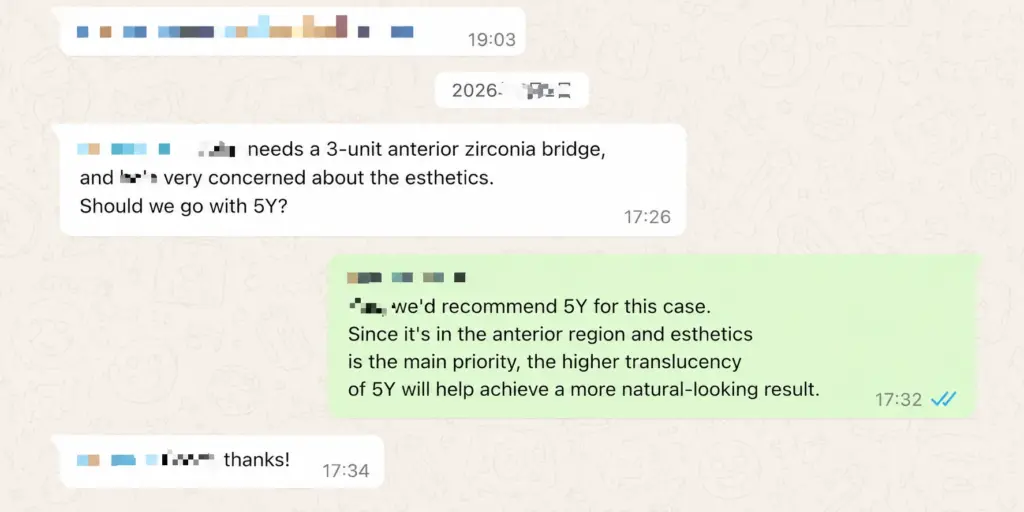
| Anterior bridge, ≤3 units, high aesthetics | 5Y | Multilayer zirconia (compromise) |
| Anterior single crown | 5Y | Lithium disilicate |
| Not sure about the case | 4Y | Safe middle-ground |
We summarized the simple rule:
| If you’re unsure about strength | → Choose 3Y |
|---|---|
| If forces are low and aesthetics matter most | → Choose 5Y |
| If you’re still unsure | → Choose 4Y |
Don’t overthink it. Evaluate the four angles, match the material to the primary demand of the case, and you’ll get it right most of the time. That’s what we’ve learned after thousands of cases at BestoDental.
5. Laboratory Considerations Dentists Often Overlook
Choosing the right material is only half the battle. The other half is making sure your lab handles it correctly. Here are a few things we’ve learned to watch out for when prescribing 3Y or 5Y zirconia, some of which we get from real experiences.
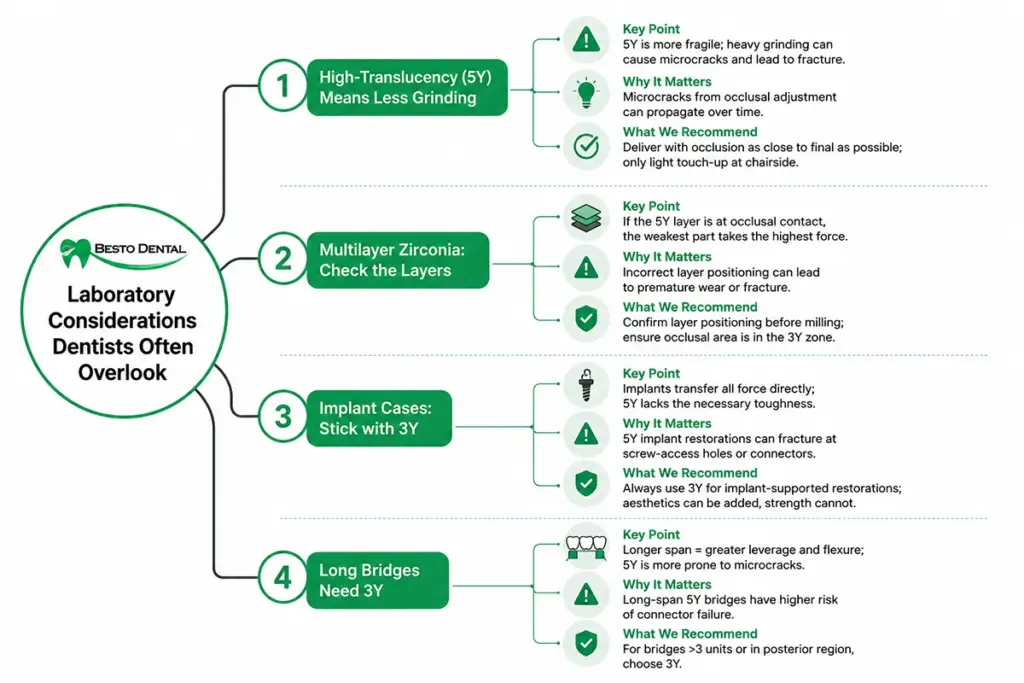
1) High-Translucency (5Y) Means Less Grinding
Here’s something that doesn’t get said enough: 5Y looks beautiful in the box, but it’s more fragile than you’d think. If you do heavy occlusal adjustment at the chairside, you’re introducing microcracks that can propagate over time and lead to fracture. We’ve seen it happen—a restoration that looks perfect on the delivery day, only to come back six months later with a crack that started right where the bur touched it.
What we recommend: Ask your lab to deliver the restoration with occlusion as close to final as possible—so all you need is a light touch-up. A few seconds with a fine diamond is fine; heavy grinding is where the risk starts.
2) Multilayer Zirconia: Check the Layers
Multilayer discs are a great concept—5Y on the outside for aesthetics, 3Y in the core for strength. But here’s the catch: if the 5Y layer ends up on an occlusal contact point, you’ve just placed the weakest part of the material right where the force hits hardest. We’ve received cases from other labs where this exact mistake led to premature wear or fracture, and the dentist had no idea why until we dug into the milling layout.
What we recommend: Ask your lab to confirm the layer positioning before milling. For posterior bridges, make sure the occlusal area falls within the 3Y zone. It’s a simple check that can save you a lot of headache later.
3) Implant Cases: Stick with 3Y
This one’s non-negotiable for us. Implants transfer all occlusal force directly to the restoration—there’s no PDL to absorb shock. 5Y simply doesn’t have the toughness for this application. We’ve seen implant crowns fabricated in 5Y fracture at the screw-access hole or the connector, and every time, the root cause was the same: the material wasn’t up to the task.
What we recommend: Always choose 3Y for implant-supported restorations. If you’re worried about aesthetics, remember this: you can add aesthetics with staining or layering, but you cannot add strength after the fact. Get the foundation right first.
4) Long Bridges Need 3Y
The math is simple: the longer the span, the greater the leverage. A 4-unit posterior bridge experiences significantly more flexure under load than a single crown or a short anterior bridge. 5Y may look better on the model, but under repeated chewing cycles, it’s more likely to develop microcracks at the connectors. We’ve replaced enough long-span 5Y bridges to know that the aesthetic gain isn’t worth the functional risk.
What we recommend: For any bridge exceeding 3 units or sitting in the posterior region, choose 3Y. The translucency difference is negligible in the posterior, but the strength difference is anything but.
If you’re considering outsourcing your zirconia restorations to an overseas lab but aren’t sure how to choose the right partner to assist you in making a choice, we’ve put together a detailed outsourcing guide to help you make an informed decision. For more information, please read our Zirconia Dental Lab Outsourcing Guide: Price, Workflow & Lab Selection.
6. Practical Selection Guide
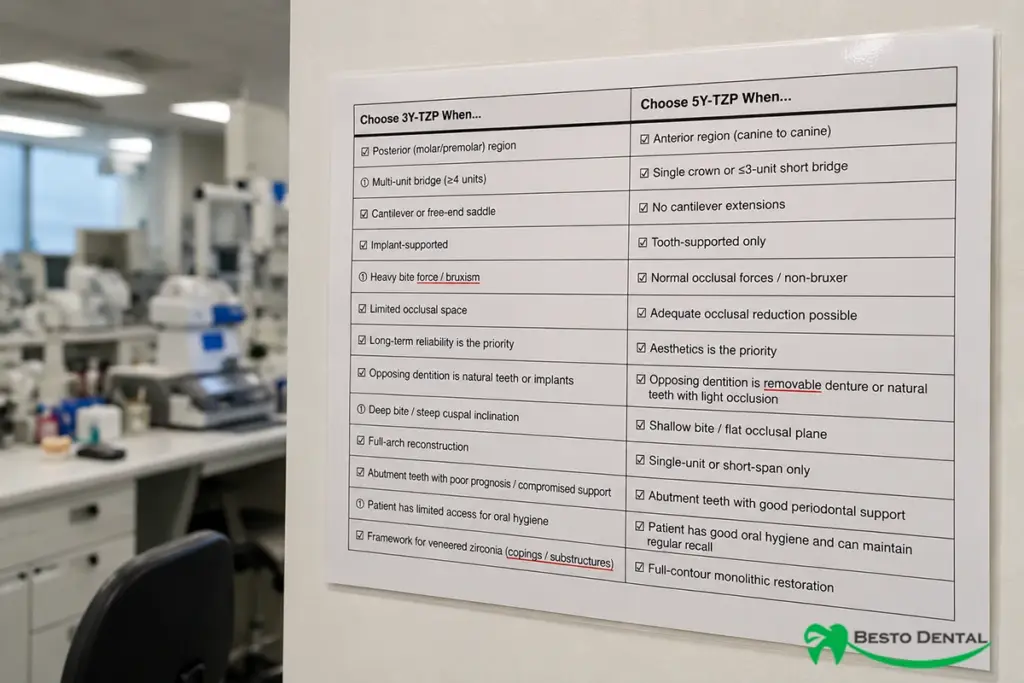
The following recommendations serve as a quick reference when choosing zirconia for bridge restorations. While every case should be evaluated individually, these guidelines reflect what we’ve learned from thousands of cases at BestoDental. Feel free to print this table and post it in your lab or clinic for quick daily reference.
| Choose 3Y-TZP When… | Choose 5Y-TZP When… |
|---|---|
| ☑ Posterior (molar/premolar) region | ☑ Anterior region (canine to canine) |
| ☑ Multi-unit bridge (≥3–4 units) | ☑ Single crown or ≤3-unit short bridge |
| ☑ Cantilever or free-end saddle | ☑ No cantilever extensions |
| ☑ Implant-supported | ☑ Tooth-supported only |
| ☑ Heavy bite force / bruxism | ☑ Normal occlusal forces / non-bruxer |
| ☑ Limited vertical space | ☑ Adequate occlusal reduction possible |
| ☑ Long-term reliability is the priority | ☑ Aesthetics is the priority |
| ☑ Opposing dentition is natural teeth or implants | ☑ Opposing dentition is removable denture or natural teeth with light occlusion |
| ☑ Deep bite / steep cuspal inclination | ☑ Shallow bite / flat occlusal plane |
| ☑ Full-arch reconstruction | ☑ Single-unit or short-span only |
| ☑ Abutment teeth with poor prognosis / compromised support | ☑ Abutment teeth with good periodontal support |
| ☑ Patient has limited access for oral hygiene | ☑ Patient has good oral hygiene and can maintain regular recall |
| ☑ Framework for veneered zirconia (copings / substructures) | ☑ Full-contour monolithic restoration |
If the table above still feels like too much to process in a busy clinic, here’s the three-line version:
| Situation | Choice |
|---|---|
| Posterior / long bridge / implant / bruxism / limited space | Choose 3Y |
| Anterior / short bridge / natural teeth / normal bite / aesthetics first | Choose 5Y |
| Not sure which way to go | Choose 4Y |
This guide isn’t a set of rigid rules, it’s our everyday working framework. Every case ultimately depends on the patient’s specific conditions. But when you need to make a quick decision at the chairside, this table will help you get it right more often than not.
7. Conclusion
This article has walked through the clinical decision-making process between 3Y, 4Y, and 5Y zirconia for dental bridges—from understanding their material differences, to matching them with specific clinical challenges, to avoiding common lab-related pitfalls. We’ve also provided a practical chairside reference to help you make faster, more confident decisions in daily practice.
After reading this guide, you’ll have a clear framework for evaluating each case from four key angles—location, occlusal load, span length, and aesthetic demand. At BestoDental, we believe the right material isn’t the strongest or the most translucent—it’s the one that best fits your specific case.