Undoubtedly, PFM remains a mainstream choice for fixed restorations; however, in clinical practice, dentists and laboratory technicians frequently ask: When is a porcelain-fused-to-metal (PFM) crown more suitable than a zirconia crown? How much space is required for the metal and porcelain layers, respectively? And what should be done if there is insufficient space for the porcelain layer? We have written this article to address these questions comprehensively.
This guide explains the structure of PFM crowns, the alloys and porcelain layers involved, how they are manufactured, and the main clinical of PFM.
At the end of this guide, you should be able to understand how the metal coping works with the porcelain; understand how material and design selections will influence the final restoration; and know when PFM may be an appropriate choice, particularly when there is limited restorative space.
1. What Are PFM Crowns?
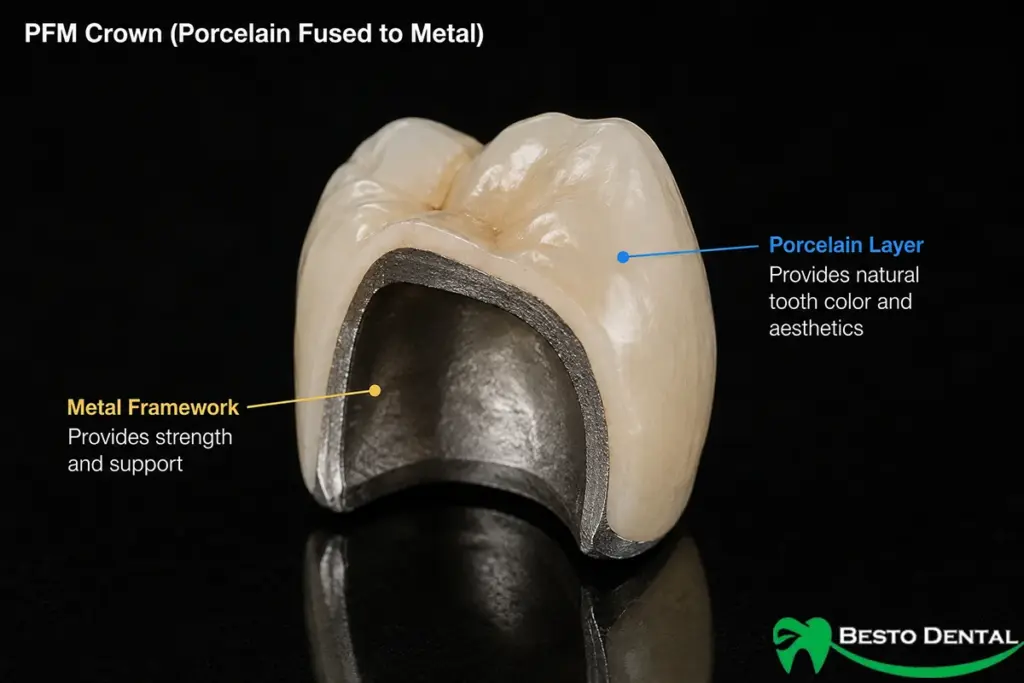
PFM crowns are made with a strong metal substructure covered by layers of tooth colored porcelain, combining the structural support of metal with the natural appearance of ceramic. The inner metal coping fits over the prepared tooth or abutment and provides the main strength of the restoration, while the porcelain is built over the metal to reproduce the visible shape, shade, and surface characteristics of a natural tooth.
Once cemented in place, the crown covers the prepared tooth and restores its original shape and function. The metal framework underneath helps the crown withstand biting forces, while the outer porcelain provides the tooth colored appearance patients see when they smile. This combination is what distinguishes PFM crowns from full metal crowns and all-ceramic restorations.
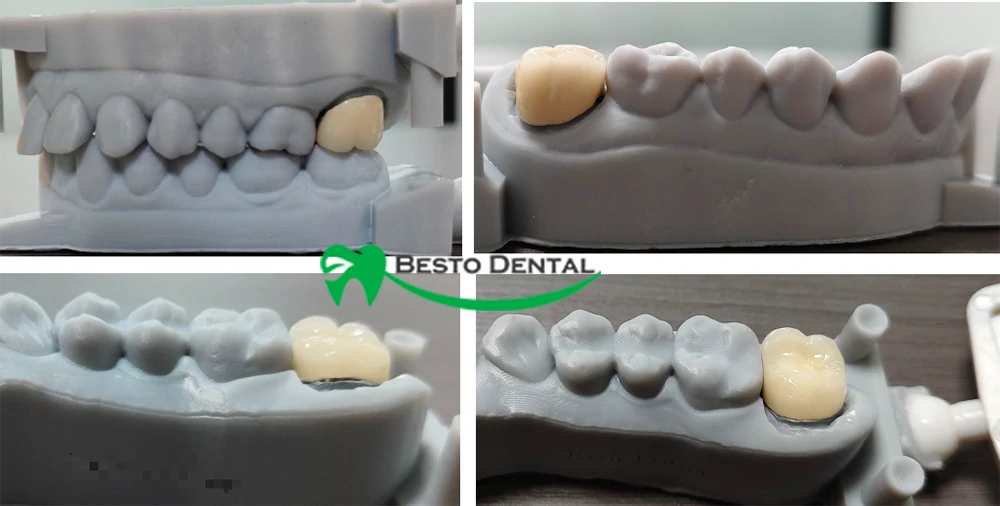
As you can see in the image below, one of the most visible differences between a PFM crown and a zirconia crown is the thin metal edge at the bottom of the PFM crown. This is part of its metal coping.
The main benefits of PFM crowns include:
- Strength with natural appearance: The metal substructure provides structural support, while the porcelain exterior gives the restoration a tooth colored appearance.
- Reliable support for chewing: The underlying metal framework makes PFM crowns suitable for areas where the restoration needs to tolerate regular biting and chewing forces.
- Good shade customization: Dental porcelain can be layered and shaded to better match the color and general appearance of surrounding natural teeth.
- Suitable for different restoration designs: PFM can be used for individual crowns as well as connected restorations such as dental bridges.
- Established clinical use: PFM restorations have been used for many years in restorative dentistry, so their materials, preparation requirements, fabrication process, and clinical behavior are well understood.
- Useful when additional structural support is needed: The metal framework can provide dependable reinforcement in cases where strength is an important consideration.
In practice, PFM crowns can be used to restore teeth that are badly damaged, heavily filled, fractured, or treated with root canal therapy when full coverage is required. They are commonly used for posterior teeth where chewing strength is important, but they can also be used for anterior restorations when appropriate porcelain layering and shade matching are provided. PFM is also widely used for multi-unit bridges because the metal framework can provide structural support across connected units.
2. Structure of PFM Crowns
As mentioned above, a PFM crown is mainly made of a metal coping and an outer porcelain layer. But its construction is not simply a matter of putting porcelain over metal. The alloy used for the coping, its thickness, the way the porcelain covers the metal, and the margin design all affect the final structure and appearance of the crown.
BestoDental has more than 10 years of experience in the dental lab; let us break down the anatomy of a PFM crown so you can see what goes into making one.
1) Metal Framework
If we take a PFM crown apart, the innermost part is the metal framework. Its job is to support the crown. Once the porcelain covers it, we can hardly see the metal underneath. The metal coping of a PFM crown is usually around 0.3–0.5 mm thick, but thicker is not always better. If it’s too thin, it might not offer enough support. If it’s too thick, it occupies the space required for the porcelain. The porosity of the porcelain then needs to be reduced, which may impact the final colour and finish of the pottery.At BestoDental, our technicians adjust the thickness according to each case, finding the right balance between the strength of the metal and the space needed for the porcelain.
2) Metal Alloys Used
PFM crowns are not limited to just one type of metal. Based on the noble metal content, at BestoDental, we usually divide the alloys used for PFM crowns into three main categories: High Noble (Precious) Alloys, Noble (Semiprecious) Alloys, and Base (Nonprecious) Alloys.
| Alloy Type | Noble Metal Content | Key Advantages | Key Limitations | Best Indications |
|---|---|---|---|---|
| High Noble (Precious) | At least 60% (gold > 40%) | Excellent biocompatibility, easy to adjust and polish, warm natural hue, long-term reliability | Higher cost | Patients with metal sensitivities, premium restorations |
| Noble (Semiprecious) | At least 25% (below 60%) | Good biocompatibility, balanced performance, more affordable than high noble | Moderate cost, not as biocompatible as high noble | Practices balancing quality and budget |
| Base (Nonprecious) | Less than 25% | Most economical, superior rigidity, high strength | Harder to adjust and polish, nickel allergy risk (in Ni-Cr alloys) | Long-span bridges, posterior restorations, budget-conscious cases |
When choosing a metal for a PFM crown, it is not simply a matter of “precious metals cost more, while nonprecious metals cost less.” Different alloys also vary in rigidity, biocompatibility, ease of adjustment, and cost.
3) Porcelain Veneer
An external view of a finished PFM crown appears to have one layer of tooth-colored porcelain. Actually, the porcelain is constructed in multiple layers, and each layer performs a specific function. The first layer is opaque porcelain that is closest to the metal coping. It is primarily used to conceal the color of the underlying metal. Failure to do this can result in the dark metal being visible through the porcelain and produce a gray colored final crown. Over the opaque layer comes dentin/body porcelain, which provides most of the crown’s main color. The outer layer is enamel/translucent porcelain. It helps add translucency and creates the layers of a natural tooth.
So, a PFM crown can be simply understood as: Metal coping → Opaque porcelain → Dentin/body porcelain → Enamel/translucent porcelain. This also explains one of the characteristics of PFM crowns. Therefore, light transmission through a PFM crown is different from that through an all-ceramic crown without a metal coping because the metal underlying the crown must first be masked with opaque porcelain.
4) Margin Designs
Remember the thin metal edge visible at the bottom of the PFM crown in the earlier image? That is the metal margin.
A PFM crown does not have to be completely covered with porcelain in every area. Depending on the location of the restoration and the aesthetic requirements, it can be made with either a metal margin or a porcelain margin.
| Margin Type | Appearance | Main Features |
| Metal Margin | A thin metal edge is visible at the bottom of the crown | Part of the metal is left exposed at the margin. The design is simple and direct, but the metal may be visible around the gingival margin. |
| Porcelain Margin | No obvious metal edge is visible in the aesthetic area | The visible margin is made of porcelain, which reduces metal exposure and is more suitable for areas with higher aesthetic requirements. |
If you do notice a thin metal edge on the bottom of a PFM (porcelain fused metal) crown, it is not because the porcelain isn’t fully complete. It means the crown was made with a metal margin. Of course, you have the option of whether or not to include a metal margin.
Before fabricating a PFM crown, BestoDental technicians will confirm your preferred margin design, such as a porcelain margin or a metal margin. In addition to providing professional recommendations based on the specific case, we will respect your preferences and fabricate the restoration according to your instructions.

3. Manufacturing Process of PFM Crowns
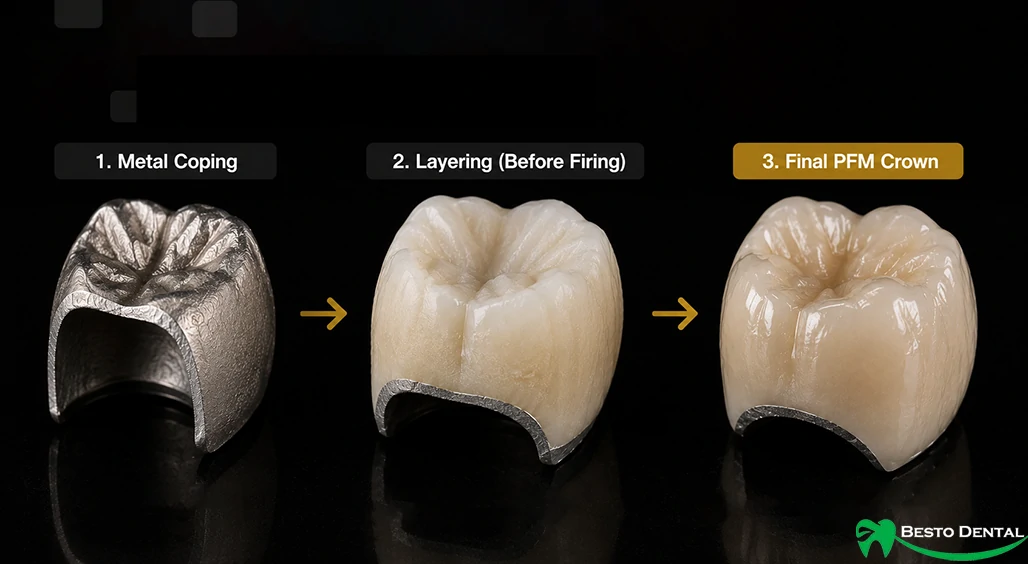
Based on BestoDental’s 10+ years of experience serving clients, we know well the manufacturing process of PFM Crowns; the following are common steps in the manufacturing process of PFM Crowns. The fabrication of a PFM crown can be simply divided into two main stages: first, making the metal coping, and then building the porcelain over it.
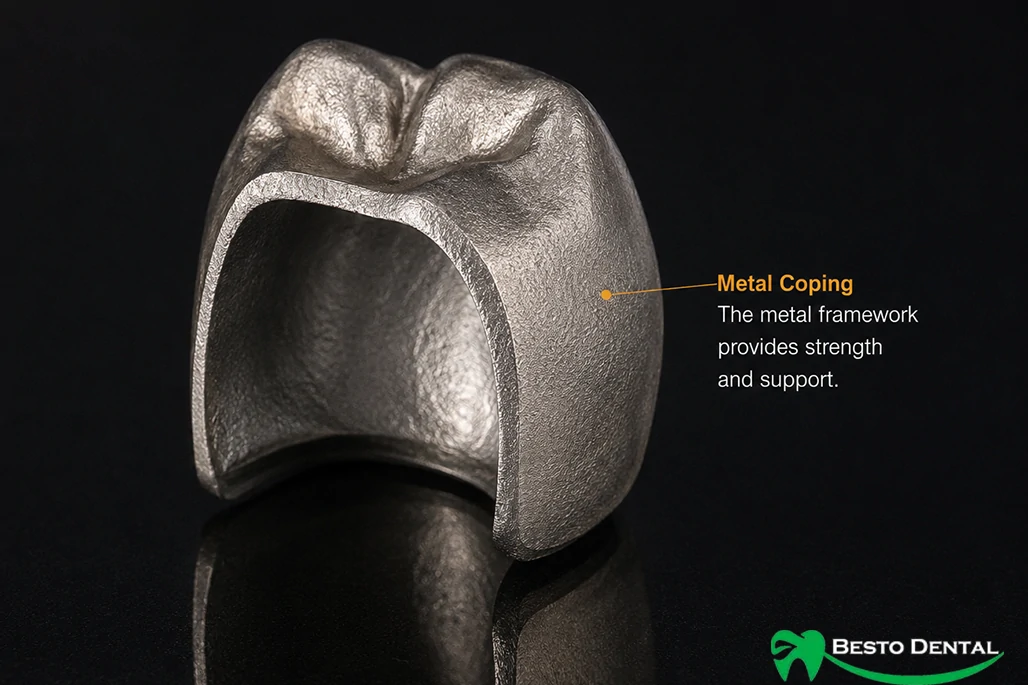
1) Making the Metal Coping
First, the metal coping is designed and made based on the model or digital data. It can be made using traditional casting or through digital design combined with technologies such as SLM.
2) Masking the Metal Color
Once the metal coping is finished, the final tooth color cannot be built directly over it. The technician first applies opaque porcelain to cover the dark color of the metal.
The natural tooth color is then built on top of this base.
3) Building the Tooth Layer by Layer
Next comes the part we actually see—the tooth itself.
The technician successively deposits dentin porcelain, enamel porcelain, and translucent porcelain to gradually evolve the color, cusps, grooves and form of the crown.
4) Firing, Adjusting, and Glazing
In the course of this, the porcelain is fired so that it is firmly attached to the metal and thus provides a stable porcelain layer.
Following this, the crown is shaped, occluded, contoured, and surface features are added. Finally, it is glazed and polished, and the PFM crown is complete.
4. Clinical Indications of PFM Crowns
PFM restorations are a well-established and commonly used restorative option. At BestoDental, we handle PFM cases almost every day, giving our technicians extensive experience in their fabrication. Below, we take a closer look at the situations where PFM crowns truly shine.
| Common Application | Why PFM May Be Considered | What to Keep in Mind |
| Posterior Single Crowns | The metal coping provides stable support and can handle higher biting forces | The porcelain layer can still chip |
| Anterior Single Crowns | Offers a balance of strength and a tooth-colored appearance | All-ceramic materials usually have an advantage when high translucency is required |
| Multi-Unit Bridges | The metal framework provides good rigidity and support across multiple units | As the span increases, framework design and porcelain support become more important |
| Implant-Supported Crowns / Bridges | The metal structure provides stable support, while the porcelain restores a tooth-colored appearance | In the aesthetic zone, the effect of the metal on the final shade and gingival appearance needs to be considered |
| Limited Occlusal Space | A metal occlusal surface can be used in selected areas, reducing the space needed for porcelain | Some aesthetics may need to be sacrificed |
| Precision Attachment Restorations | The metal coping can be incorporated with attachment components while providing the required rigidity | The design is relatively more complex |
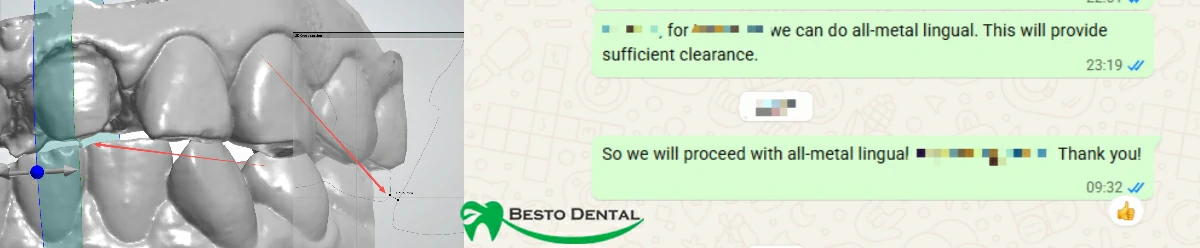
In fact, not every surface of a PFM restoration has to be covered with porcelain. In cases where the restorative space is limited, and there is not enough room for both the metal coping and the porcelain, part of the porcelain coverage can be reduced and the metal surface can be left exposed where appropriate.
At BestoDental, we often come across cases like this. For example, when there is not enough space for porcelain on the lingual side, the original design can be changed to an all-metal lingual design, reducing the space needed for porcelain. Another option, when clinically appropriate, is to slightly adjust the opposing tooth to create more space for the restoration.
The choice of which option to use will be dependent on the occlusion, the esthetic goals, restorative space, and the natural tooth structure of the patient. A final decision should be made depending on the individual situation.
5. PFM Crowns vs Zirconia Crowns
After reading the information above, you may still have one question: Both PFM and zirconia crowns can be used for posterior bridges, so how should you choose between them?
To help you make the right choice, we’ve prepared the following comparison between PFM and zirconia restorations. Of course, if you want to learn more about zirconia crowns, you can visit our other guide: Zirconia Crowns Guide: Types, Materials, Manufacturing & Clinical Uses.
To make the comparison easier, we have listed the main differences between PFM and zirconia crowns in the table below:
| Comparison | PFM Crowns | Zirconia Crowns |
| Structure | Metal coping + outer porcelain layer | Mainly made of zirconia; available as monolithic or layered zirconia |
| Strength | The metal coping provides good rigidity and structural support | Zirconia itself has high strength, especially monolithic zirconia |
| Chipping Risk | The outer porcelain layer can chip | Monolithic zirconia has no veneering porcelain to chip; layered zirconia can still have porcelain chipping |
| Aesthetics | Can achieve a good tooth-colored appearance, but the metal and opaque porcelain limit light transmission | No metal underneath; high-translucency zirconia usually provides better light transmission |
| Gingival Margin | A metal margin may become visible if the gingiva recedes | No metal margin to become exposed |
| Metal Allergy | The alloy type needs to be considered, especially nickel-containing alloys | Metal-free |
| Restoration Types | Single crowns, bridges, implant restorations, etc. | Single crowns, bridges, implant restorations, etc. |
| Cost | Usually more economical | Usually more expensive depending on the type of zirconia and fabrication method; zirconia crowns typically cost 30–50% more |
When it comes to aesthetics and translucency, zirconia is typically the best choice if aesthetics is your top priority and you don’t want to introduce any metals into your mouth. For a case that requires a metal structure, or a combination of strength, style, and price, PFM is still a popular option.
The final decision will be based on the location of the restoration, occlusion, esthetic needs, and the design of the restoration. You can send us your digital case details if you are uncertain which is the best choice for your case. Our technical team will review the case before production and provide recommendations.
6. PFM Crowns FAQs
In our communication with clients, we frequently receive questions about PFM crowns. We’ve listed a few of the most frequently asked questions below to help answer some questions and clarify confusion.
1) Why does a dark line sometimes appear around a PFM crown?
PFM crowns contain a metal coping, and some designs also have a metal margin. As the gum line moves back over time, this metal border can appear as a dark or gray line at the gum line. A porcelain margin can minimise the amount of visible metal at the crown margin, but it will not affect the fact that PFM will have a metal substructure.
2) Do PFM crowns cause wear on opposing teeth?
They can, particularly if the porcelain surface is rough after occlusal adjustment. A properly finished and polished porcelain surface is much less abrasive to opposing enamel. If a PFM crown is adjusted chairside, the adjusted surface should therefore be properly polished afterward.
3) What is the typical lifespan of a PFM crown?
PFM crowns can last for 10-15 years or longer with proper oral hygiene and regular dental care. Numerous patients keep their PFM restorations for a number of years.
4) Can PFM crowns chip or fracture?
Yes. The metal base is extremely strong, but the porcelain is prone to chipping or fracture, particularly if extremely hard to bite on or if the restoration is inadequately designed. This is one of the most common mechanical complications with PFM crowns.
5) Does the type of metal used in a PFM crown matter?
Yes. The alloy affects several characteristics of a PFM crown, including rigidity, biocompatibility, handling, and cost. For example, Co-Cr offers high rigidity, while high-noble alloys are easier to adjust and generally offer excellent biocompatibility. Nickel-containing alloys should be avoided in patients with known nickel sensitivity.
7. Conclusion
PFM crowns are a versatile option for single crowns, bridges, and implant-supported restorations, particularly in situations where durability and cost are key considerations.
A well-chosen PFM, coupled with proper tooth preparation and masterful laboratory work, can deliver good esthetic and functional restorations that last for many years. If you don’t know how to get started with PFM crowns outsourcing, read our guide, PFM Restoration Outsourcing Guide: Price, Workflow & Lab Selection, to gain a comprehensive understanding of the PFM crowns outsourcing process.