“How do I choose the right implant crown for my patient?” This is one of the most common questions you may face when planning an implant restoration. The answer is not simply “zirconia or PFM.” Factors such as the components below the crown, the type of restorative material used, the position of the implant, and the type of crown (screw-retained or cement-retained) can all influence the final decision.
This guide explains the various components of an implant crown and the materials and retention available for consideration when planning the implant restoration.
At the end, you will have an understanding of the various elements of an implant crown, how they work together, and the differences between the various common crown materials, where they might be considered, and the differences between screw-retained and cement-retained restorations, to make an informed decision for each case.
1. What are Implant Crowns?
A dental implant crown is made up of the implant, abutment (connector), and dental crown. This restoration is used to replace the visible portion of the missing tooth and is anchored to the surgically implanted titanium alloy implant – the artificial tooth root.
In appearance, it is shaped like a natural tooth; in feel, it feels like a natural tooth; and in function, it acts like a natural tooth, but it doesn’t have a natural root. Rather, it securely attaches to the abutment, which in turn is connected to the titanium implant post that is inserted in your jawbone.
The implant crown is the part you see and use daily; it is your new tooth. The implant post and abutment underneath do the heavy lifting of providing stability and support. Here are the key benefits of dental implant crowns:
- Natural shading & shape: The crown is custom shaded to look natural and seamless with the adjacent teeth, providing a lifelike smile.
- Enhanced chewing function: Re-establishes up to 90-95% of biting forces and enables you to chew comfortably on all foods.
- Saves the natural adjacent teeth: No need for grinding or modification of adjacent teeth, as in a traditional fixed bridge.
- Resists bone loss: The titanium implant stimulates the jawbone, thus preventing bone resorption and keeping the face the same shape over time.
- Long-term durability: The implant crowns can last for 15 years or longer and, in many cases, a lifetime.
- Medical-grade materials with high biocompatibility, ceramics and titanium, are used. Materials used are ceramics and medical-grade titanium, which integrate well with human tissue.
- Easy to maintain: Clean and floss in much the same way as a natural tooth, no special adhesives or overnight soaking needed.
- Improves self-confidence: Provides full clarity of speech, smile appearance, and social comfort without fear of slipping.
In practice, dentists will ordinarily suggest this type of restoration for any patient who has one or more missing teeth, or even an entire row of missing teeth per arch. An implant crown rests on its own and does not have to be supported by adjacent teeth, unlike traditional bridges and removable dentures, which can shift around and must have healthy surrounding teeth to hold them in place. This leaves your natural teeth undamaged and returns your chewing power to a condition of stability and reliability that is close to normal.
Next, we will start with the components of an implant crown to better understand how it is structured and designed.
2. Components of Implant Crowns
From the outside, what we ultimately see is only the crown. However, a complete implant crown restoration consists of more than just the crown itself. Unlike a natural tooth crown, it requires a series of components underneath to connect the restoration to the implant placed in the bone.
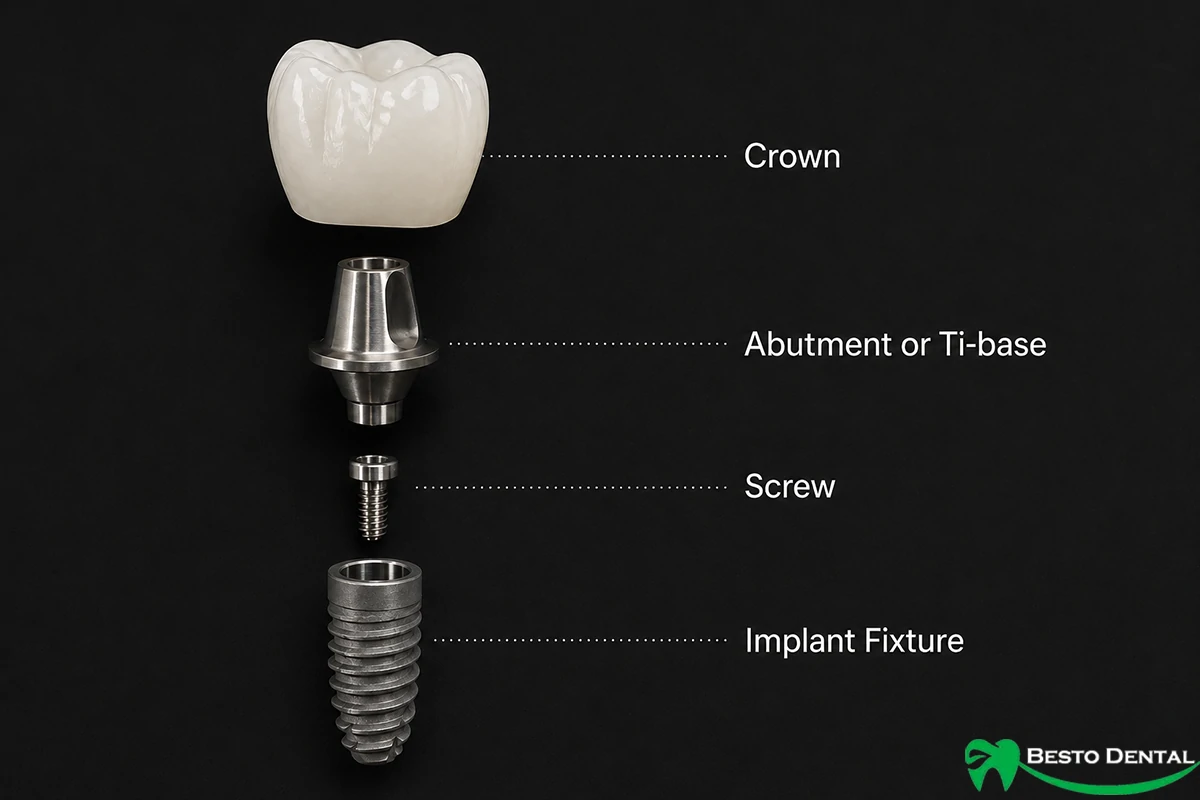
If we break down an implant crown from top to bottom, it can be simply understood as: Implant Crown → Abutment / Ti-base → Screw → Implant Fixture
| Component | What It Is | Main Function |
| Implant Fixture | The implant component placed into the patient’s jawbone | Acts as the foundation of the entire implant restoration and provides support for the upper restoration |
| Abutment | The connecting component located between the implant and the crown | Connects the implant to the final crown while providing support for the crown |
| Ti-base | A short titanium connection base that can be bonded to a zirconia or other restorative structure | Provides a titanium interface for connection to the implant while supporting the upper restoration |
| Screw | The screw that connects the abutment, Ti-base, or restoration to the implant | Secures the relevant components to the implant |
| Implant Crown | The tooth-like portion that the patient ultimately sees in the mouth | Restores the shape, color, and chewing function of the missing tooth |
When outsourcing implant cases, there is one point that can easily cause confusion: an abutment and a Ti-base are not exactly the same thing.
A traditional abutment itself forms a more complete supporting structure for the crown, and the crown is then fixed to the abutment, typically by cementation. A Ti-base, on the other hand, is usually shorter. It provides a titanium interface for connection to the implant, while the upper portion is bonded to a zirconia or other restorative structure.
We have discussed abutments in more detail in another article, so we will not go into too much detail here. If you are interested, you can read Custom Abutment Guide: Materials, Design, Manufacturing, and Clinical Applications for more information.
Therefore, the internal structure you see in different implant crown cases may not always be the same. For example:
- Cement-Retained Crown: Implant → Abutment → Crown
- Some Screw-Retained Restorations: Implant → Ti-base → Zirconia Restoration
This is also why, before fabricating an implant crown, our technicians need to know more than just what material the crown should be made of. They also need to confirm the implant system, connection method, and final restoration design.
3. Materials of Implant Crowns
The materials commonly used for implant crowns today include three primary ceramic-based options—zirconia, lithium disilicate, and porcelain‑fused‑to‑metal (PFM), along with PMMA. PMMA is mainly used as a material for temporary crowns. The table below provides a quick overview.
| Material | Main Characteristics | Common Considerations |
|---|---|---|
| Zirconia | High strength, metal-free, with good tooth-colored aesthetics | Different types of zirconia vary in strength and translucency, so the material should be selected according to the tooth position and case requirements |
| PFM | A metal framework provides structural support, while the outer porcelain layer restores the tooth-colored appearance | Offers a good balance between strength and cost, but porcelain chipping and the aesthetic influence of the metal framework should be considered |
| Lithium Disilicate / e.max | Offers good translucency and aesthetic performance | More suitable for cases with higher aesthetic requirements when restorative space and occlusal conditions are appropriate |
| PMMA | Easy to process and adjust, with a relatively low cost | Mainly used for temporary implant crowns rather than as a routine permanent restorative material |
For implant crowns, zirconia is one of the most commonly used material options. As discussed in our previous article on zirconia, there are several different types of zirconia. If you would like to learn more, you can refer to 3Y vs 5Y Zirconia for Dental Bridges: What’s the Best Option for Your Restoration.
Different zirconia materials vary in strength, translucency, and masking ability. For example, posterior implant crowns generally place more emphasis on strength, while anterior restorations in the aesthetic zone need to consider not only strength, but also translucency and whether the underlying Ti-base or metal abutment may affect the final shade. In actual cases, some of our customers ask what strength of zirconia we use to ensure that the color of the metal abutment underneath can be properly masked.
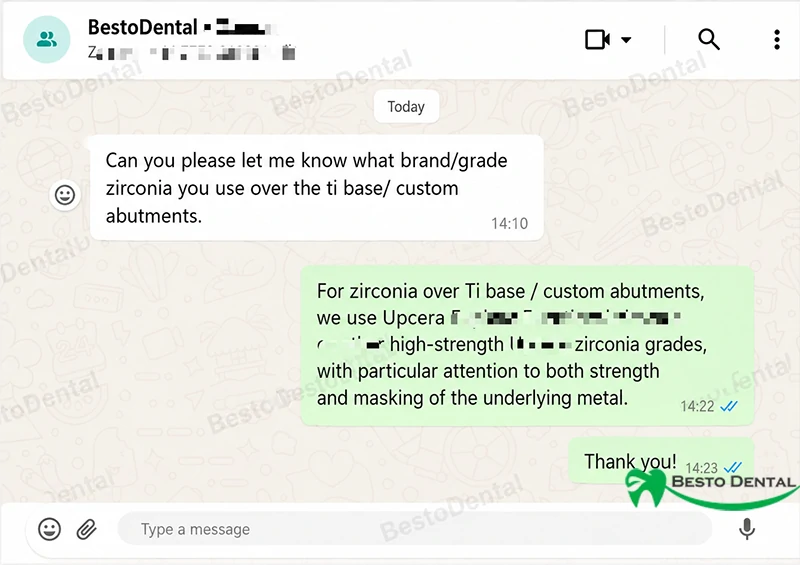
PFM can also be used for implant crowns. Its basic structure is the same as that of a natural-tooth PFM crown: Metal Framework + Porcelain. The difference is that the support underneath changes from a natural tooth to an implant abutment. We will not go into the PFM structure in detail here, as we have already written a dedicated PFM Crowns Guide.
E.max is used in some anterior implant crown cases because its main advantages are aesthetics and translucency. PMMA is mainly used for temporary implant crowns. It can restore basic form and function before the final restoration is completed, is relatively easy to adjust, and is also a more economical material option.
4. Retention Methods of Implant Crowns
Implant crowns mainly use two common retention methods: Screw-Retained Implant Crowns and Cement-Retained Implant Crowns. Below, we will take a closer look at how each method works and their main differences.
1) Screw-Retained Implant Crown
As the name suggests, a screw-retained implant crown is connected and secured with a screw. This requires a screw access channel, which allows the technician and dentist to access the restorative screw.
The screw access channel is not always located in the center of the crown. The position and angulation of the implant affect where the channel eventually exits through the restoration. Depending on the case, the opening may therefore appear on the lingual, occlusal, or even buccal side of the crown. The exact position needs to be evaluated according to the individual case. Before final fabrication, our technicians will send the screw access opening design to the customer for confirmation.
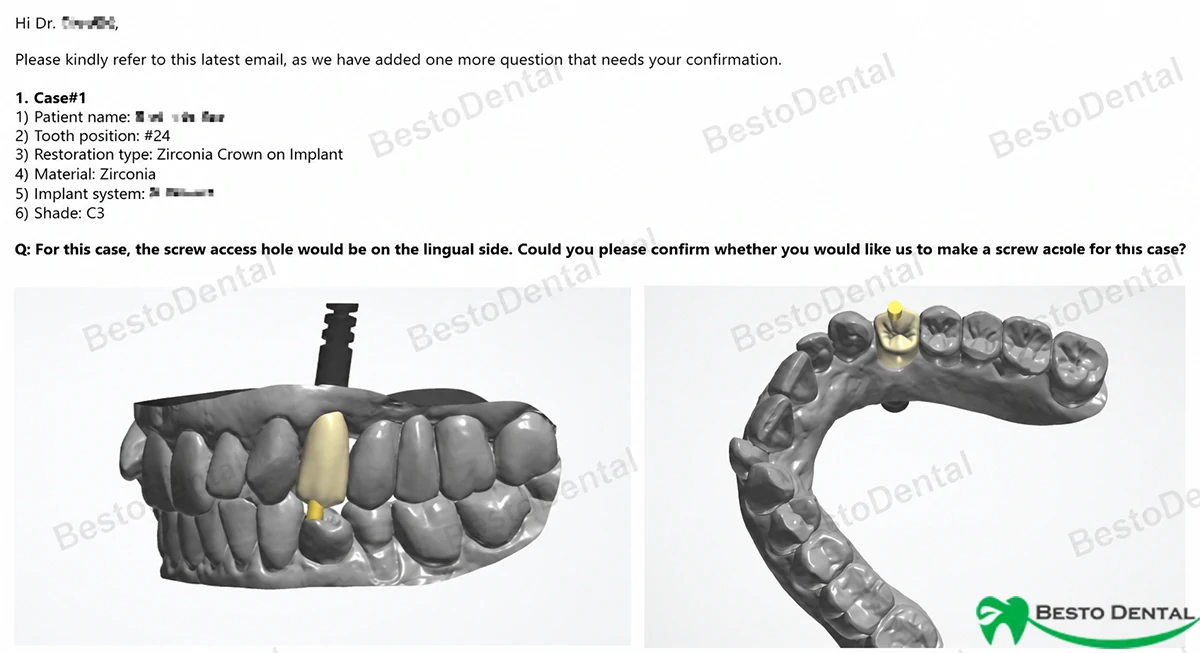
Once the crown is seated and the screw has been tightened, the access hole is not left open. It is normally sealed with appropriate restorative materials, so the patient does not end up with an obvious “hole” in the final crown.
However, not every case is suitable for screw retention. If the patient cannot accept the position of the screw access channel, or if the channel would compromise aesthetics, particularly in the anterior region, another retention method may need to be considered. In such cases, a cement-retained restoration or another restorative design may be more appropriate.
2) Cement-Retained Implant Crown
The basic principle of a cement-retained implant crown is similar to cementing a crown on a natural tooth. First, a separate abutment is installed on the implant and tightened with a screw. The crown is then cemented onto the abutment in much the same way as a conventional tooth-supported crown.
Because the crown itself does not require a screw access channel, this method can offer more flexibility when the implant angulation would otherwise cause the screw channel to emerge in an undesirable position.
However, cement retention also has an important consideration: residual cement. When the crown margin is positioned deeper below the gingiva, excess cement can be more difficult to detect and remove completely.
The table below provides a quick comparison of these two retention methods.
| Comparison | Screw-Retained | Cement-Retained |
|---|---|---|
| How It Is Retained | The restoration is secured to the implant/abutment with a screw | The abutment is first secured to the implant, and the crown is then cemented onto the abutment |
| Screw Access Hole | Yes. The access hole needs to be sealed after placement | The crown itself usually has no screw access hole |
| Removal & Maintenance | Relatively easy to remove | Usually more difficult to remove |
| Residual Cement | No risk of residual cement around the crown margin | Subgingival residual cement needs to be carefully managed |
| Aesthetics | The position of the screw access hole may affect aesthetics | No screw access hole in the crown, making it easier to maintain an uninterrupted crown surface |
| Implant Angulation | The exit position of the screw channel is an important consideration | Can provide more restorative design flexibility in some cases with less favorable implant angulation |
| Future Repair | Usually easier to remove for inspection, repair, or replacement | More complex if the crown needs to be removed |
We cannot simply say that one retention method is better than the other, because the choice needs to be made based on several factors. These include implant angulation, restoration position, available restorative space, retrievability, margin position and cement control, and the implant system being used.
There is also a combined approach called a screw-cement-retained restoration (SCR), which is generally used when the restoration needs the retrievability of screw retention while also benefiting from an extraoral cementation or bonding interface between the crown and the abutment or Ti-base.
5. Manufacturing Workflow of Implant Crowns
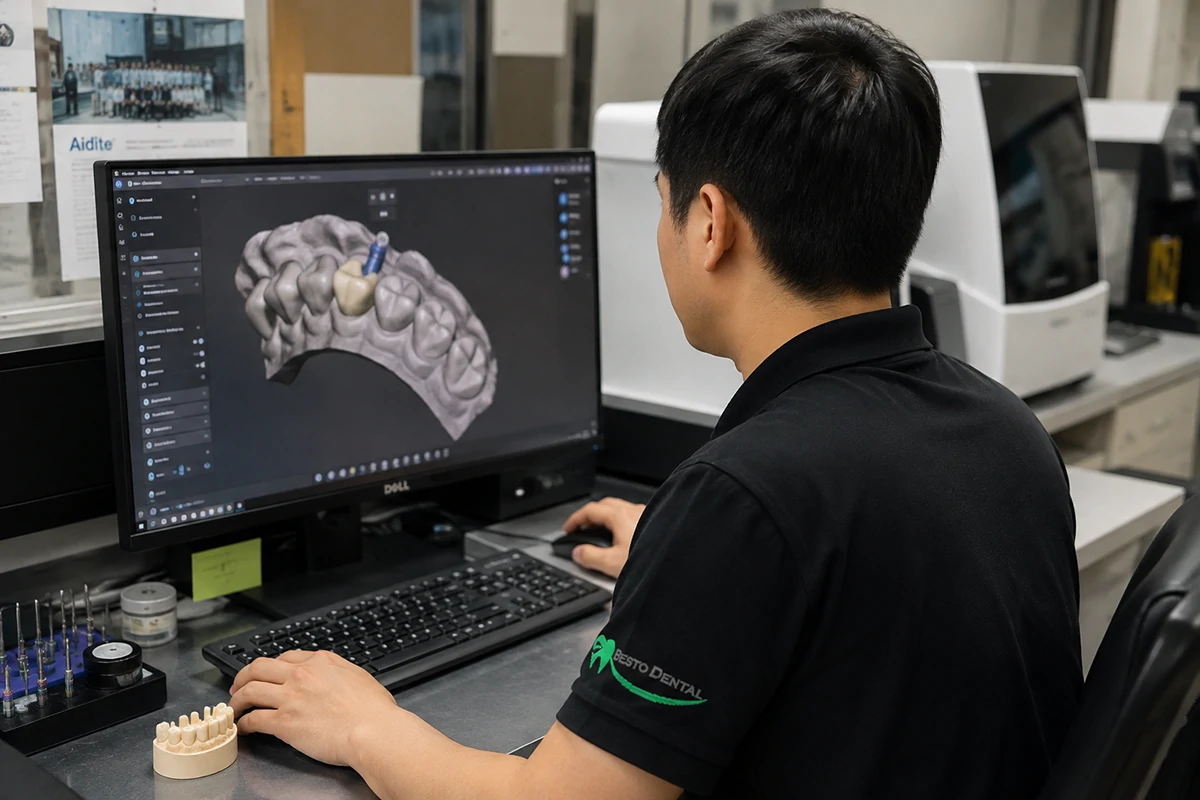
The manufacturing process of an implant crown is similar to other digital restorations in some ways, but there is one important difference: the laboratory must first identify the implant system and match the correct implant library before the restoration can be designed.
The workflow can be simplified as: Scan Body / Impression → Identify Implant System → Select Correct Library → Design Abutment / Ti-base & Crown → Fabrication → Final Check
| Stage | What Happens | What to Keep in Mind |
| 1. Scan Body / Impression | Record the implant position, surrounding teeth, soft tissue, and occlusion | The scan body must be captured clearly so the implant position and direction can be transferred accurately |
| 2. Identify Implant System | Confirm the implant brand, series, platform, and connection | Different implant systems utilize distinct connection types and configurations; clarify the following information: implant system/series, Implant dimensions, Platform size, Connection type, Scan body information, Restorative component information, Corresponding implant library |
| 3. Select the Correct Library | Match the scan body and implant system with the corresponding digital library | Using the wrong library can result in an incorrect connection or component selection |
| 4. Design the Restoration | Design the abutment or Ti-base restoration together with the final crown | The design needs to consider restorative space, screw channel position, emergence profile, and crown contour |
| 5. Fabrication | Manufacture the selected components and crown according to the approved design | The fabrication method depends on the crown material and the abutment or Ti-base design |
| 6. Final Check | Check fit, contacts, occlusion, shade, screw channel, and the implant connection | The restoration should be checked before delivery to make sure the components match the intended implant system |
The implant system and scan body information are very important for implant crown cases and must be confirmed before fabrication begins. A scan body tells the software where the implant is and how it is positioned, while the implant library tells the software what connection the implant has and which components are compatible with it.
At BestoDental, if the implant system or scan body information cannot be clearly identified from the case files, we will confirm it with the customer first rather than guessing the implant connection type.

6. Clinical Applications of Implant Crowns
Implant crowns are mainly used to restore single missing teeth. The table below summarizes some common clinical situations and the main considerations for each.
| Specific Clinical Situation | How an Implant Crown Is Used | Main Considerations |
|---|---|---|
| Single missing tooth with healthy adjacent teeth | A single implant is placed in the missing-tooth area and restored with an individual implant crown, without preparing the adjacent teeth as bridge abutments. | Bone volume, available space, implant position, and the condition of the adjacent teeth |
| Single missing anterior tooth | An implant crown is used to replace a missing incisor, canine, or other anterior tooth while restoring the tooth shape in the smile zone. | Soft-tissue contour, emergence profile, shade, abutment color, and implant position are especially important |
| Single missing posterior tooth | A single implant crown is used to replace a missing premolar or molar and restore chewing function. | Occlusal load, material strength, restorative space, and crown thickness are particularly important |
| Single tooth lost due to trauma | When the damaged tooth cannot be retained, and implant treatment has been completed, an implant crown can be used to independently replace the missing tooth. | Bone and soft-tissue conditions need to be evaluated, especially the aesthetic conditions in anterior trauma cases |
| Tooth cannot be retained due to severe caries, root fracture, or other damage | After the non-restorable tooth is extracted and implant treatment is completed, an implant crown can be used to replace the original tooth. | Whether the patient is suitable for implant treatment and the timing of implant placement need to be clinically evaluated |
| Existing single implant requiring a new crown | If the existing implant remains suitable for restoration, a new implant crown or related restorative components can be made without necessarily replacing the implant itself. | The existing implant system, connection, implant position, and available restorative components must be confirmed |
We often receive cases where a single implant is already in place and a new crown needs to be made. Even when the implant has already been placed, the implant system information still needs to be provided so that the laboratory technician can accurately identify and match the correct implant components.
7. Implant Crowns FAQs
Based on our years of experience working with dentists and dental laboratories, the following are some of the most frequently asked questions when outsourcing implant crown cases. We have summarized them here so you can find the key answers in one place.
1) Which material is best for an implant crown?
There is no single material that is best for every implant crown. Zirconia is one of the most common choices, particularly where strength is important, while PFM remains another option. Lithium disilicate may also be considered in selected aesthetic cases.
The final choice depends on factors such as the location of the implant, occlusal load, restorative space, aesthetic requirements, underlying abutment or Ti-base, and the overall restoration design.
2) Why does a screw-retained implant crown have a hole?
The hole is the screw access channel, which allows the dentist to access the screw that secures the restoration to the implant.
After the crown is seated and the screw is tightened, the access opening is filled with an appropriate restorative material. One advantage of this design is that the opening can later be accessed again if the crown needs to be removed for maintenance or repair.
3) Can an implant crown be removed and replaced?
Yes, but how easily it can be removed depends largely on the retention method.
A screw-retained implant crown is generally easier to retrieve because the dentist can reopen the screw access channel and remove the screw. A cement-retained crown can be more difficult to remove and, in some cases, the crown may need to be damaged or sectioned during removal.
Importantly, replacing an implant crown does not necessarily mean that the implant fixture itself needs to be replaced.
4) Why does the dental lab need to know the implant system?
Different implant brands and systems can use different connections, platforms, screws, Ti-bases, scan bodies, and restorative components.
The laboratory therefore needs to identify the correct implant system and match it with the appropriate digital library and components before designing the restoration.
A scan body records the position and orientation of the implant, while the correct implant library helps determine which connection and restorative components correspond to that implant.
5) What information should I send to the lab for an implant crown case?
For a digital implant crown case, the laboratory will generally need the intraoral scan containing the implant scan body, opposing arch, and bite, together with information about the implant brand, system/series, platform or connection, and scan body.
The prescription should also include the restoration material, shade, and any specific design or retention requirements. For anterior aesthetic cases, clinical shade photographs can provide the technician with additional information that cannot always be communicated by a shade number alone.
6) Why might the lab ask me to rescan the scan body?
The scan body is used to transfer the implant’s position and orientation into the digital workflow. If it is not completely seated, is partially missing from the scan, or the surrounding scan data is unclear, the laboratory may not be able to position the implant accurately in the design software.
In these situations, requesting a new scan is safer than continuing the restoration based on uncertain implant-position data.
7) Does a Ti-base mean the implant crown is cement-retained?
Not necessarily. A zirconia restoration can be bonded to a Ti-base outside the mouth, and the completed crown/Ti-base assembly can then be secured to the implant with a screw.
Although cement or bonding material is used between the zirconia restoration and the Ti-base, the completed restoration is ultimately retained on the implant by a screw. Therefore, the presence of a bonded Ti-base does not automatically make the restoration a cement-retained implant crown.
8) Can the implant crown correct an implant that is placed at an angle?
Restorative design can compensate for some degree of implant angulation, but there are limits.
Implant position affects the emergence profile, crown contour, restorative space, and especially the location of the screw access channel. If the implant angle is significantly unfavorable, changing the crown design alone may not be enough to achieve an ideal result.
9) What is a stock Abutment and a custom Abutment?
A Stock Abutment is a prefabricated standard abutment produced by the manufacturer and selected from available sizes and configurations. A Custom Abutment, on the other hand, is individually designed and fabricated according to the patient’s specific implant position, soft tissue conditions, and final restoration design. We will discuss Custom Abutments in more detail in a separate article.
8. Conclusion
After understanding the components, materials, retention methods, and the factors that influence implant crown design, you should be better prepared to evaluate a case as a whole—what information needs to be provided, which questions should be discussed with the laboratory, and why the same restoration approach may not be suitable for every patient.
For dentists and laboratories working together, this understanding also makes communication much easier. At BestoDental, this is also how we approach implant cases: understand the case first, confirm what is unclear, and then move into production.