Bestodental will give you all the relevant details about outsourced zirconia, including the different types of zirconia, pricing, ordering process, after-sales services, and how to find the right outsourcing company in this guide. In case you are intending to start a dental prosthesis outsourcing business, or you are already seeking a new supplier, then this article is a one-stop shop that comprises all the important information you would need to know about zirconia.
Bestodental is a service-based dental laboratory, and the data herein is a condensation of our long-time experience in the industry. In case you find any errors in the information given below, you can contact us without any hesitation, and we will update our information as soon as possible.
1. Common Types of Zirconia Outsourcing
Many newcomers to the field of outsourced dental prosthetics lack precise product knowledge and often conflate different types of dental prostheses. As illustrated in the figure below:
Zirconia is the major material in the production of fixed dental prostheses; thus, when most of the industry members mean zirconia, they actually mean zirconia dental prostheses. Thus, when your dental laboratory or dentist is talking about zirconia, they are probably referring to fixed dental restorations, a difference that might not necessarily be immediately apparent to someone not in the dental profession.
These products contribute well above 90 percent of the total outsourcing business; thus, should you be new in the dental prosthetics business, you must first and foremost be well-informed of their pricing and outsourcing particulars.
Being one of the world’s leaders in the outsourcing of dental prosthetics, China has the most advanced technologies in zirconia production that can offer both quality and affordability simultaneously. For your convenience, we have compiled a simple reference table outlining these various zirconia products.
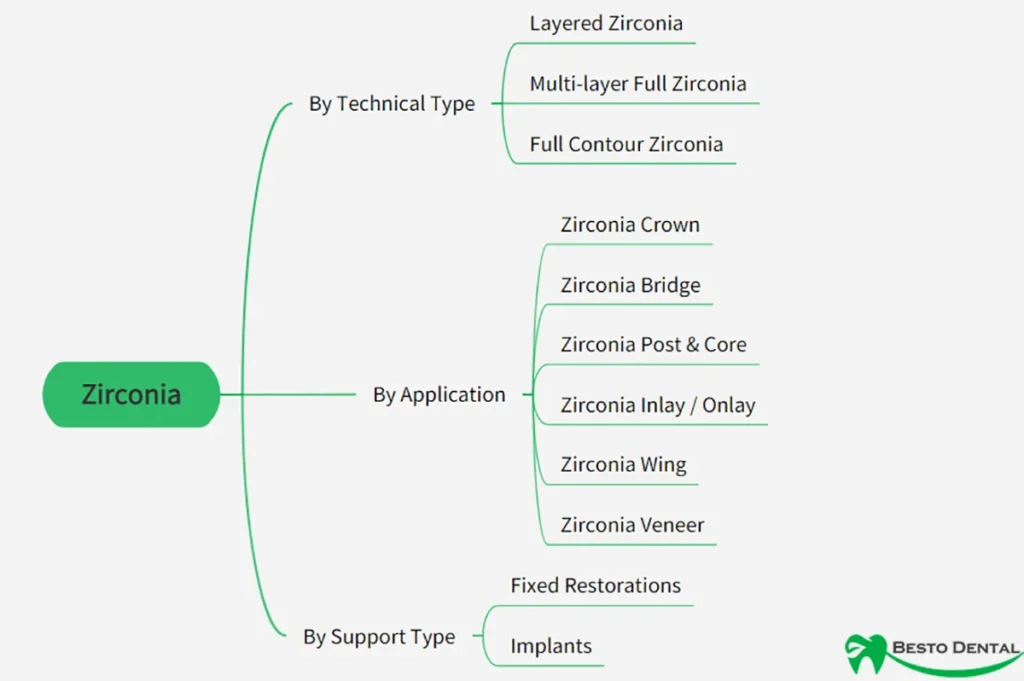
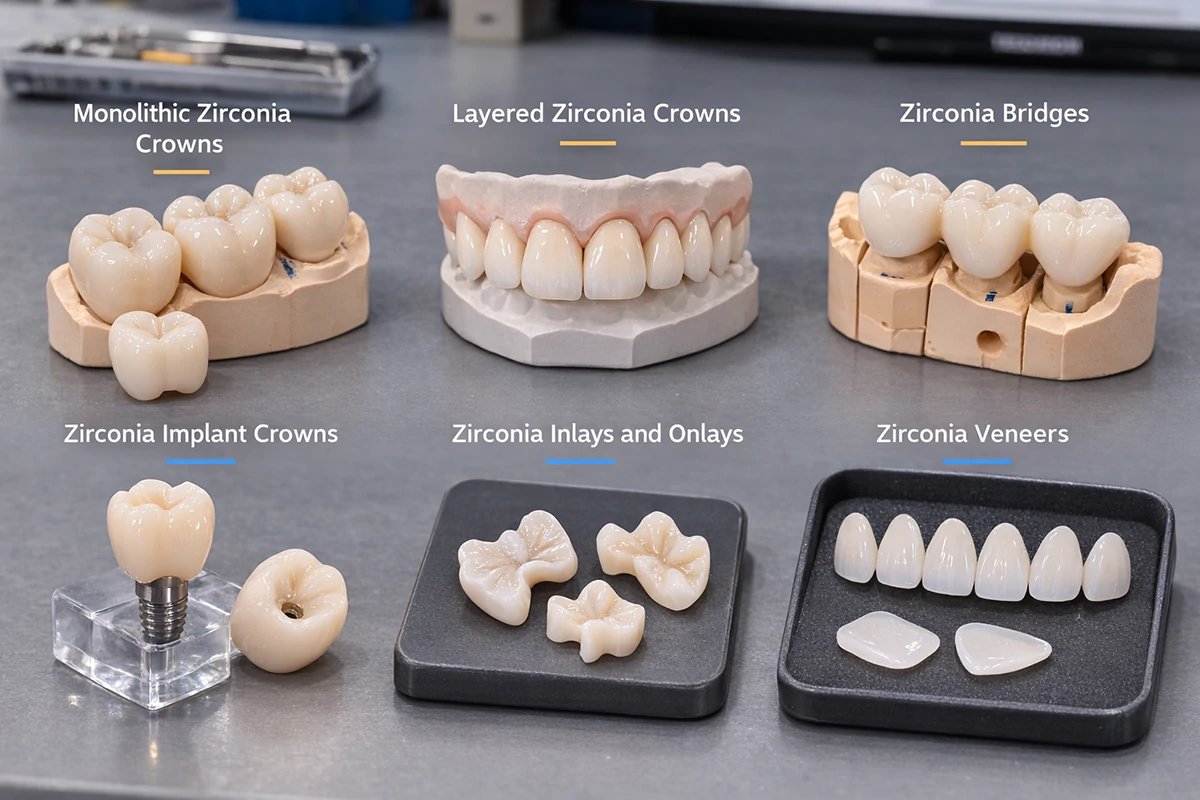
Among the various zirconia products mentioned above, zirconia crowns and bridges are the most frequently outsourced items, utilized respectively in fixed prosthetics and dental implants. These products account for over 90% of all outsourcing business; therefore, if you are just starting in the dental prosthetics industry, you must gain a thorough understanding of their pricing and outsourcing specifics. As the global hub for dental prosthetics outsourcing, China boasts highly mature zirconia manufacturing technologies capable of simultaneously delivering both high quality and cost-effectiveness.
Moreover, a well-standardized outsourcing workflow has been established after years of development. When planning to outsource your dental prosthetics work to China, Bestodental has written a helpful guide titled Bestodental New Partner Guide.
This guide is not only the best choice for all companies or agencies that are not yet in the business of delivering dental prosthetics and have not yet considered outsourcing to foreign laboratories, but also for dentists who have outsourced exclusively to local laboratories. You may contact our customer service team and ask to receive a copy.
2. Market Prices for Outsourced Zirconia Crowns
Outsourcing hubs for zirconia production include China, Vietnam, India, the Philippines, South Korea, Turkey, and various Eastern European nations such as Romania. Among these, China stands as the world’s largest and most technologically advanced center for outsourced dental prosthetics.
Compared to outsourcing to local laboratories, the pricing for zirconia outsourcing at overseas laboratories is determined by a range of factors, including production costs, communication logistics, manufacturing capacity, and shipping expenses.
In the following section, we will examine the general pricing trends for zirconia crowns across these various outsourcing markets. It is necessary to mention that, due to the vast range of different zirconia types, the estimates of prices of basic zirconia crowns are only given in this article, as they are presented to you as an example. As the complex zirconia implant restorations and veneers are more complex procedures that are more technically difficult, their particular pricing will differ by individual supplier.
| Country/Region | Base Price Range | Currency | Price Type |
| China | 22 to 48 | USD/unit | Outsourcing lab price |
| Vietnam | 30 to 50 | USD/unit | Lab price |
| India | 21 to 34 | USD/unit | Lab price |
| Philippines | 21 to 40 | USD/unit | Lab price |
| South Korea | 50 to 95 | USD/unit | Lab price |
| Turkey | 45 to 90 | USD/unit | Lab price |
| Romania | 65 to 76 | USD/unit | Lab price |
The least cost of production is, in practice, often reached when the manufacturing laboratory is large-volume, especially in markets like China, where CAD/CAM production is of large scale, and the zirconia milling is concentrated in one location, making the process less costly. Several foreign outsourcing laboratories can work in this cost and still utilize zirconia materials and digital processes used all over the world.
In contrast, smaller production capacity, labor costs, and regulatory requirements cause the local laboratories of the United States and Europe to operate at a higher price. These laboratories tend to be quicker in delivery and more in touch, but the price of their laboratory services should, of course, be higher.
For markets such as Vietnam, India, and the Philippines, publicly available pricing is often associated with clinic treatment packages rather than laboratory-only services. Consequently, these numbers may be applied as a good guideline on the general market positioning, but not necessarily as direct costs of outsourcing laboratories.
Finally, price is not the only factor used to consider an outsourcing partner. The even stronger effect on the long-term collaboration can be brought by quality control, compatibility and compatibility of digital workflow, material sourcing, communication efficiency, and remake policies.
In our case study at Bestodental, most dentists start with price as their starting point with outsourcing, but after a consistent period of working together, it is usually the time of reliability and certain turnaround time that leads to long-term relationships.
3. Information Regarding Outsourced Zirconia Orders
Three major details are usually needed when outsourcing zirconia work, and these include the type of material, warranty coverage, and the turnaround time. Bestodental breaks down these three requirements of placing an order in more detail below:
1) Materials
Zirconia normally comes in three types of materials, namely: Layered Zirconia, Multi-layer Full Zirconia, and Full Zirconia. These three types are priced differently, and thus when ordering, it is necessary to indicate to your outsourcing partner which of these types you need.
2) Warranty
The dental labs in China usually have a warranty of 5 years on zirconia restorations. A study by Bestodental suggests that the zirconia dental restoration is usually more covered than most forms of dental restorations, as evidenced by the available warranty policies published by leading dental laboratories. The following data summarizes the standard after-sales warranty periods for zirconia in various key markets we have surveyed:
| Market | Typical Public Warranty Range | Note |
|---|---|---|
| China | 5 years is commonly visible, with some labs promoting lifetime for selected zirconia products | Mostly outsourcing lab-facing policies |
| Vietnam | Up to 5 years is visible, but policy transparency varies by lab and product line | Often product-level or lab-level warranty messaging |
| India | Not clearly standardized | Some suppliers emphasize remake conditions more than long fixed warranty terms |
| USA | 3 to 5 years is common, with some large labs offering lifetime coverage for monolithic zirconia | More structured written warranty policies |
3) Turnaround Time
Turnaround time encompasses both factory production time and shipping time. Typically, factory production takes 2–3 days, while shipping duration varies by country: direct shipments generally take 2–3 days, whereas those requiring transshipment may take 3–7 days. Bestodental has detailed the specific turnaround times for various countries in its BestoDental New Partner Guide; please feel free to contact our customer service team to request a copy.
4. Zirconia Dental Lab Remake Policy
When zirconia restorations are outsourced to overseas laboratories, the cost of rework becomes significantly higher due to shipping expenses. This is, in fact, the primary concern for many dentists who choose to outsource their prosthetics to labs abroad. Indeed, it is a worry shared not only by dentists but also by us at the laboratory; any instance of rework inevitably drives up the overall cost of the outsourced prosthetic work.
Given that dental prosthetics are highly customized products, it is often difficult to definitively assign blame when rework becomes necessary. However—regardless of whose fault it may be—a rework situation can range from merely wiping out all profit margins to, in severe cases, resulting in a net financial loss.
There is an amusing anecdote regarding this: Bestodental’s laboratory manager—who has nearly 20 years of industry experience—finds the process of fabricating dental prosthetics to be an incredibly stressful endeavor. The constant need to address rework issues over the years has actually caused him to develop a psychological stress response.
Consequently, he has instructed our company staff to refer to any *repeat orders* from long-standing clients simply as “new orders,” rather than using the term “repeat orders.” This is because the Chinese words for “repeat order” (*fan dan*) and “rework” (*fan gong*) both share the same prefix (*fan*); hearing this prefix makes him instinctively assume that there is a problem with the order and that it requires rework.
Although this can be perceived as a funny incident, it is indirectly used to highlight the severe effects that accompany rework. However, zirconia has evolved into a very mature product line, and Chinese dental laboratories have long since developed uniform operational procedures in the production of zirconia. It is a product that has a very low rework rate; when you are keen on the particular points discussed below, the chances of incurring a rework are limited to a minimum.
1) Inaccurate Case Information
Oxidation Case Information Includes:
- Patient Name
- Restoration Tooth Position
- Material Requirements
- Restoration Type
- Shade
2) Incomplete Intraoral Scan Data
In relaying outsourced cases, the intraoral scan data completeness and accuracy is of utmost importance. It is important to ensure that scanning coverage is complete, i.e. prepared tooth, adjacent tooth, opposing arch, occlusal relationship, and margin line area are covered to prevent problems like loss of data, voids, overlaps, artifacts or ambiguous occlusal records.
In order to reduce communication overhead, it is suggested to use a standardized file-naming scheme in sending files, and to provide accompanying clinical notes, reference photos or face photos. It is only under the condition that the data is complete and the information is unambiguous that the outsourced laboratory can properly perform the process of design and fabrication, and thus allows for minimizing the number of rework and avoiding delays in delivery.
3) Unclear Communication
Once a case has been reviewed, the dental laboratory may find that there are any ambiguities or that it is in need of clarification. In this case, the dental laboratory will contact the clinician with questions; this is when the clinician must employ immediate and clear communication.
Also, the necessity to rework can be faced because of the rush, and hence, one should schedule enough lead time in advance.
The second concern to consider is that zirconia restorations are extremely sensitive to the accuracy of the digital workflow. The dental laboratory then creates the crown using all the scan information provided, and even a slight difference in scan quality, tooth preparation design, or occlusal records would affect the result. Therefore, more experienced dentists usually perceive the outsourcing of zirconia restorations as a joint venture. Effective communication, well-designed tooth preparation, and case information can go a long way in creating fewer chances of rework.
5. How to Find a Dental Laboratory That Offers Outsourcing Services for Zirconia Crowns?
One of the most typical and basic products in dental outsourcing is zirconia crowns. As a result, nearly all of the dental laboratories offering international outsourcing services can produce zirconia restorations. That is, as soon as you make the decision to outsource zirconia crowns, you will generally have an overwhelming number of potential suppliers.
If your clinic or laboratory does not yet have a partner laboratory, the simplest approach is to search online. We frequently recommend a highly practical approach: directly searching for potential outsourcing laboratories on Google using specific keywords. In practice, you can begin by adopting one of the following three strategies:
1) Search Directly Using Product Keywords
If your objective is clearly defined, you can search directly using product-specific terms—for instance, “zirconia crown” or “zirconia restorations outsourcing.” This method is ideal for quickly identifying laboratories specializing in zirconia-related products.
2) Search Using “Product Keyword + Country Name” Combinations
If you already have a specific country or region in mind for collaboration, you can combine the product keyword with the country’s name to refine your search—for example, “zirconia China” or “zirconia restorations Vietnam.” This approach is highly effective for narrowing down your options and rapidly locating suppliers within a specific target market.
3) Search Directly Using Role-Based Keywords
Given that zirconia is a fundamental and ubiquitous restorative material within the dental industry—meaning virtually all outsourcing laboratories possess the capability to produce it—you can also search directly using role-based terms, such as “dental lab + country name.” This method is equally effective for identifying laboratories capable of handling outsourced zirconia production work.
Below is an illustrative example table:
| Product Keywords | Product Keyword + Country Name((Replaceable with different target countries)) | Role-Based Keywords |
| Zirconia Crown | China Zirconia | China Dental Lab |
| Zirconia Restorations Outsourcing | China Zirconia Restorations | Zirconia Dental Lab |
| Zirconia Bridge | China Zirconia Outsourcing | Vietnam Dental Lab Outsourcing |
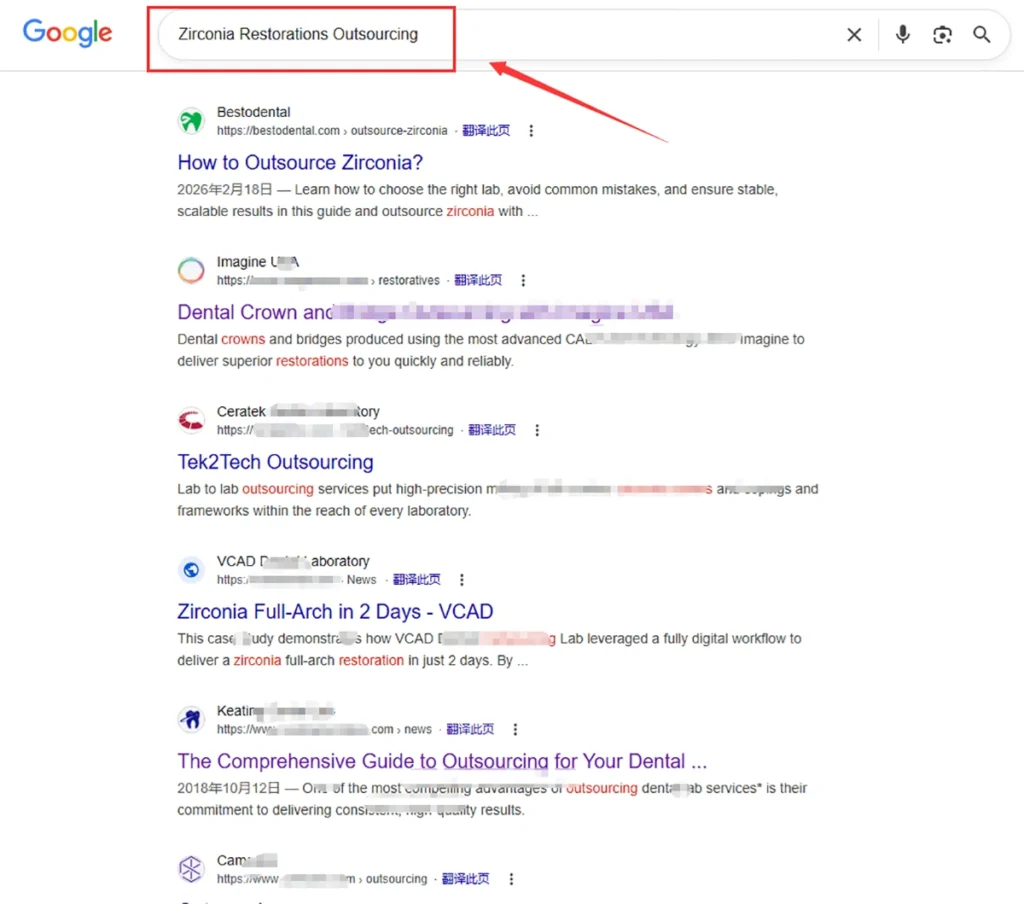
Compared to other manufacturing sectors, dental laboratories rarely rely on trade shows to acquire international clients. In fact, a simple Google search is often the quickest way to identify potential suppliers.
Once you begin your search, you will discover numerous dental laboratory websites showcasing their zirconia crown services, digital workflows, turnaround times, and case studies. This allows you to gain a preliminary understanding of their capabilities.
However, merely finding a laboratory online is just the first step. After identifying a few potential suppliers, many dentists also seek recommendations from peers or look for laboratories that are widely recognized within the industry.
For instance, dental forums, professional associations, or peer networks often share lists of trusted outsourcing laboratories that other dentists have already utilized. Seeking recommendations from dentists who have actual outsourcing experience is often a more reliable approach than judging a supplier based solely on their website.
If you would like to learn more about how to evaluate dental laboratory suppliers, we have also compiled a comprehensive guide on finding reliable laboratory partners—complete with practical search strategies, assessment techniques, and common red flags to watch out for.
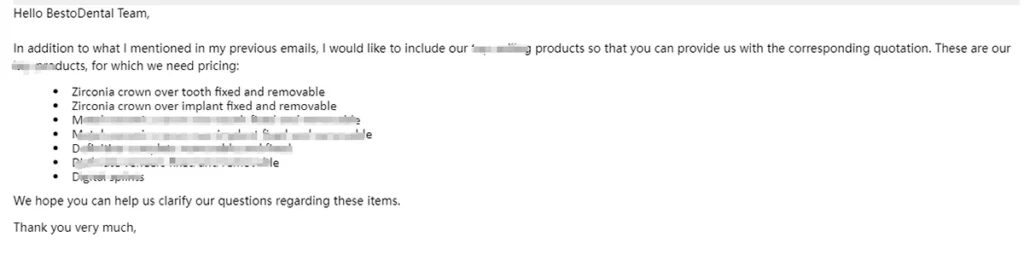
4) Practical Inquiry Email Templates for Zirconia Outsourcing
Of course, after identifying potential suppliers, many newcomers often encounter an even more practical challenge: How should I craft my inquiry emails to ensure the recipient recognizes me as a genuine prospective client—rather than just a competitor fishing for price quotes?
To address this issue, BestoDental has compiled a selection of practical inquiry templates about zirconia that have proven highly effective in securing responses during real-world communication, offered here for your reference.
Dear [Name],
We are a dental clinic based in the United States, currently handling approximately 200 cases per month. We are currently seeking a suitable international dental laboratory partner and are very interested in your company’s zirconia products and services.
At present, we are not working with any overseas dental laboratory, and we are now exploring potential long-term cooperation opportunities. We typically send case information via STL files as part of our digital workflow.
We would like to learn more about the pricing for the following products offered by your company. Would it be possible for you to provide us with a price list for our review and evaluation?
- Monolithic zirconia crowns
- Layered zirconia crowns
- Zirconia bridges
- Implant zirconia crowns
- Full-arch zirconia restorations
We look forward to your reply. Thank you.
In your email, it is advisable to proactively provide certain key details, such as:
- Your entity type—whether you are a dental laboratory, a dental clinic, or a dental service organization;
- Your approximate monthly case volume;
- The specific product categories you are currently interested in;
- Whether you are already collaborating with other overseas dental laboratories;
- And whether you prefer to submit cases via STL files or physical models.
Ideally, all of these points should be clearly articulated in your initial inquiry email. For suppliers, this information enables them to quickly assess your level of professional expertise, your business model, and the sincerity of your intent to collaborate. When a supplier can immediately recognize from your email that you are an industry insider with a fundamental understanding of the collaboration process, they are typically more inclined to respond and provide a price list. Consequently, the likelihood of receiving a meaningful and effective response is significantly increased.
6. Zirconia Dental Lab Outsourcing FAQs
Below are some common questions you might have regarding zirconia outsourcing.
1) Is it safe to outsource zirconia crowns to another country?
Yes, outsourcing zirconia crowns is widely practiced by dental clinics and labs worldwide. Many overseas labs follow international standards such as CE and ISO certifications. However, the key is not the country, but the lab’s quality control, communication ability, and consistency. Choosing a reliable partner is more important than choosing a location.
2) How much can I save by outsourcing zirconia crowns?
In most cases, outsourcing can reduce costs by:
- 30% to 70% compared to local labs
However, the real value is not just a lower price, but:
- Stable quality
- Reduced remake rates
- Scalability for growing clinics
3) What is the biggest risk when outsourcing zirconia crowns?
The biggest risk is not shipping or production, but:
- Poor communication
- Unclear case requirements
- Inconsistent quality between cases
Most problems come from miscommunication, not manufacturing.
4) How do I ensure a good fit when outsourcing?
To ensure accuracy, you should:
- Provide a clear margin design
- Send accurate bite registration
- Use high-quality scan data
- Clearly state contact and occlusion requirements
A good case starts with good input data.
5) Are zirconia crowns from overseas labs as good as local ones?
Yes, many overseas labs use:
- The same materials
- The same CAD/CAM systems
- The same workflows
In some cases, they even have more specialized production teams.
6) What is the typical turnaround time for outsourced zirconia crowns?
Typical timelines include:
- Production: 2–5 working days
- Shipping: 3–7 days
Total turnaround: around 7–10 days.
Planning cases in advance is key.
7) How do I start outsourcing zirconia crowns?
A typical starting process is:
- Send a trial case
- Evaluate fit and aesthetics
- Adjust communication and workflow
- Move to regular orders
Never start with large orders.
8) What information is most important when sending a case?
The most critical information includes:
- Tooth number
- Shade
- Margin design
- Occlusion requirements
- Photos (if aesthetic case)
Missing information is the #1 cause of remakes.
9) How do I choose the right zirconia outsourcing lab?
You should evaluate:
- Case consistency
- Communication speed
- Willingness to solve problems
- Experience with international clients
Price should never be your only criterion.
10) Should I outsource all zirconia cases or only some?
Many clinics start by outsourcing:
- Posterior crowns
- Simple cases
Then gradually move to:
- Anterior aesthetic cases
- Implant restorations
Start simple, then scale.
11) What happens if there is a problem with the case?
Most professional labs will:
- Offer remake
- Provide credit
- Help analyze the issue
A good lab focuses on long-term cooperation, not one case.
12) Is zirconia always better than other materials?
Not necessarily. Zirconia is ideal for:
- Strength
- Durability
- Posterior restorations
But for high aesthetics, materials like:
- E.max may still be preferred.
7. Conclusion
If you are considering outsourcing zirconia restorations, the most important thing is not simply comparing prices between laboratories. In most cases, the final result depends much more on clear scan data, proper tooth preparation, and good communication between the clinic and the lab.
In our experience at Bestodental, dentists who start with a few test cases and gradually build a stable workflow with a laboratory partner usually see the best results. Once the communication and case submission process becomes consistent, zirconia outsourcing can become a reliable and efficient part of everyday clinical work.