In this guide, BestoDental provides you with a practical overview of outsourcing E.max restorations. Covering common restoration types, pricing considerations, ordering requirements, issues related to remakes, and how to find the right partner. Whether you are evaluating new suppliers or planning to expand your restoration outsourcing workflow, this article aims to help you gain a better understanding of how E.max restoration outsourcing works in practice. As a service-oriented dental laboratory with 14+ years of industry experience, BestoDental has compiled this guide based on our daily experience in case management, vendor communication, and long-term outsourcing partnerships.
1. Types of E.max Restoration Outsourcing
E.max is one of the primary materials utilized in aesthetic dental restorations. Unlike zirconia, E.max is typically not discussed in terms of layered structures or implant-supported configurations; instead, it is classified in a more practical manner based on technical methodology, clinical application, and restorative category.
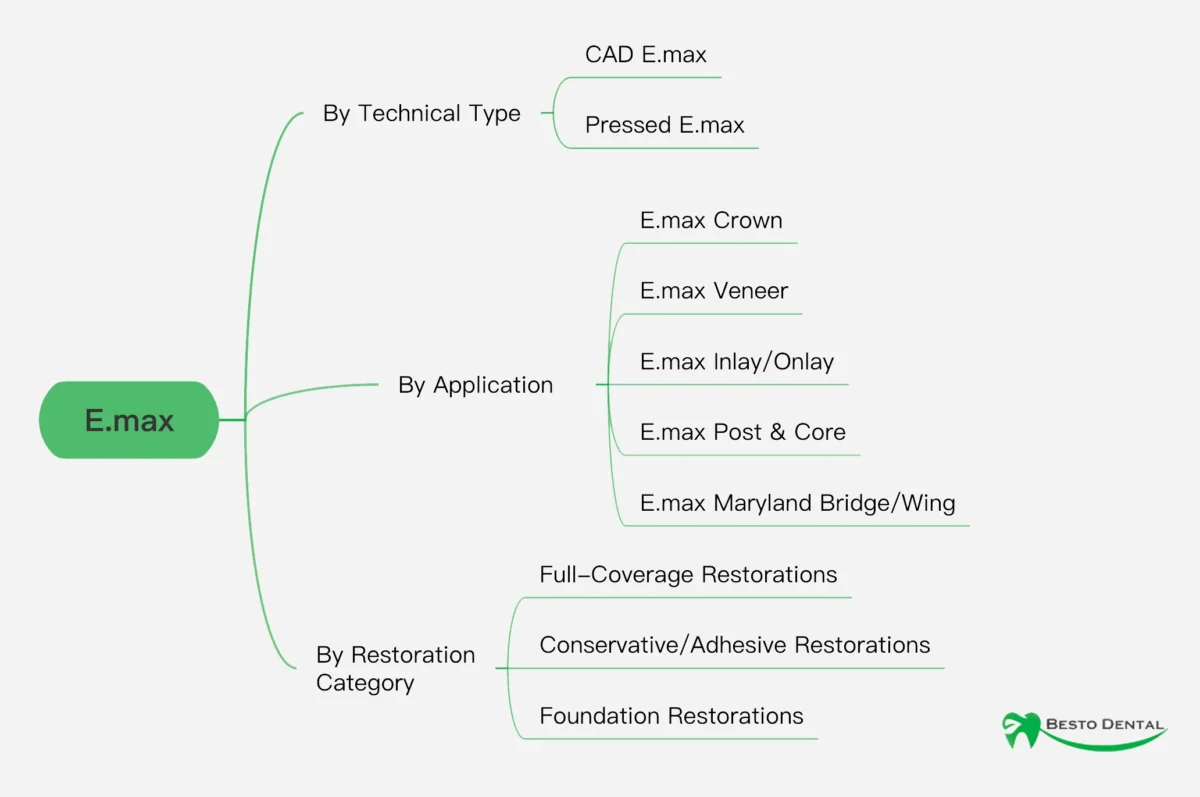
From a technical perspective, outsourced E.max restorations are generally categorized, based on the fabrication methods employed by dental laboratories, into E.max CAD and Pressed E.max. E.max CAD typically refers to restorations milled from lithium disilicate blocks using a CAD/CAM workflow, whereas Pressed E.max refers to restorations fabricated using heat-pressing techniques. In certain instances, Pressed E.max may represent the superior choice for restorations requiring more individualized anatomical contours or finer aesthetic characteristics.
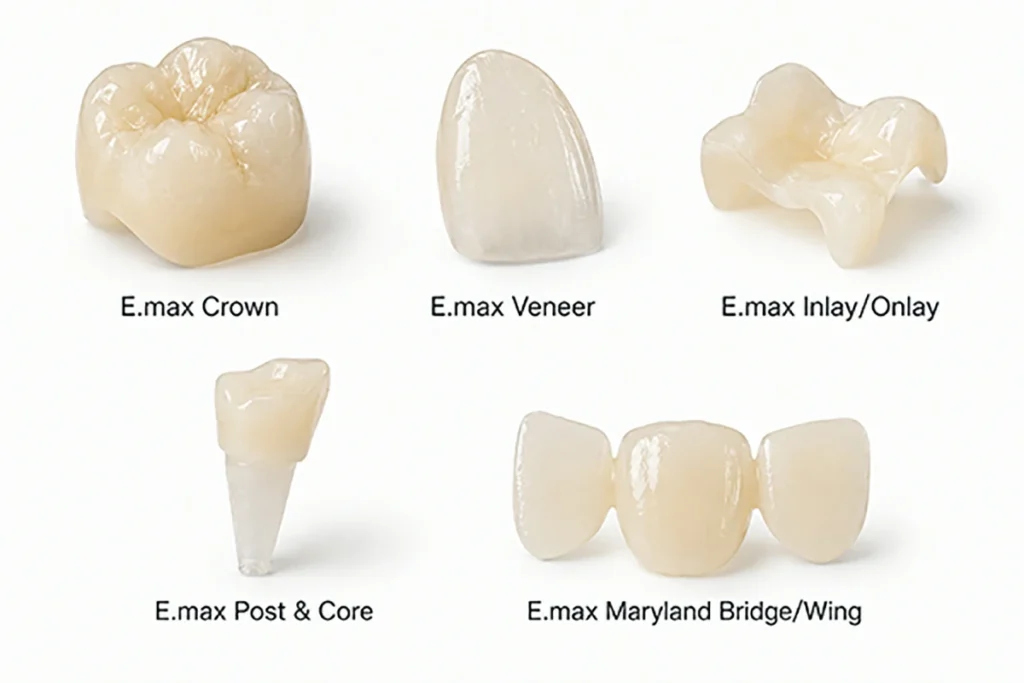
When considering clinical applications, the most common outsourced E.max products are E.max crowns, veneers, inlays and onlays, post-and-core, and Maryland bridges (resin-bonded fixed partial dentures).
Considering the different restorative types, one could categorize such products as full coverage restorations (such as E.max crowns), conservative/bonded restorations (for example, E.max veneers and E.max inlays/onlays), and foundation restorations (E.max post-and-core).
Among those listed above, the most common outsourced products would be the E.max crowns and veneers especially if one is seeking perfection in such attributes as translucency and color match. Inlays and onlays are another group of conservatively treated patients while post-and-core and Maryland bridges are more specific for each particular patient.
For clients outsourcing E.max restorations for the first time, it is generally advisable to begin with relatively simple cases, such as single crowns or standard veneers, before gradually progressing to more technically demanding aesthetic restorations. If you are considering outsourcing your E.max cases to China, BestoDental has compiled a comprehensive “BestoDental New Partner Guide,” drawing upon our extensive experience in the outsourcing field. We invite you to contact our customer service team to request a copy of this guide.
2. Price of E.max Restoration Outsourcing
According to publicly available procurement and pricing information regarding E.max, the primary cross-border markets include China, India, Vietnam, and Turkey. Among these, China and India are more closely associated with production-oriented dental laboratory outsourcing operations, whereas Vietnam and Turkey figure more prominently in the clinical retail sector—particularly in the realms of cosmetic dentistry and dental tourism.
China remains one of the most mature regions for dental laboratory outsourcing, with numerous export-oriented laboratories actively promoting E.max services to overseas clinics and laboratories.
Public pricing for outsourced E.max is still limited, especially for basic E.max crowns. Many laboratories promote E.max production but do not publish a complete fee schedule for full crowns. Public prices are often easier to verify for veneers or for clinic retail treatment than for straightforward lab-side manufacturing. Drawing upon over a decade of outsourcing experience, BestoDental has summarized the baseline price range for the E.max outsourcing market in the table below. All price estimates in this article are for basic E.max cases only and should be treated as reference values rather than fixed benchmarks. Because labor costs, manufacturing capabilities, and shipping costs vary by market, actual prices may differ by supplier.
| Country/Region | Price Range | Currency | Price Type |
|---|---|---|---|
| China | 64–104 | USD/unit | Lab price (publicly verifiable, mainly for E.max veneer; basic E.max crown lab price not clearly posted) |
| India | 35-78 | USD/unit | Lab price (lower pricing, but relatively limited in digital workflow efficiency, large-scale production capacity, turnaround stability, and comprehensive restorative solutions) |
| Vietnam | 35-70 | USD/unit | Lab price (lower pricing, but relatively limited in large-scale digital production and comprehensive restorative capabilities) |
| Turkey | 60-120 | USD/unit | Lab price (parts of the lab lack advantages in large-scale digital production, stable turnaround, and comprehensive restorative outsourcing capabilities) |
| USA (benchmark) | 87–149 | USD/unit | Public lab price (standard single-unit E.max fee schedules) |
BestoDental has compiled a price list for E.max restorations, if you are interested, please contact us to “Get Price List.” After reviewing the pricing across different markets, you may already have a general idea of your target outsourcing market. The next question, especially for first-time buyers, is what information should be provided when outsourcing E.max cases for the first time. Based on more than ten years of industry experience, BestoDental has compiled the following reference information for you.
3. Information Required for Outsourced E.max Orders
When outsourcing E.max cases, the following three aspects typically need to be taken into consideration: the final aesthetic outcome, the warranty period, and the turnaround time.
1) Esthetic Outcome
When submitting an E.max case to an outsourcing lab, you should clearly communicate the final aesthetic outcome you want to achieve. This means you need to provide both the target shade and the stump shade, as these two pieces of information are essential for the lab to balance masking, translucency, and final shade accuracy.
2) Warranty
Warranty terms for E.max restorations are not standardized across markets. In practice, some published policies are laboratory-facing warranty or remake terms, some are clinic retail warranties, and some are manufacturer guarantees for the IPS e.max material itself. For that reason, you should look carefully at what type of warranty is actually being offered before comparing suppliers.
The following table summarizes the E.max warranties that are visible across several key markets we learned:
| Market | Typical Public Warranty Range | Note |
|---|---|---|
| China | 5 years is commonly visible | Mostly export-facing lab warranty or remake policy. |
| India | Public warranty terms are not consistently standardized or easily verifiable | More often presented as clinic-specific assurance, service support, or remake support rather than a clear, standardized fixed warranty. |
| Vietnam | 5–15 years is publicly visible in some clinic-facing E.max / zirconia crown and veneer messaging | Mostly clinic-facing warranty messaging rather than standalone lab warranty. |
| Australia | 2–5 years is publicly visible, depending on lab policy | Written lab warranties are visible, but the period varies by lab and product category. |
3) Turnaround Time
Turnaround time encompasses both factory production time and shipping time. Typically, the factory requires 2–3 days to produce E.max restorations; however, this process may take longer if delays arise due to communication issues or time zone differences. The delivery period differs depending on the destination country or region – in the case of direct shipping it takes up to 2–3 days while transshipping may require from 3 to 7 days. All necessary shipping times for various destinations can be found in BestoDental New Partner Guide. You can obtain a copy of this document from our customer support representatives at BestoDental.
4. Post-Sale Rework in E.max Outsourcing
One of the greatest concerns in overseas dental outsourcing is rework. It creates headaches for dentists and places considerable pressure on laboratories as well. At present, E.max outsourcing in China has achieved a high level of development, especially in digital workflows and bulk production. Nevertheless, there are still significant differences in aesthetic skills, communication skills, and quality control between laboratories. Therefore, giving serious consideration to the following issues will greatly decrease the possibility of remake when outsourcing E.max cases.
1) Inaccurate Case Information
In many E.max remakes, the main issue is not that the laboratory received no information, but that the information was incomplete or too vague.
When sending an outsourced E.max case, the laboratory usually needs the following basic information:
- Patient name
- Restoration of tooth position
- Restoration type, such as E.max crown or E.max veneer
- Shade
- Margin line confirmation
- Any special instructions or characterization requirements
2) Aesthetic Communication Problems
Because E.max is often used in appearance-sensitive restorations, unclear aesthetic communication can easily lead to remake even when fit is acceptable.
Common problems include:
- Unclear aesthetic direction, such as whether the case should look natural, brighter, or highly blended with adjacent teeth
- Shade instructions that are too general
- No clear reference tooth or visual priority
- No explanation of what results should be avoided, such as over-whiteness, excessive translucency, or an artificial appearance
3) Incomplete Intraoral Scan Data
It is extremely essential to make sure that the intraoral scanning process is comprehensive and accurate when outsourcing E.max cases. Specifically, all the information related to the preparation of the tooth, adjacent teeth, the opposite arch, occlusion, and margin line needs to be included. For anterior E.max cases in particular, incomplete scan data may also affect the laboratory’s ability to evaluate tooth morphology, symmetry, and integration with the surrounding dentition. Problems such as :
- missing data
- voids
- overlaps
- artifacts
- unclear margins
- or inaccurate bite records
These can easily lead to design errors, poor fit, esthetic mismatch, and ultimately remake cases.
To reduce communication costs and improve case predictability, BestoDental advises you to submit standardized digital files together with clear clinical notes, shade information, stump shade, and relevant reference photos.
4) Unclear Communication
After the review is finished, the laboratory may encounter some ambiguity or confusion. In such a situation, the laboratory will contact the dentist and ask him about this issue. At this stage, the dentist must ensure that the communication is prompt, effective, and accurate.
5) Rush Turnaround
When outsourcing E.max restorations, sufficient lead time should always be reserved. In addition, the communication time, time spent on manufacturing within the laboratory, shipment time, and any additional time that might be required due to a remake or adjustments must also be considered when scheduling the production timeline.
5. How to Find the Right E.max Outsourcing Lab?
Because E.max is a common outsourced restoration category, most dental laboratories engaged in fixed restoration outsourcing are capable of fabricating E.max restorations. As a result, you usually have a wide range of supplier options when selecting an E.max outsourcing partner.
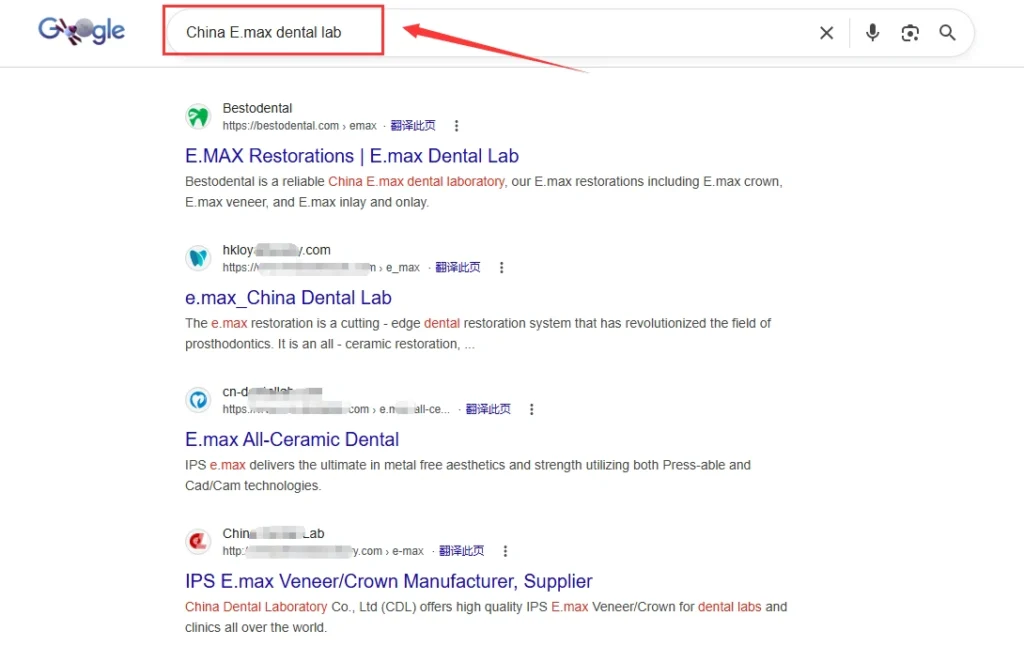
The simplest way to begin is often by searching online with relevant keywords. Below, we have outlined three practical approaches for your reference:
1) Search by Product Keywords
If your target is clear, you can search directly using product-specific keywords, such as:
- E.max crown
- E.max Veneer
- E.max restorations
- E.max Inlay and Onlay
- E.max Restorations Outsourcing
2) Search by Product Keyword + Country Name
If you prefer suppliers in a specific country or region, you can combine the product term with the location, for example:
- China E.max crown
- E.max veneer China
- E.max crown Vietnam
- E.max crowns India
This approach helps narrow the supplier pool and makes comparison easier within a target market.
3) Search by Role-Based Keywords
Because many full-service outsourcing laboratories can produce E.max restorations, broader role-based searches can also be effective, such as:
- dental lab outsourcing China
- E.max crown outsourcing China
- E.max Dental Lab Outsourcing Vietnam
- Dental Lab Outsourcing India
Below is an illustrative example table:
| Product Keywords | Product Keyword + Country Name((Replaceable with different target countries)) | Role-Based Keywords |
| E.max crown | China E.max crown | dental lab outsourcing China |
| E.max Veneer | E.max crown Vietnam | E.max Dental Lab Outsourcing Vietnam |
| E.max Restorations Outsourcing | E.max crowns India | Dental Lab Outsourcing India |
After identifying potential laboratories, evaluation should not depend only on price or website presentation. Yous should also review:
- Whether real case examples are shown
- Whether the laboratory explains its workflow clearly
- Whether the communication appears professional and timely
- Whether the supplier has experience with international cases
- Whether aesthetic support is mentioned clearly
- Whether trial cooperation is welcomed
- Are the materials traceable?
However, finding a laboratory is only the first step. Having identified several possible suppliers, most dentists will also try to get references from colleagues or find reputable E.max outsourcing labs that are well known in the field.
For instance, there are many dental forums and professional organizations that regularly publish lists of reputable labs that have already been certified by other dentists. In fact, getting recommendations from dentists who have used outsourcing services before is usually more credible than evaluating suppliers based on the content available on their websites.
If you wish to know more about how to assess dental lab suppliers, we can also offer you a detailed guide on how to choose a reliable outsourcing lab, which includes search tips, assessment strategies, and common red flags.
4) Practical Inquiry Email Template for E.max Outsourcing
After identifying potential suppliers, many buyers face a practical question: how should the first inquiry email be written?
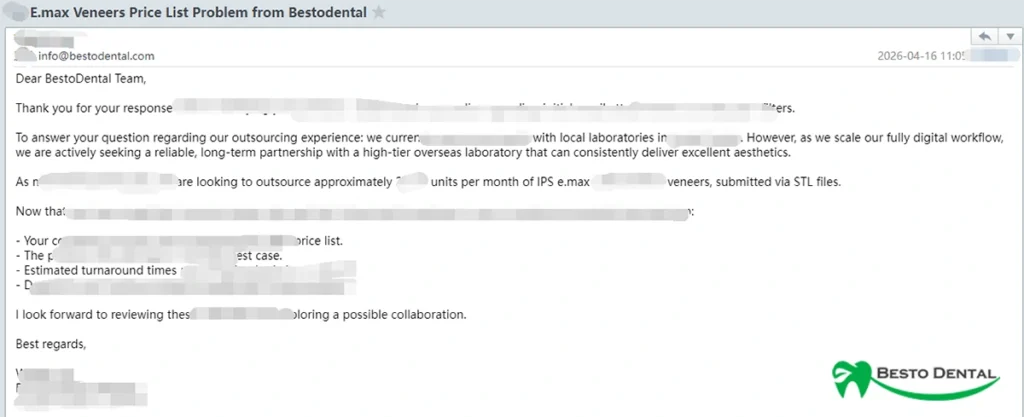
An effective initial email should help the supplier quickly understand your business type, your case profile, and the seriousness of your interest in cooperation. This makes it easier for the laboratory to provide relevant information rather than treating you merely as a competitor looking to fish for our price list.
To address this question, BestoDental has compiled a series of practical inquiry templates for E.max products. These templates have proven highly effective in generating responses during real-world communication, and we are pleased to provide them here for your reference.
Dear [Name],
We are a dental clinic based in the United States, currently handling approximately 100 cases per month. We are currently seeking a suitable international dental laboratory partner and are very interested in your company’s E.max products and services.
At present, we are not working with any overseas dental laboratory, and we are now exploring potential long-term cooperation opportunities. We typically send case information via STL files as part of our digital workflow.
We would like to learn more about the pricing for the following products offered by your company. Would it be possible for you to provide us with a price list for our review and evaluation?
E.max crowns
E.max venner
E.max Post & Core
E.max Maryland BridgeWe look forward to your reply. Thank you.
In the initial inquiry, it is generally helpful to include:
- Whether you are a clinic, laboratory, or distributor
- Your country or market
- Your approximate monthly case volume
- The product categories you are interested in
- Whether you use digital scans or physical models
- Whether you already work with overseas laboratories, where are they?
6. E.max Outsourcing FAQs
Below are some of the most common questions buyers may have about E.max outsourcing, especially before placing an order, during project execution, and when evaluating long-term cooperation.
1) How can I verify that the IPS e.max material is genuine?
Before starting cooperation with a dental lab, you can ask whether they can provide material traceability information, such as the original material packaging, batch number, or traceability card.
At BestoDental, we provide an IPS e.max material traceability card with the finished restoration. You can simply scan the QR code on the card to verify the material source and confirm that the IPS e.max material used for your case is genuine.
2) What is the best way to start E.max outsourcing?
The safest approach is usually to begin with a small number of carefully selected cases rather than sending all E.max work at once. Many clinics and laboratories start with manageable cases, review fit, aesthetics, communication, and turnaround, and then expand the cooperation step by step.
3) What information is most important before sending an E.max case?
At minimum, the laboratory should receive the restoration type, tooth number, shade, scan or impression data, opposing information, bite registration, and any relevant aesthetic notes. For anterior or highly aesthetic cases, stump shade, photos, and provisional or pre-op references are often equally important.
4) What should I look for in an E.max outsourcing supplier?
Look at more than price. A reliable lab usually communicates clearly, asks questions when case information is incomplete, follows instructions carefully, and handles remakes responsibly.
5) Do I need to send photos if I already sent the scan?
In many E.max cases, yes. A scan gives structure, but photos help with shade reference, tooth shape, smile context, and overall esthetic communication.
6) What should be confirmed about the remake policy before regular cooperation begins?
You should understand what kinds of problems are covered, whether fit issues and aesthetic issues are handled differently, who is responsible for remake shipping, and whether policy terms vary by restoration type. These points are especially important in E.max outsourcing, where visual expectations can be more subjective.
7) How much time should I allow for outsourced E.max cases?
In addition to the time needed for patient communication, you should allow an extra 3–4 days of buffer time for outsourced E.max cases. This buffer helps cover unexpected situations that may occur during the process, such as case clarification, design confirmation, shipping delays, or minor adjustments before final delivery.
Therefore, we recommend avoiding a very tight patient appointment schedule and leaving enough flexibility to ensure the case can be completed smoothly.
7. Conclusion
If you are considering outsourcing your E.max restorations, the critical question is not merely which laboratory offers the lowest price, but rather which laboratory can provide a consistent and efficient workflow for your aesthetic restoration cases. In reality, successful E.max outsourcing entails far more than just production capacity. It requires appropriate case selection, comprehensive case documentation, clear communication regarding shade matching and aesthetics, realistic scheduling, and a laboratory capable of responding promptly should adjustments or remakes become necessary.
If you are currently evaluating whether E.max outsourcing services are suitable for your clinic or laboratory, BestoDental can assist you, prior to the commencement of any partnership, in professionally reviewing your specific case requirements and workflow needs.