In this guide, Bestodental will share crucial details about the dental lab outsourcing for orthodontics, such as the types of appliances, costs, procedures, post-sale support, and methods to choose a reliable dental lab partner.
If you’re considering an orthodontic outsourcing venture, or you’re in the process of finding a new supplier for your practice, this article will help you understand the orthodontic outsourcing industry, particularly regarding the products you use like clear aligners, Hawley retainers, Herbst appliances and sports guards.
Bestodental is a dental lab with a service-based approach, with a wealth of experience in the production of orthodontic appliances and overseas assistance. The following is developed from our practical experience in the industry. Should you find any errors or inaccuracies in this article please do not hesitate to get in touch to make the necessary amendments.
1. Types of Orthodontic Appliances
Orthodontic products include a far greater diversity of appliance types and are more complicated to design and manufacture than the average fixed restorative outsourcing. It is beneficial, however, to know the entire picture of the products before delving into orthodontic laboratory outsourcing.
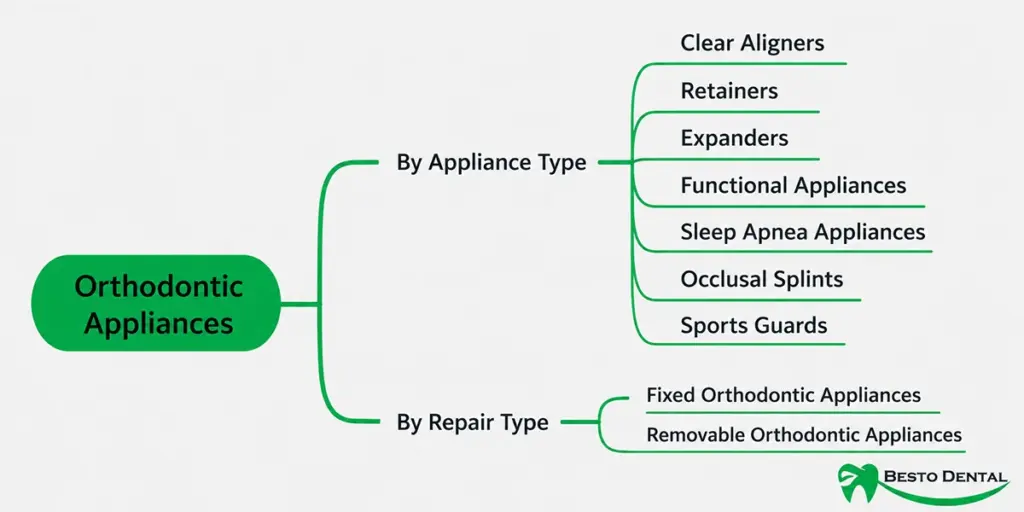
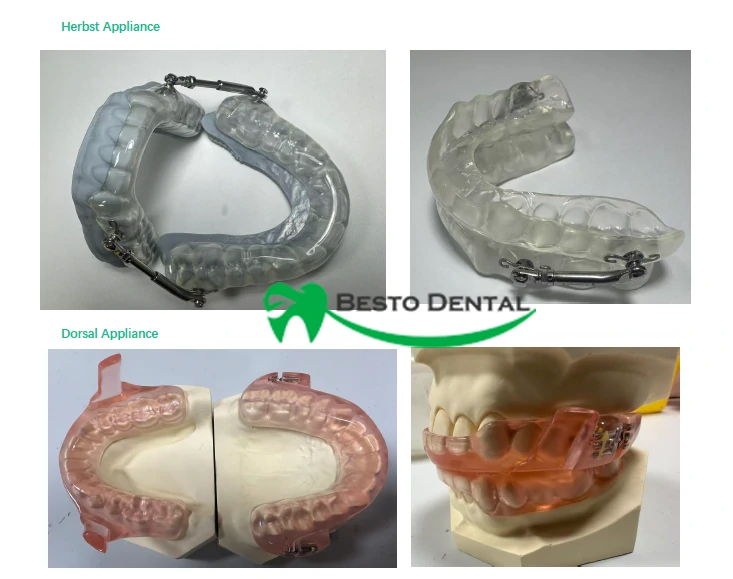
Orthodontic appliances can be divided into several types: clear aligners, retainers, functional appliances, sleep apnea appliances, sports mouthguards, occlusal splints and expanders. These may also be divided based on the method of treatment used into fixed orthodontic appliances and removable orthodontic appliances. There are, of course, many various product designs and variations in each appliance category. Examples are Herbst appliances, Silensor-style appliances, Shark anti-snoring appliances, Dorsal appliances, EMA-style appliances, MDSA appliances, Moss appliances and much more.
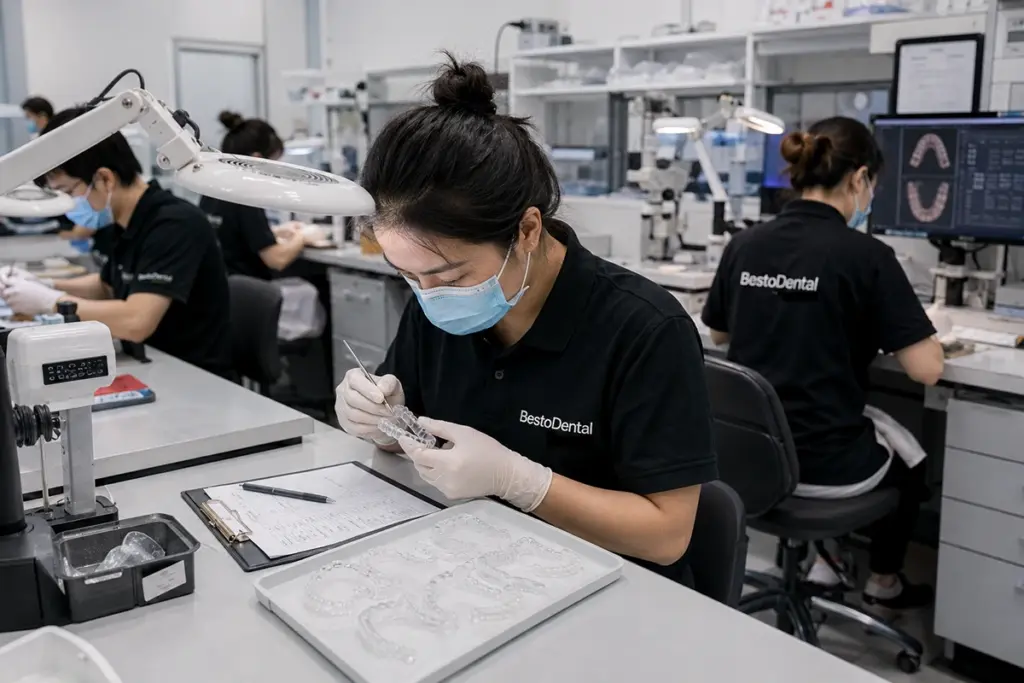
The most frequently outsourced of these product types are clear aligners, clear retainers, and Hawley retainers. We make and mold hundreds of Clear Aligner and Herbst and Silensor style appliance cases each month at BestoDental.
2. Orthodontic Lab Outsourcing Price
Major global outsourcing hubs for orthodontic laboratory services include China, India, Vietnam, the Philippines, South Korea, and selected European countries. Among them, China have become leading centers for digital orthodontic outsourcing, with mature capabilities in clear aligner case setup, treatment planning, and large-scale production.
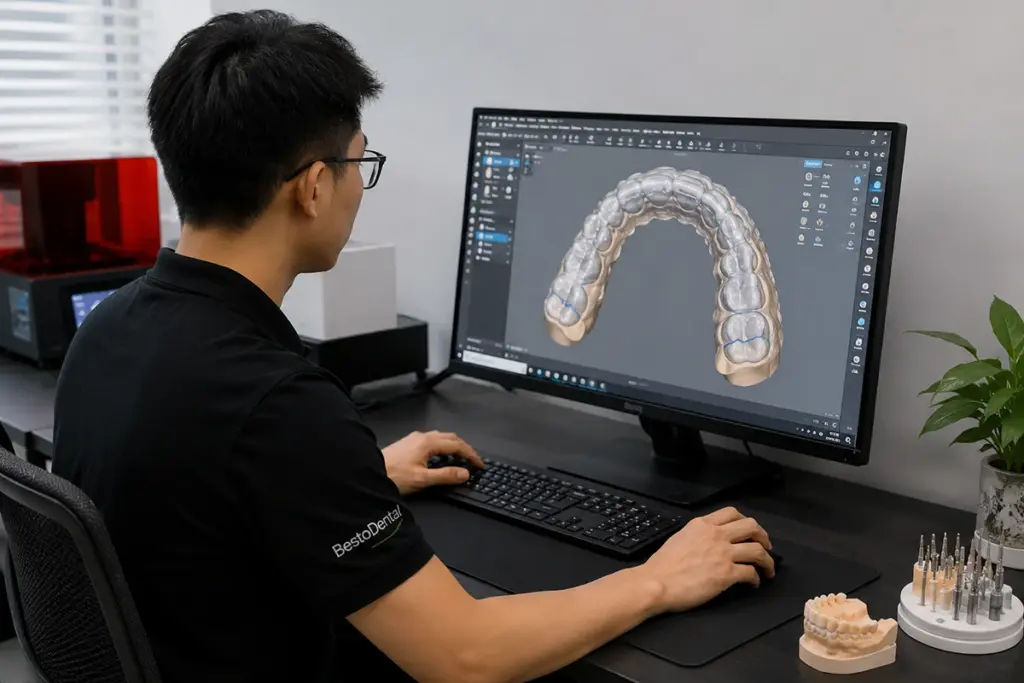
In contrast to conventional products, orthodontic outsourcing is not limited to product manufacturing. It frequently involves digital case evaluation, treatment planning, tooth motion simulation, attachment design, staging and aligner manufacturing. That means the clear aligner cost varies based on production costs, case complexity, stages, design skills, clinical assistance, communication abilities, and global shipping.
In the next section, BestoDental takes a look at the cost of outsourcing clear aligners in the top global markets. To ensure a fair comparison, we use a full clear aligner case (include design) as the reference standard. Please note, the ranges listed are multi-case and are for complex cases, multiple refinements, skeletal malocclusions or cases where advance treatment planning is required may be more expensive than the listed ranges. Final prices will be discussed with the supplier in the specific application.
| Country/Region | Typical 10-Stage Clear Aligner Case | Currency | Price Type |
| China | 310-330 | USD/case | Lab Price |
| India | 280-300 | USD/case | Lab Price |
| Vietnam | 300-310 | USD/case | Lab Price |
| USA | 700-1000 | USD/case | Lab Price |
| Germany | 756–784 | USD/case | Lab Price |
| South Korea | 500-1000 | USD/case | Lab Price |
The price of clear braces varies not simply in line with manufacturing costs, but additionally on case set up capability, manufacturing scale, and overall operating costs. China may be able to provide some of the most competitive laboratory prices around the world because it has a mature workflow, high production capabilities, and relatively low labor costs.
Developed markets, on the other hand, have the experience and modern orthodontic technologies that can help lower lab costs, but their local service systems are highly developed and lab costs are generally higher because of the higher operating cost of their labs and greater labor prices. Indonesia, Vietnam and Philippines are emerging markets, which have developed quickly in recent years and have some cost benefits, but the overall scale and maturity of the industry is still developing.
According to BestoDental experience, the price should not be the only criterion to select an orthodontic outsourcing partner. Often the quality of treatment planning, as well as compatibility of electronic workflow, turnaround time, technical support, and refinement policy have a greater impact on the long-term functioning and success of a clinic, as well as on patient outcomes. Stability and reliability are more likely to provide the greatest long-term benefit for most clinics than just the lowest price.
3. Information Required for Outsourced Orthodontic Appliance Orders
Three important points are usually needed when outsourcing orthodontic appliances: the kind of appliance and materials, warranty and remake policy and the turnaround time. Generally, orthodontic appliances require more case-specific adjustments, digital workflows, and technical support.Orthodontic appliances typically require more case specific adjustments, digital workflows and technical support compared with zirconia restorations. As a result, laboratories tend to focus more on the ability to support a remake and to communicate efficiently than on providing a single long term warranty.
Bestodental is offering a thorough explanation of these three critical factors of appliance outsourcing orders below.
1) Appliance Types and Materials
Orthodontic appliances can generally be divided into several major categories, including Clear Aligners, Retainers, Expanders, Functional Appliances, Sleep Apnea Appliances, Occlusal Splints, and Sports Guards.
Each type of appliance has unique manufacturing processes and materials needed. Clear aligners, retainers, 3D printing workflows and digital models are frequently used to manufacture thermoformed sheet materials, whereas wire bending, acrylic processing and metal soldering and screw systems are used to manufacture expanders and functional appliances.
Many orthodontic labs utilize materials and components that are recognized and used internationally, such as the combined ERKODENT from Germany and LEONE rods from Italy to make the Herbst anti-snoring appliance.
The manufacturing complexity and production cost differ greatly with different appliance types, so during outsourcing orders, the category of the appliance, design requirements, workflow preference should be clearly specified.
2) Warranty and Remake Policy
Long-term warranties for orthodontic appliances do not exist. In accordance with BestoDental’s over 10 years of experience in the dental outsourcing market worldwide, we have conducted our own research and come up with the average warranty duration for orthodontic appliances in several countries for your reference. Most labs offer only limited remake, adjustment, or defect handling, depending on the type of appliance, case records, patient compliance, and whether the defect is related to the manufacture of the lab.
| Market | Typical Warranty / Support | Notes |
|---|---|---|
| China | 5 months-1 year | Usually varies by product category |
| United States | Usually 30–90 days | 30–90 days standard warranty; 6–12 months extended warranty for material and manufacturing defects. |
| Canada | Around 3–6 months | Most dental laboratories offer a 90-day to 6-month warranty for orthodontic appliances; some labs may provide up to 12 months for material and workmanship defects. |
| United Kingdom | 30days-90days | Typically 30–60 days for orthodontic appliances, retainers, night guards, and repairs; some labs may offer up to 90 days depending on their remake policy. |
| Vietnam | Around 30 days | Often covers adjustments, cracks, fractures, or material defects |
| India | No unified public standard | Remake and adjustment terms are usually confirmed case by case |
3) Turnaround Time
The appliance turn around time is typically a combo of production and international shipping. Digital approval of a crown and bridge setup, model printing, appliance set up or manual lab fabrication may be necessary for orthodontic appliances compared to standard crown and bridge restorations.
Clear aligners typically require digital treatment planning, approval of the treatment plan, manufacturing and shipping of the aligners. In most laboratories performing outsourcing activities, set up can take around 1-3 working days, and manufacturing of aligners can take around 2-5 working days. Please allow 2-7 days for international shipping, depending on the country of origin.
Typical production times for retainers, night guards and sports guards are around 1-3 working days for manufacturing and delivery.
Production time is typically longer for functional appliances and expanders as these appliances may require wire bending, acrylic processing, soldering, screw installation and manual finishing processes. The manufacturing time for such products is typically 4-8 working days.
Delivery time may also differ greatly due to customs clearance, courier service and the need for direct international shipping or transshipment. To help you get started, Bestodental has compiled detailed turnaround references to various categories of orthodontic appliances and countries of destination in the Bestodental New Partner Guide. For further details, please contact us.
4. Post-Sale Rework for Orthodontic Appliances
The costs to producing, shipping, and waiting for an orthodontic appliance to be remade or reworked will be increased if it is outsourced to an overseas dental lab. This is particularly true when it comes to clear aligners and orthodontic retainers, dental expanders and functional appliances. These products are not just made by normal processing, but they rely on the accurate provision of the case information, intraoral scan data, and effective communication between the clinic and the lab. Final appliance may not fit if information given at the beginning is incorrect or incomplete, may cause wearing discomfort, may not achieve the treatment plan or may require remaking.
Orthodontic appliances are extremely specialized and sometimes it can be difficult to tell if a remake is due to just one party. A number of problems could stem from the information given by the dentist or orthodontist; from the quality of the information collected in the scan; from the lab’s knowledge of the information needed to make a design; or from the efficiency of communication. Hence, the following three major aspects should be considered to minimize the re-manufacturing of orthodontic products:
1) Inaccurate or Incomplete Initial Case Information
Ideally an orthodontic order should contain all information about the case and be very clear, including the type of appliance, upper or lower, treatment goals, material needs, IPR/extrusions, if necessary, and special design instructions. Without these information or if they are not clear, the lab won’t understand what the clinician intended to design.
For instance, when it comes to clear aligners, there should be precise directions on how the teeth should be moved, the places they should be attached, and how the treatment progresses. It is necessary to verify the range of coverage, material thickness and requirements for wearing the retainer. In the case of dental expanders and functional appliances the following parameters need to be well understood: screw position, acrylic base coverage, wire design, and occlusal relationship. The better the case details are presented at the beginning, the less likely that the case will be deviated from and remade later in the process.
2) Inaccurate Intraoral Scan Data
Intraoral scan data is critical to orthodontic appliances. The STL file should completely cover the dental arch, gingival margins, opposing arch and bite relationship before submitting a case. The completed scan can be incomplete, distorted, overlapped, noisy, bite record may be unclear and the final appliance can present with issues of poor fit, pain on occlusion, overextended margins, occlusal interference or insertion issues.
Thus, when placing an outsourcing order, the clinic must pay attention to the quality of the intraoral scan and when required, submit intraoral photos, bite photos, or clinical notes. A precise digital file is the basis for the seamless design and manufacturing of orthodontic appliances.
3) Inefficient Communication
The lab and clinician typically must verify certain information before orthodontic appliances are designed and manufactured. The clinic should reply promptly to the lab if there are any concerns regarding the case information or if they wish to confirm aspects of the treatment plan, attachment design, IPR amount, material selection, trimming range, and/or position of the screw or other details.
Turnaround time may be impacted if there is a delay in communication, unclear instructions or changes in instructions during the production process, which can lead to rework. When outsourcing orders from overseas, design requirements confirmation and timely feedback are particularly critical, because of time zone differences and international shipping costs.
In summary, even if the product is covered by warranty, after-sales remakes of orthodontic appliances are not merely a question of whether or not the item can be remade. They can be caused by many factors, such as initial information about the case, intraoral scan data, and the communication process. To minimize remake rates of orthodontic products, complete case information, accurate digital files, and efficient clinician-lab communication are the key.
5. How to locate an Orthodontic Appliance Outsourcing Lab?
Orthodontic Appliances is not an entity of one product. Hence, you should not only choose an Orthodontic Appliances outsourcing supplier by applying a broad keyword like “dental lab”.So, when it comes to looking for an Orthodontic Appliances outsourcing supplier, you should not just look at a broad keyword like“dental lab.”Each laboratory might be more focused on a particular product. There are also some labs that specialize in Clear Aligners, some are better known for Retainers and Expanders and others may concentrate on Functional Appliances, Sleep Apnea Appliances, Occlusal Splints or Sports Guards.
If you don’t have a stable orthodontic lab partner yet, the easiest way to find a lab partner is to Google them using various keyword strategies. In practice, the following three approaches can be started out.
1) Use Product Keywords to Search.
You can search directly if you have an idea of what you need to outsource to find it. For example:
- Clear Aligner
- Retainer Dental
- Palatal Expander
- Functional Appliance
- Sleep Apnea Appliance
- Occlusal Splint
- Sports Guard
This approach works well for customers that have well-defined needs. For instance, if you’re more interested in finding a clear aligner supplier, you could put“Clear Aligner” into your search. If you’re having a look for a sports guard supplier then you’ll be able to search“Sports Guard.”
2) Search Using “Product Keyword + Country Name” Combinations
If you already have a country of outsourcing that you want to choose, you can include the product keyword with the country name. For example:
- Clear Aligner China
- Clear Aligner outsourcing China
- Retainer Dental China
- Palatal Expander China
- Functional Appliance China
- Sleep Apnea Appliance China
- Occlusal Splint Vietnam
- Sports Guard Manufacturer China
This is helpful if customers want to benchmark suppliers across different markets that outsourcing. For instance, Chinese orthodontic labs may benefit when it comes to digital production, mass manufacturing, and cost management. Local labs in the U.S. typically focus on local communication and more timely turnaround. Korean labs could be more inclined towards the more refined digital orthodontic services.
3) Directly Search For The Role-Based Keywords
Orthodontic appliances are not just like normal dental products. Few dental labs can make orthodontic appliances so keywords like that will not always work. Instead, the idea is to introduce the supplier role with the target country. For example:
- Orthodontic Outsourcing China
- Orthodontic Lab India
- Orthodontic Laboratory China
- Orthodontic Appliance Manufacturer China
- Clear Aligner Outsourcing China
This approach can assist to pinpoint laboratories that offer outsourcing and manufacturing of orthodontic devices, making it easier to locate suitable manufacturing partners.
Below is a keyword reference table:
| Product Keywords | Product Keyword + Country Name (Replaceable with Different Target Countries) | Role-Based Keywords |
|---|---|---|
| Clear Aligner | Clear Aligner China | Clear Aligner Outsourcing China |
| Retainer Dental | Retainer Dental China | Orthodontic Laboratory China |
| Palatal Expander | Palatal Expander China | Orthodontic Appliance Manufacturer China |
| Functional Appliance | Functional Appliance China | Orthodontic Production Lab China |
| Sleep Apnea Appliance | Sleep Apnea Appliance China | Orthodontic Outsourcing China |
| Occlusal Splint | Occlusal Splint Vietnam | Orthodontic Outsourcing Vietnam |
| Sports Guard | Sports Guard Manufacturer China | Orthodontic Lab India |
However, found suppliers only the first step. Once you have identified potential suppliers, you should then assess their orthodontic production experience, their digital manufacturing capabilities, the quality control system they have, communication efficiency, and their service level.
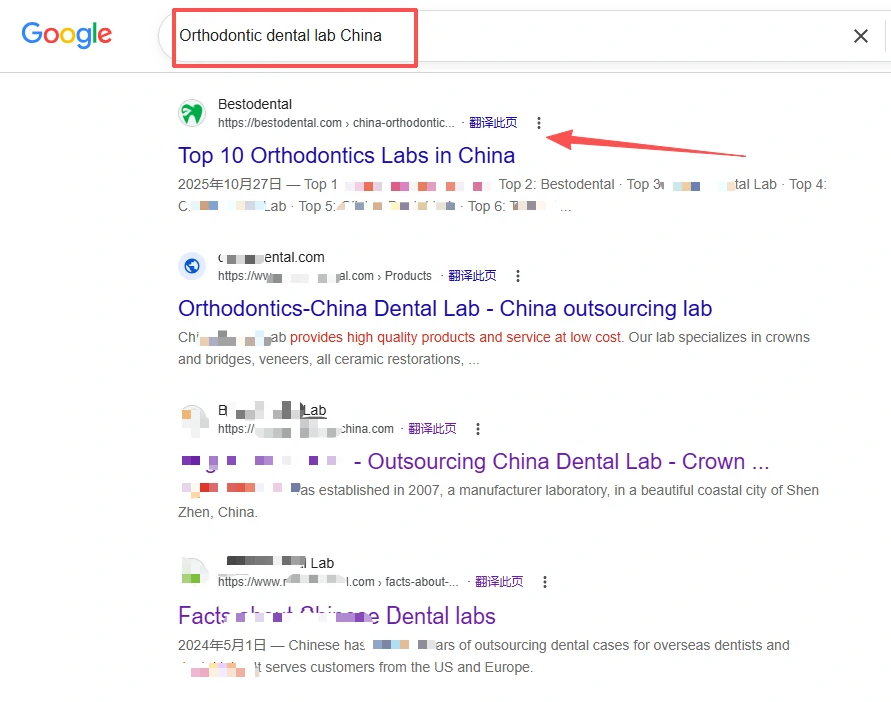
The end result is to not only identify a laboratory that can produce the products but also to identify a long-term partner that will be able to consistently deliver high-quality products and reliable service. If you want to find a reliable outsourcing lab quickly, we have compiled “Top 10 Orthodontics Labs in China” for your reference.
4) Practical Inquiry Email Template for Orthodontic Appliances Outsourcing
Once a new customer locates potential suppliers, he or she has to ask himself the question: How do I write my inquiry e-mail in a way that makes the supplier realize I’m not just a competitor asking for prices?
It is recommended that in your initial e-mail, you clearly state your identity, your country, what you are ordering, your approximate case volume per month, your target product categories and if you are submitting cases using STL files. This will enable the supplier to get a better idea of your cooperation model and offer you a more precise quotation.
Here is a sample inquiry e-mail:
Dear [Name],
We are a dental clinic / dental laboratory based in [Country]. We are currently looking for a reliable overseas orthodontic appliance lab partner.
We are interested in outsourcing the following products:
Clear Aligners
Retainers
Expanders
Functional Appliances
Sleep Apnea Appliances
Occlusal Splints
Sports GuardsAt present, we usually submit cases by STL files / physical models, and our approximate monthly case volume is around [number] cases.
Could you please send us your price list, turnaround time, material options, remake policy, and shipping details for these orthodontic appliances?
We would also like to know whether you support digital case review, custom design requirements, and international shipping to [Country].
Thank you, and we look forward to your reply.
Best regards,
[Your Name]
In the email, it is advisable to provide the following information:
- Your identity: dental clinic, dental laboratory, distributor, or dental service organization;
- Your country
- Estimated monthly number of cases;
- Product categories you are interested in;
- Whether you are dealing with STL files or models;
- Whether you have experience in overseas outsourcing;
- From a price list to turn around, from information about material to remake policy, shipping methods, etc.
If these are explicitly communicated in the initial e-mail, suppliers will be able to more easily grasp the true needs and will supply full quotations and cooperation details. Clear initial communication is one of the key first steps in establishing a helpful long-term flow when it comes to Orthodontic Appliances outsourcing.
6. Orthodontic Appliance Outsourcing FAQs
Here are some frequently asked questions that clinics, dental labs, distributors and orthodontists might have before embarking on orthodontic appliance outsourcing.
1) How do I start outsourcing orthodontic appliances?
A key initial process is:
- Send 1–2 simple cases first
- Check communication and design workflow
- Assess appliance suitability and quality
Avoid start-up of urgent/complex cases.
2) What information should I be sending with a case?
The following information is the most important:
- STL files
- Appliance type
- Upper or lower arch
- Bite record
- Design requirements
- Material preference
- Special notes
- A marked screenshot of the problem, if applicable
Having case information clearly stated allows the lab to expedite the order.
3) What is the best way to communicate design requirements?
Be specific. Do not only write “standard design.” Explicitly indicate:
- Appliance type
- Wearing purpose
- Material thickness
- Trimming line
- Attachments
- IPR details
- Screw position
- Wire design
- Expansion requirements
Using photos that are taken, or marked, is helpful to reduce confusion.
4) Can I obtain a quote without all the information available?
Yes, it is possible to request a rough estimate prior to first contact. But the end price is typically dependent on:
- Appliance type
- Material
- Case complexity
- Order quantity
- Shipping method
A thorough case history enables the lab to carefully develop a quote.
5) What affects the cost of orthodontic outsourcing?
There is more to the cost than just the unit price. There are also some other factors to bear in mind:
- Design service
- Material selection
- Remake risk
- Communication time
- Shipping cost
- Order volume
The lower the price, the longer and more costly it can be if it will result in delays or remakes.
6) What may delay the delivery time?
Common reasons include:
- Incomplete STL files
- Unclear bite records
- Missing design instructions
- Slow confirmation
- Repeated changes
- Production schedule
- Customs or shipping delays
The majority of delays are caused because of the information is unclear, or the feedback is late.
7) How do I ensure good quality when outsourcing?
So that a better quality is guaranteed, you should:
- Send complete scan data
- Complete bite records are provided.
- Give detailed design instructions
- Verify design prior to manufacture
- Check the appliance after delivery
Good case information is the first step in a good result.
7. Conclusion
When you’re thinking of outsourcing orthodontic appliances, it’s not just about selecting the cheapest option. The workflow, material, turnaround, remake requirements vary among different products (Clear Aligners, Retainers, Expanders, Functional Appliances, Sleep Apnea Appliances, Occlusal Splints, and Sports Guards).
In most situations, the key to the success of orthodontic outsourcing requires the clinic to provide complete case information, scan data that is accurate, prescriptions that are clear, and effective communication between the clinic and the lab.
We advise that it is advisable to try a few simple trials cases first and then progress into the more complicated products. As soon as the workflow starts to take a stable form, the outsourcing of orthodontic appliances can be a sure, scalable solution for your dental business and can be cost-effective as well.