BestoDental will give you a thorough rundown of the dental implant restoration outsourcing process, the different dental implant restore types, pricing, ordering processes, post-sale support, risks of remakes, and how to choose the right dental outsourcing lab.
This article will be a useful, hands-on guide if you are considering outsourcing dental restorations or if you want to find a new dental restoration supplier for cases involving implants. It will provide all the information you need to know before you outsource implant crowns, implant bridges, custom abutments, full-arch implant restorations, implant supported hybrid dentures, and implant overdentures.
BestoDental is a service-oriented dental laboratory, therefore all the information provided in this guide is the result of our vast experience in the international dental outsourcing market. There are numerous factors to consider when outsourcing implant restoration. If you find any information in this article that requires correction or further clarification, please feel free to contact us. It will be reviewed speedily and changes will be made as necessary.
1. Common Types of Implant Restorations
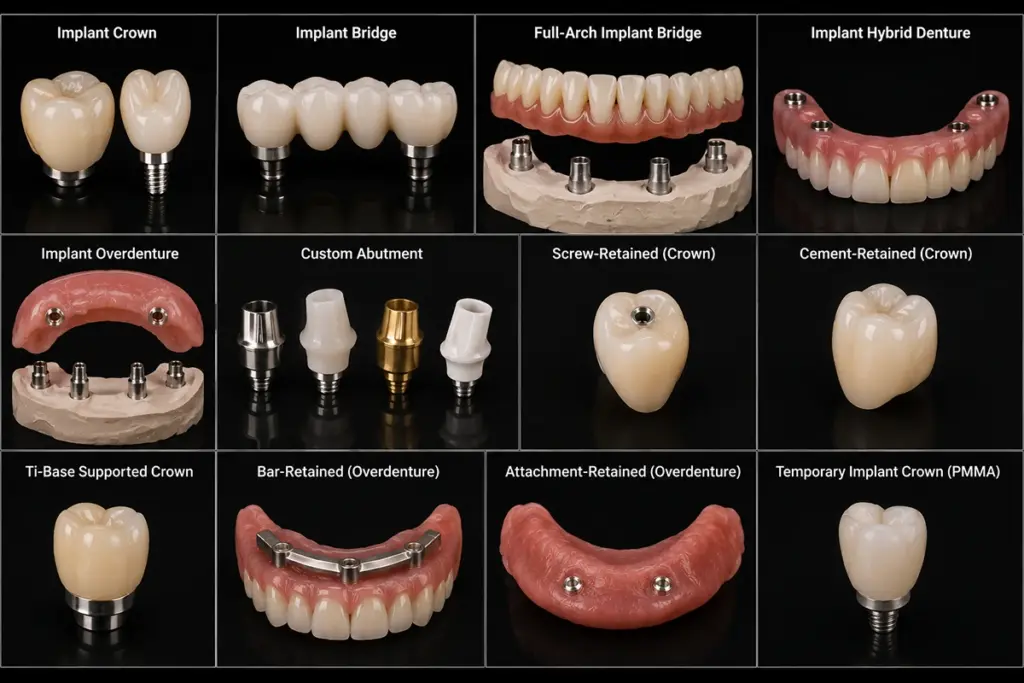
“Implant Restoration” is not a product but a broad term that includes any of the following Implant Restoration Products: It’s a series of implant dental restoration options. Dramatically different design concepts, components, materials and manufacturing processes may be required for different implant cases in actual laboratory production. For instance, an approach in a single implant crown is completely different from that of a full-arch implant bridge. Likewise, custom abutment cases differ significantly from Ti-base restorations or implant overdentures.
China is one of the world’s leading nations for outsourcing dental restoration, having established a complete implant restoration manufacturing system, well-developed digital design workflow, and extensive experience dealing with a variety of implant systems. This allows Chinese dental labs to offer accurate, high-quality and competitively priced implant restorations.
In order to help you understand what is available, we have created the following basic table for your reference on the most common types of implant restorations.
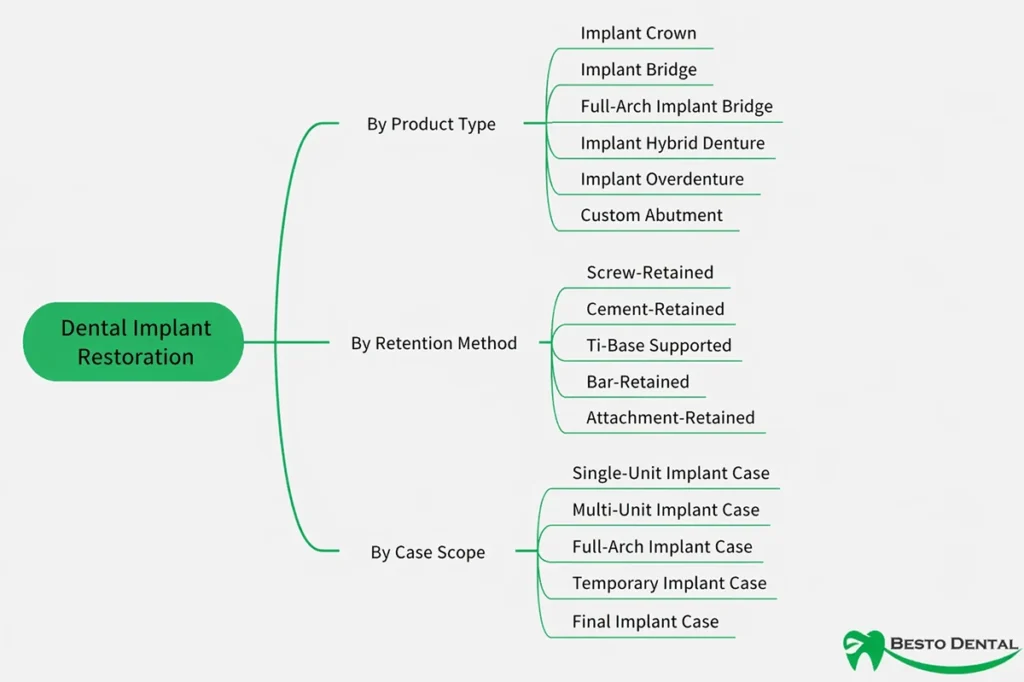
The most popular implant restoration categories for outsourcing are implant crowns, implant bridges, custom abutments and full-arch implant restorations. The most common indications for implant crowns and bridges are the restoration of one or more missing teeth. Custom abutments are designed to improve implant angulation, emergence profile, and support for the final restoration. In partial arch or full implant rehabilitation cases, it is more common to use full-arch implant bridges, implant supported hybrid dentures or implant overdentures.
In the field of dental outsourcing, implant restorations are typically one of the more complicated classifications of restorations when compared to zirconia, PFM and E.max. If you are new to the dental restoration industry, or just starting to consider an implant restoration outsourcing program for the first time, it is essential to understand their pricing and case requirements, as well as the factors to consider for outsourcing. China is one of the world’s leading dental implant restoration outsourcing destinations and has established a well-ripened implant restoration manufacturing system that can ensure the precision, consistency and cost efficiency of the production process.
Through many years of experience serving international outsourcing clients, BestoDental has established a relatively comprehensive workflow for implant restoration outsourcing. This process typically includes case data review, design confirmation, restoration production, pre-shipment quality control photos, and communication support throughout the project. If you are considering outsourcing implant restorations to China, BestoDental has prepared a practical resource titled “BestoDental New Partner Guide”.
This guide is not only suitable for companies and organizations that have not yet started outsourcing dental restorations, but also for dentists and dental laboratories that are already working with local labs and are considering adding an overseas supply chain. You may contact our customer service team to request a copy.
2. Outsourcing Implant Restorations Price
One of the many factors that influence the decision of a clinic or a dental lab to outsource implant restorations is price. But the cost of implant restorations is typically more complicated than that of traditional crowns and bridges.
For a standard zirconia crown, the price is mainly determined by factors such as material, design, production process, and surface finishing. For implant restorations, however, the cost may involve not only the restoration itself, but also implant components, scan body matching, custom abutment design, Ti-base, screws, analogs, 3D printed models, verification jigs, try-in restorations, and framework fabrication.
For instance, the Ti-base and fixation screw is often incorporated into the price quoted for a screw-retained implant crown, whereas other laboratories quote the implant crown only and the screw and base separately. Thus, if you’re requesting multiple quotes from different vendors, you have to consider the price tag and also ensure you’re getting every product and component that you require or else you’ll certainly find yourself having to pay for extra costs later.
BestoDental has researched the common price ranges of implant restoration products across several major markets. Here, we use the basic configuration price of one of the most common implant restoration products, the All-on-4 Full Zirconia Bridge & Ti Base, as an example for comparison with other mainstream markets. The following information is intended to serve as a guideline for dental laboratories and clinics. Please note that because restoration material, implant systems, implant source, implant design, and whether it is a single unit restoration, bridge restoration or full-arch restoration, actual prices may differ. Hence, when comparing prices, it is recommended to check the product configuration and the scope of quotation in detail with the supplier, in order to have a more realistic price estimate.
| Country/Region | Price Range | Currency | Price Type |
| China | 1000-1300 | USD/arch | Outsourced Lab Fee |
| Vietnam | 1000-1200 | USD/arch | Lab Fee |
| India | 900-1000 | USD/arch | Lab Fee |
| Philippines | 1000-1200 | USD/arch | Lab Fee |
| South Korea | 1,500–2200 | USD/arch | Lab Fee |
| Turkey | 1,200–1,700 | USD/arch | Lab Fee |
| Romania | 1,300–1,800 | USD/arch | Lab Fee |
| Germany | 2,000–2,800 | USD/arch | Lab Fee |
| U.K. | 2,000–2,800 | USD/arch | Lab Fee |
| USA | 2,800–3,500 | USD/arch | Lab Fee |
Based on BestoDental’s experience, the most common pricing misunderstanding in implant restoration outsourcing is often not the cost of the restoration itself, but whether the quotation includes the related implant components and additional services.
Therefore, before comparing quotations from different laboratories, it is recommended to confirm the following details:
- Does the price include the Ti-base?
- Does the price include the fixation screw?
- Does the price include the implant analog?
- Does the price include the 3D printed model fee?
- Does the price include the custom abutment design fee?
- Does the price include try-in or verification support for full-arch cases?
- Does the price include shipping?
- If a remake is required due to incorrect implant database, scan body matching, or component information, who will be responsible for the related cost?
Only after these details are clearly confirmed can clinics and dental laboratories truly compare prices between different suppliers, rather than simply comparing the surface-level unit price. BestoDental has compiled a specialized price list for implant restorations. If you are interested, please contact us to “Get Price List“.
3. Information Required for Outsourced Implant Orders
Based on more than ten years of outsourcing experience at BestoDental, if you plan to outsource implant restoration cases, it is best to provide the following information to your supplier at the very beginning. This can help save communication time and reduce unnecessary delays.
1) Case Information
Compared with conventional crowns and bridges, implant restoration outsourcing requires more detailed case information. In addition to the standard information mentioned in related articles for restorations such as zirconia and PFM, implant restorations also involve implant system and component-related data. Without this key information, the case may experience unnecessary delays before it can officially enter the design or production stage.
Implant system, brand, and platform information: The laboratory must clearly understand the implant system, brand, and platform specification being used. Different brands and platforms are usually not directly compatible with each other, so this is one of the most basic pieces of information for implant restoration cases.
a. Connection Type: The connection type of the implant interface should be provided, such as Internal Hex, Conical Connection, etc. The connection type will directly affect restoration design and component matching.
b. Intraoral scan data showing the scan body and master model together: For digital cases, the laboratory needs to confirm whether the scan body matches the actual implant system and ensure that the corresponding CAD database is correct. If there is a mismatch between the scan body, implant system, and database, the restoration may appear correct in the design software but still fail to seat accurately in the final case.
c. Scan body library file or implant database information, if available: If the clinic can provide the implant library file, scan body model, or related database information, it is recommended to submit these together with the case. This not only reduces the laboratory’s confirmation time, but also lowers the risk of matching errors. Therefore, experienced implant restoration laboratories usually proactively confirm the relevant implant system information before formal production.
d. Restoration type: When submitting a case, the required restoration type should be clearly specified. Common implant restoration types include:
- Screw-Retained Implant Crown
- Cement-Retained Implant Crown
- Ti-Base Zirconia Crown
- Custom Abutment with Crown
- Implant Bridge
- Full-Arch Zirconia Bridge
- PMMA Temporary Restoration
- Hybrid Prosthesis
- Implant Overdenture
e. Restoration material: Common implant restoration materials include:
- Zirconia
- PFM
- Titanium
- PMMA
- Acrylic
- Hybrid Restorations
f. Retention method: When submitting a case, the retention method of the restoration should also be clearly specified:
- Screw-Retained
- Cement-Retained
- Custom Abutment + Crown
All of this information will directly affect the laboratory’s design workflow, component selection, and final quotation.
2) Turnaround Time
Implant restorations usually require a longer production time than conventional crowns and bridges because the laboratory needs to perform additional component matching, database confirmation, and design verification.
Generally, the production time for a single implant crown or implant restoration is approximately 7–10 working days, whereas an implant bridge, a full-arch implant restoration, custom abutment or a complex framework case takes longer.
Note that the production time for implant cases should begin not from the date the files are submitted, but from the time all implant information has been verified.
For example, if the laboratory spends two days after receiving the case repeatedly confirming missing implant system information, those two days are actually communication delays rather than normal production time. Many delays in implant restoration cases do not occur during the production stage, but during the initial information confirmation stage. Therefore, we recommend providing complete implant information as much as possible when submitting the case for the first time, in order to reduce unnecessary back-and-forth communication.
Moreover, overseas outsourcing cases: overseas shipping time should also be added for estimating the entire delivery schedule. The actual shipping time is subject to change due to the country or region of origin, the channel of shipping and clearance conditions. Estimated shipping time is suggested to be checked with the supplier beforehand.
At BestoDental, we have tracked international shipping times to different countries and regions over a long period and summarized this information in our New Customer Guide. If you would like to know the estimated shipping time for your region, please feel free to contact us for the relevant information.
3) Warranty
Implant restorations are usually one of the more complex product categories in a dental laboratory’s warranty policy. Unlike traditional crowns, implant restorations involve multiple factors, including the implant system, abutment, screw, restoration design, and clinical installation. Therefore, the warranty scope is usually subject to more conditions and limitations.
Based on BestoDental’s research into dental laboratory warranty policies across several major markets, most laboratories provide a limited warranty of 1–5 years for implant restorations, but the specific terms may vary depending on the laboratory, material, and implant system.
| Country/Region | Public Warranty Coverage | Note |
| China | 1–5 years is more common | Typically addresses only laboratory manufacturing defects. |
| Vietnam | 1–3 years is more common | Most are linked to the warranty for the restorative materials. |
| India | Lack of Unified Standards | Warranty policies vary significantly depending on the supplier. |
| Philippines | 1–3 years is more common | Internal laboratory policies generally take precedence. |
| Türkiye | 1–5 years is more common | High-end products typically offer longer warranties. |
| Europe | 2–5 years is more common | Warranty terms are typically standardized. |
| USA | 1–5 years is more common | Large laboratories typically provide written warranty policies. |
4. Post-Sale Rework in Implant Restorations Outsourcing
Based on BestoDental’s experience, many remake issues in implant restorations are not simply caused by poor milling or production quality. More often, they result from unclear case information before production begins or from key implant-related details not being confirmed in advance.
The most common causes include the following.
1) Inaccurate Case Information
Incorrect implant system or platform: If the implant system, brand, or platform information is inaccurate, the final restoration may not seat correctly. To avoid this situation, clinics or dental laboratories should check whether the provided data is accurate before submitting the case. BestoDental will also reconfirm the implant system, platform, scan body, and database matching before design in order to reduce the risk of remakes later.
Scan body or database mismatch: For new cooperation cases, it is recommended to provide complete scan body information before production begins and confirm whether the implant database matches. If there is an inconsistency between the scan body, implant system, and CAD database, even if the design looks correct in the software, the actual restoration may still fail to seat accurately.
2) Unclear Bite Data
If the bite record is unstable, incomplete, or the relationship between the upper and lower jaws is unclear, the final restoration may require significant adjustment. For a single implant crown, this may affect the contact, occlusion, and screw access channel position. For full-arch implant restorations, an incorrect vertical dimension or bite relationship may lead to more serious problems, and may even require redesigning or remaking the case.
3) Poor Communication
After the case review is completed, the dental laboratory may identify certain information that requires further confirmation. For implant restorations, these questions are usually not limited to tooth position, shade, or material selection. They may also involve details such as the implant system, platform specification, connection type, scan body model, Ti-base matching, screw specification, and restoration retention method.
In this case, the lab will follow up with the clinician or dental laboratory to verify. At this stage, timely and clear communication is very important. Without the key implant information being confirmed, the case may not be able to enter the Design/Production phase and impact the overall delivery schedule.
In addition, once an implant restoration mismatch occurs, the case may require redesigning, remaking, or even reconfirming components. In the case of out-sourcing terms of work, therefore, there should be enough time, not only for the production time of a traditional crown, but also for communication and confirmation.
That is why a well-established implant clinic and dental lab will prefer to deal with implant restoration outsourcing as a partnership and not just sending files and getting the final product. Successful communication, implant system details, implant scan accuracy, and restoration design specifications are all critical factors in minimizing remakes, risk management, and restoration outcome.
5. How to Find the Right Implant Restoration Outsourcing Laboratory?
Because implant restorations are relatively complex cases, they are different from common restoration cases such as zirconia crowns and PFM restorations. Finding a dental laboratory with strong implant restoration capabilities is not easy, especially in regions such as India and Vietnam. In comparison, Chinese dental laboratories have strong price advantages and production capabilities in the implant restoration outsourcing field. Many Chinese laboratories are already able to handle digital cases for common implant systems, including intraoral scan files, scan body matching, CAD database matching, custom abutment design, and Ti-base restorations.
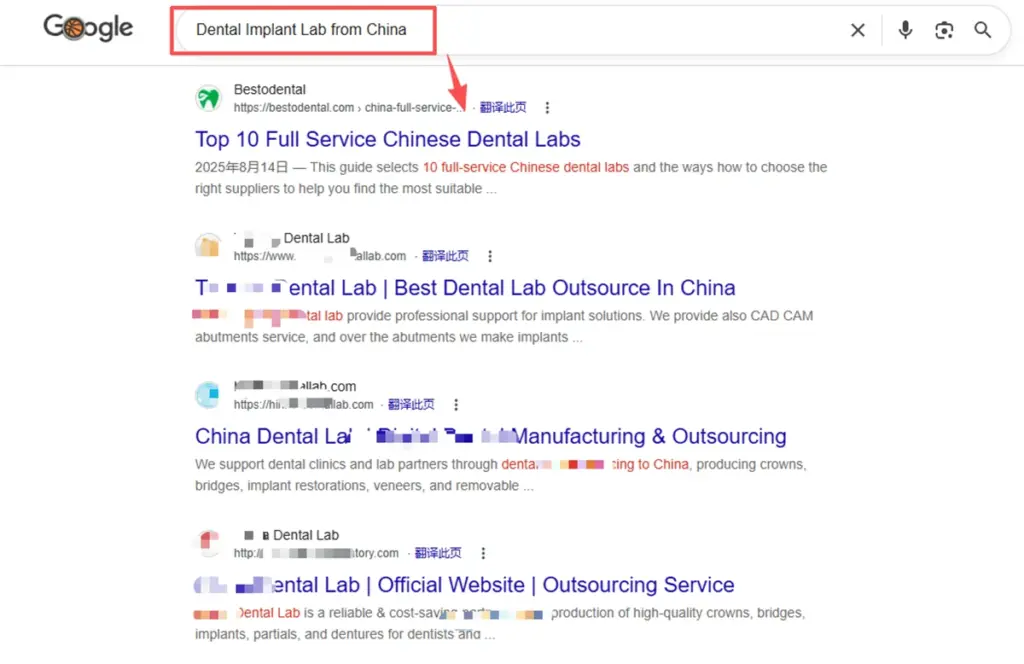
If your clinic or laboratory does not yet have a partner lab, the simplest method is to search online. We often recommend a very practical approach: directly use specific keywords on Google to search for potential partner laboratories. In practice, you can start with one of the following strategies:
1) Search Directly Using Product Keywords
If your target is clear, you can directly search using product-related keywords, such as “Dental Implant” or “implant restorations outsourcing”. This method is very suitable for quickly finding laboratories that specialize in implant restorations.
2) Search Using “Product Keyword + Country/Region Name”
If you have an idea of the country or region you want to target, you can add the country or region name to the product keyword to restrict the search area, e.g. “China dental implant” or “dental implant India”. This approach can help you whittle down your choices and discover the right suppliers in a defined target market in a jiffy.
3) Search Using “Role-Based Keyword + Country/Region Name”
If you have already decided to look for an implant restoration supplier in a specific country or region, combining a role-based keyword with the country or region name can usually produce more accurate results. For example, “Implant Dental Lab China”. You can also further refine the search based on the target market, such as “Implant Dental Lab China Shenzhen” or “Implant Dental Lab California”.
Since implant restoration is a technically demanding and process-intensive restoration category, not every dental laboratory is capable of handling implant cases. Therefore, when searching for implant restoration outsourcing suppliers, the “Search Directly Using Role-Based Keywords” method mentioned earlier in this article is often less suitable for this field.
Compared with searching for general crown or denture suppliers, it is more advisable to include the core word “implant” in your search keywords. This allows you to quickly filter laboratories with implant restoration experience, familiarity with implant systems, and digital workflow capabilities, thereby improving the efficiency of finding the right supplier.
Below is a sample reference table:
| Product Keywords | Product Keyword + Country Name((Replaceable with different target countries)) | Identity + Country/Region |
| Dental Implants | China Dental Implants | Implant Dental Lab China |
| Implants Restorations Outsourcing | dental implant India | Implant Dental Lab China Shenzhen |
| Implants Bridge | Implants Bridge China | Implant Dental Lab California |
| Implant Crown | implant restorations China | implant restorations outsourcing lab India |
Compared with other manufacturing industries, dental laboratories usually do not rely entirely on trade shows to acquire international customers. In fact, for clinics or dental laboratories, a simple Google search is often one of the fastest ways to find potential outsourcing suppliers.
As you begin to do your research, you will notice that many dental laboratory sites have their implant restorations, digital workflow, turnaround time, material options and real case examples. The data can help you make a preliminary decision if a lab can take the case of implant restoration.
But locating a lab online is the first step. Many dentists will also ask peers for recommendations and/or search for laboratories that built a good reputation in the industry.
Dental fora, dental societies, peers, and industry network groups may have discussion areas for individuals to share their experiences with outsourcing labs. Compared with judging only based on the information presented on a supplier’s website, learning from dentists who have actual outsourcing experience is usually more reliable.
If you are considering outsourcing implant restoration cases to China, we have also prepared an article titled “Top 10 Dental Implant Labs in China”, which lists several representative implant restoration laboratories in the Chinese market. We hope this list can help you screen suppliers more efficiently and find a partner that better fits your case requirements.
4) Practical Inquiry Email Template for Implant Outsourcing
Of course, after identifying potential suppliers, many beginners in outsourcing often face a more practical challenge: how should I write an inquiry email so that the recipient sees me as a genuine potential customer, rather than simply as a competitor asking for prices?
To address this issue, BestoDental has compiled a series of practical inquiry templates for zirconia restorations. These templates have proven to be very effective in obtaining replies during real communication and are provided here for your reference.
Dear [Name],
We are a dental clinic based in the United States, currently handling approximately 200 cases per month. We are now looking for a suitable international dental laboratory partner for implant restoration cases and are interested in learning more about your implant restoration products and services. At present, we are not working with any overseas dental laboratory, and we typically submit cases through STL files as part of our digital workflow.
We would like to know whether your laboratory can support implant restoration outsourcing. Could you please provide a price list for the following products and services for our review?
- Single screw-retained implant crowns
- Ti-Base zirconia implant crowns
- Custom abutment with crown
- Implant bridges
- Full-arch zirconia implant restorations
- PMMA implant temporary restorations
In addition, please let us know whether your prices include Ti-Bases, screws, analogs, printed models, and other implant components, or whether these items are charged separately.
We look forward to your reply. Thank you.
Best regards,
[Your Name]
Ideally, all of these key points should be clearly explained in your first inquiry email:
- Your business type — whether you are a dental laboratory, dental clinic, or dental service organization;
- The approximate number of cases you handle each month;
- The specific product categories you are currently interested in;
- Whether you have already worked with other overseas dental laboratories;
- And whether you prefer to submit cases through STL files or physical models.
For suppliers, this information helps them quickly evaluate your professional background, business model, and cooperation intent. If a supplier can immediately tell from your email that you are an industry professional and that you have a clear understanding of the cooperation process, they are usually more willing to reply and provide a price list. As a result, your chances of receiving an effective response will be much higher.
6. Dental Implant Restoration Outsourcing FAQs
Q1: Is it safe to outsource dental implant restorations overseas?
Yes, implant restorations can be outsourced overseas when the lab has experience with implant systems, digital workflows, component matching, and quality control.
The key is not only production ability. The lab must also review implant information carefully before production. For implant cases, safety and reliability depend on accurate data, correct library matching, suitable components, and clear communication.
Q2: What is the biggest risk in implant restoration outsourcing?
The main danger is often simply the wrong information or incomplete information about the implant. If the implant system/platform, scan body, or CAD library are incorrect, the restoration may not fit. It is more serious than a shade problem, such as it may impact seating, screw access, and clinical usability.
Q3: Are implant crowns more difficult to outsource than regular crowns?
Yes. Implant crowns require additional information, such as implant system, platform, scan body, component type, screw access position, and retention method.
A regular crown mainly depends on tooth preparation and margin. An implant crown depends on both prosthetic design and implant component compatibility.
Q5: Can a lab make implant restorations if I only send STL files?
Sometimes yes, but STL files alone may not be enough. Other information that the lab requires for an implant case would be implant system, platform, scan body, bite information, opposing arch, and restoration instructions. The lack of this information will make it impossible for the lab to match the right implant library.
Q6: What should I prepare for a full-arch implant case?
For full-arch implant cases, you should prepare as much information as possible. Useful records include upper and lower scans, bite record, implant system information, scan body data, facial photos, smile photos, shade requirements, vertical dimension notes, existing denture reference, and clinical instructions.
A full-arch case should not be treated like a simple crown order.
Q7: How long does implant restoration outsourcing take?
Simple implant crowns may be completed within several working days after all information is confirmed. Custom abutments, implant bridges, and full-arch cases usually take longer. Some labs list implant or hybrid denture turnaround around 10 business days, while more complex implant frameworks may require additional time. International shipping should also be added to the total timeline.
Q8: How should I start if I have never outsourced implant restorations before?
Start with a simple case. A posterior implant crown or a single custom abutment case is usually a better first trial than a full-arch restoration. This allows you to test communication, file review, design accuracy, component policy, turnaround time, and shipping before sending complex cases.
7. Conclusion
Dental implant restoration outsourcing can help clinics and laboratories reduce production pressure, expand product capability, and control costs. However, implant cases require more technical communication than standard crown and bridge cases. The most important issue is not only whether a lab can make an implant crown. It is whether the lab can correctly understand implant systems, scan bodies, CAD libraries, components, retention methods, restorative space, and remake responsibility.
At BestoDental, we believe successful implant restoration outsourcing depends on three things: clear case information, careful technical review, and stable long-term communication. A low price may help you start a trial order, but reliable cooperation depends on whether the lab can prevent mistakes before production begins.