A zirconia bridge for your posterior teeth patients is required. When sending your case to the lab, the lab requests to know if you want a monolithic zirconia bridge or a multilayer zirconia bridge and you are not quite sure about the differences between the two.
This guide is all about explaining to you what a monolithic zirconia bridge is, how strong are different generations of zirconia, scan-to-finish procedure, and where are the cases suitable for monolithic zirconia bridges.
By the end, you will be able to distinguish the appropriate type of zirconia for the specific bridge span and position, the sequence of actions from the STL file to the completed restoration, and what types of clinical cases are easy to deal with and those that need more preparation before designing.
1. What Is a Monolithic Zirconia Bridge?
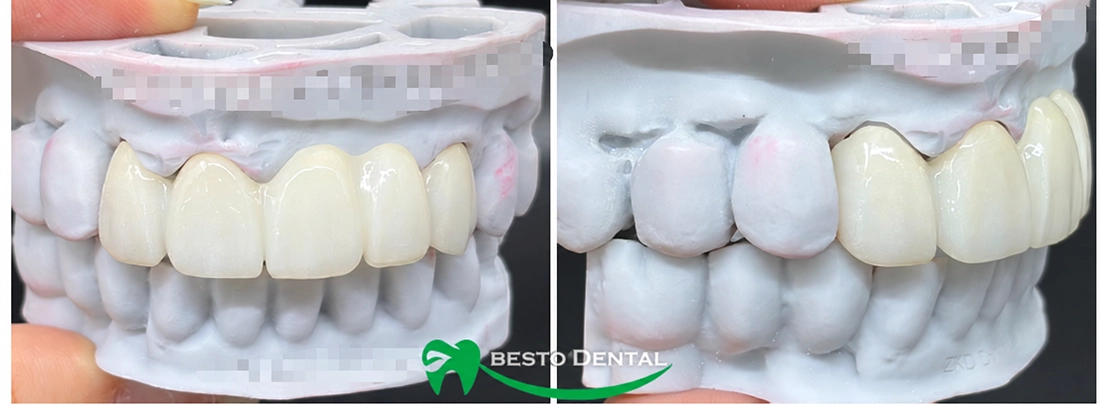
A monolithic zirconia bridge is a fixed restoration that is created from a single, solid piece of Zirconia, from the connectors to the pontic to the occlusal surface. No layering, no veneering ceramic, no separation of materials.
In actuality, the dentist prepares the abutment teeth, makes a digital scan of the arch or takes an impression in a conventional way, and then sends it to the lab. The lab will design the whole bridge, mill the material which is pre-sintered on a zirconia disc, and sinter it to its maximum density. The structural support, along with its visible surface, is provided by the material itself.
The key benefits of monolithic zirconia bridges are :
- No veneering ceramic to chip: The most common complication with zirconia bridges has always been chipping or fracture of the veneering porcelain. There is no porcelain layer in a monolithic bridge, thus eliminating that interface. Clinical data have always demonstrated that there are far fewer technical complications with monolithic designs than veneered designs.
- High fracture resistance: as the whole restoration is one material, there is no weak bond line between framework and veneer. The flexural strength values of the zirconia itself contribute to fracture resistance.
- Fewer steps in fabrication: A full-contour bridge is milled from one disc, eliminating the process of veneering. No layering, no porcelain build-up, no additional firing cycles. That will not only speed up the turnaround time but will also minimize the risk of human error during the aesthetic layering process.
- Minimal chairside manipulation: No underlying framework will be exposed with the monolithic zirconia, as it can be manipulated and polished intraorally. The occlusal adjustments in veneered restorations may weaken the restoration by going through the porcelain layer.
- Appropriate for limited occlusal space: The material itself is both structure and surface, so there is no need for space that will be used for a veneer. This is the reason why monolithic bridges are a viable choice when interocclusal distance is limited.
- Harmonious wear properties: Monolithic zirconia generally has good wear properties against opposing enamel, as compared to other ceramic materials. Can be polished to form a smooth surface to reduce abrasive wear on opposing dentition.
In reality, monolithic zirconia bridges are mainly applied for posterior tooth replacement (strength and function) and full-arch implant-supported restorations. They are also ideal for patients who have bruxism and heavy occlusal forces. Aesthetic indications have increased with better translucency grades, but posterior cases continue to be the primary indication.
2. Strength of Monolithic Zirconia Bridge
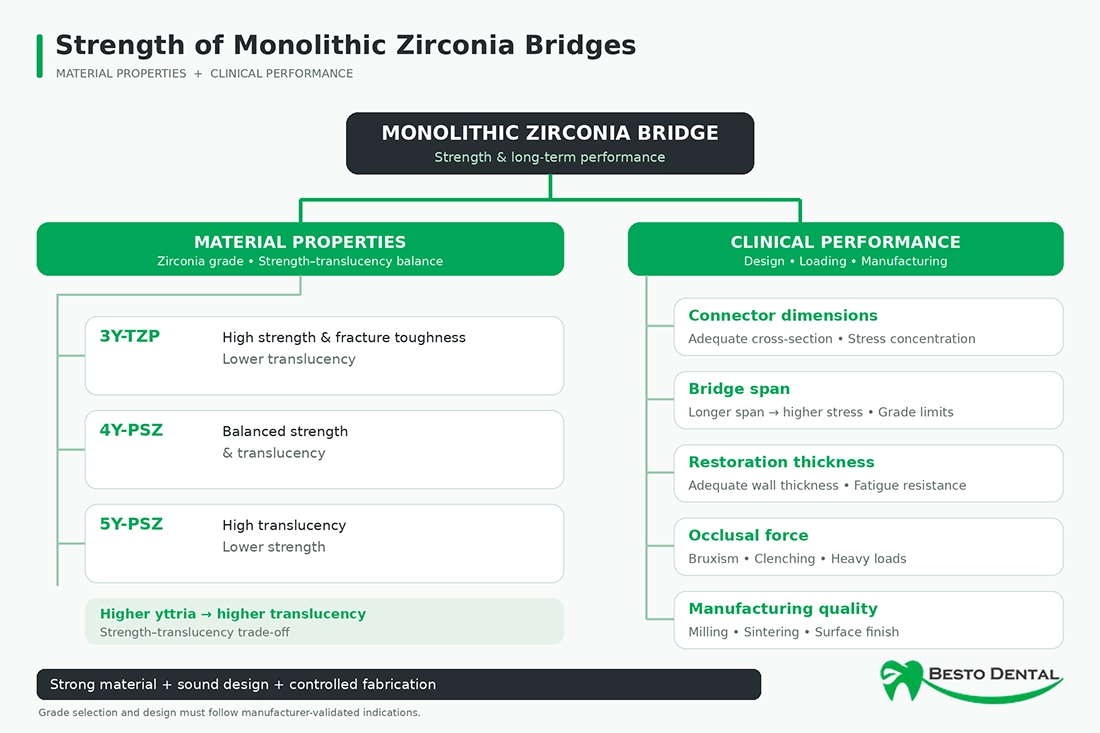
The strength of zirconia is its main attribute; this is the main reason why it can be applied to posterior teeth. The following are the details regarding the strength.
| Zirconia Type | Flexural Strength (Reference Range) | Key Characteristics |
|---|---|---|
| 3Y-TZP | 900–1,200 MPa | High strength, high fracture toughness, lower translucency |
| 4Y-PSZ | 600–900 MPa | Balanced strength and translucency |
| 5Y-PSZ | 500–700 MPa | High translucency, lower strength |
Generally, as the proportion of the cubic phase in zirconia materials increases, light transmission improves, while flexural strength and fracture toughness tend to decrease.
The strength of a monolithic zirconia bridge is influenced by the following factors:
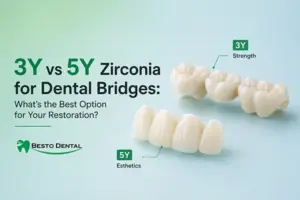
- Zirconia Material: Options include 3Y, 4Y, and 5Y zirconia. For more details, please refer to our other article: 3Y vs. 5Y Zirconia for Dental Bridges.
- Connector Dimensions: Larger dimensions result in greater flexural strength.
- Bridge Span: A longer span increases the stress placed on the bridge (e.g., comparing a three-unit bridge to a six-unit bridge).
- Restoration Thickness: Reduced thickness leads to lower strength. Consequently, if BestoDental identifies insufficient tooth preparation, resulting in inadequate space for the restoratio. We will advise the dentist to perform further preparation.
- Occlusal Force: Conditions such as bruxism (teeth grinding) or abnormal occlusal contacts increase the stress exerted on the bridge.
- Manufacturing Quality: The overall quality of the restoration’s fabrication is also a contributing factor.
3. Fabrication Process of Monolithic Zirconia Bridges
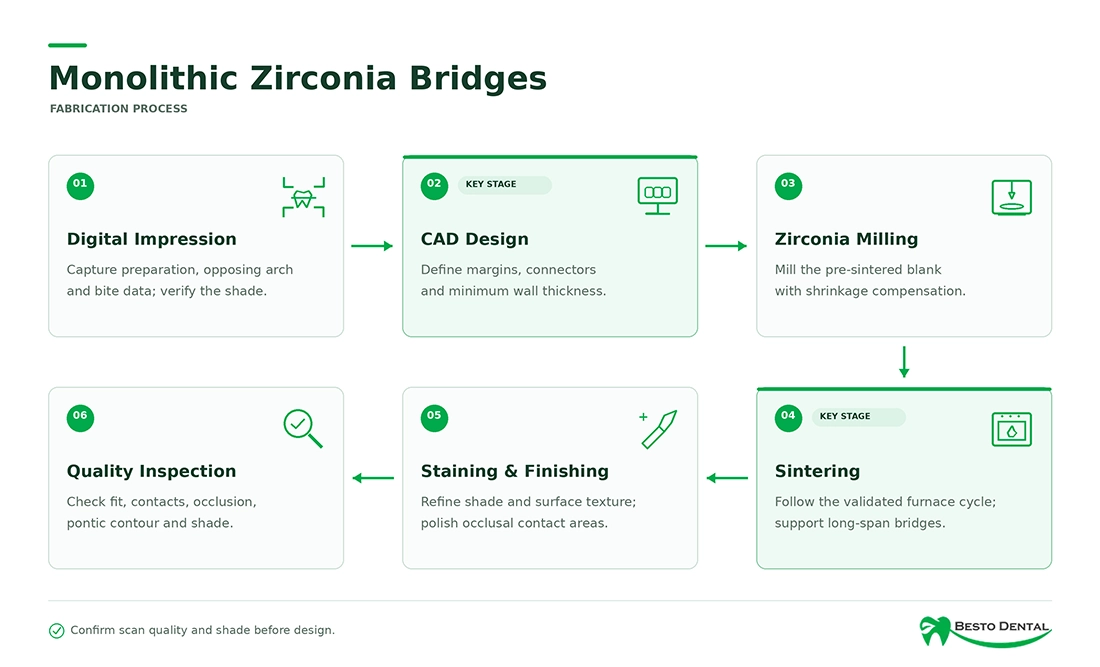
All monolithic zirconia bridges are designed digitally and end as a completed and sintered piece of zirconia. The general process is outlined as follows:
| Stage | What Happens | What to Keep in Mind |
|---|---|---|
| Digital Impression / Model Scanning | Have an intraoral scan STL or physical model scan; capture preparation arch and opposing bite data | Scan quality and margin definition determine downstream; retraction and moisture control most critical |
| CAD Design | Margins, connectors, shape of bridge, proximal contacts, occlusion, overall shape of bridge: designed in CAD software | Connector dimensions and minimum wall thickness set here; main source of design-related failures |
| Zirconia Milling | CAD/CAM milling from pre-sintered zirconia disc | Approx. 25% enlargement to compensate sintering shrinkage; exact value depends on blank |
| Sintering | Furnace sintering per manufacturer’s specified program; achieve full density | Heating rate, peak temperature, hold time, cooling rate follow manufacturer’s validated protocol; large-span bridges with support structure to prevent distortion |
| Staining & Glazing / Polishing | Stain for color if needed; refine surface texture; polish or glaze | Pre-shaded/white blanks: stain before sintering; surface character: stain after sintering; occlusal contact areas: polishing preferred over glazing |
| Quality Inspection | Check margin fit, proximal contacts, occlusion, pontic contour, color, surface quality | Visual + physical check, not a formality; poor margin fit = poor performance regardless of material strength |
However, the most frequently occurring issue in the clinical setting is the lack of information. In case the scanned information was not complete or there is no clear understanding of what the production requirements are, the whole bridge needs to be re-made, causing additional costs and delays for everyone involved. Properly verifying these factors prior to the production process will, in most cases, eliminate the need for remaking.
4. Clinical Indications for Monolithic Zirconia Bridges
Monolithic zirconia bridges are primarily used for posterior tooth replacement in the cases we’re dealing with, but the material may be appropriate for different applications based on the situation, the number of unit span, and the occlusal forces that the patient presents. In the table below, we have listed some common clinical applications.
| Specific Clinical Situation | How the Product Is Used | Main Considerations |
|---|---|---|
| Posterior missing teeth | A bridge replaces one or more missing teeth with a fixed restoration supported by the abutment teeth adjacent to the lost tooth (or teeth) | The main indication for monolithic zirconia is for posterior applications; strength is key, aesthetics are secondary |
| Anterior missing teeth | It can be used in the anterior area as a monolithic bridge, usually using a higher translucency grade zirconia | There is a need for more attention to translucency, shade matching, and gingival aesthetics; not all anterior cases are good candidates for monolithic design |
| Limited occlusal space | The monolithic design does not need extra space for an interocclusal veneering layer, which can be used in situations in which there is a smaller interocclusal distance | There are still minimum thickness requirements; the preparation must be thick enough for the required wall thickness for the zirconia |
| Bruxism | Patients with heavy occlusal forces can reasonably be given high strength monolithic zirconia | An occlusal scheme should be assessed; at the very least, a night guard may be advised for protection |
| Long-span restoration | Some grades of high-strength zirconia are validated for longer spans; however, the span and connector requirements will need to be confirmed with the manufacturer’s indications | The longer the spans, the greater the stress on connectors; connectors must be of the same material grade and size as the span length |
| Implant-supported restoration | For implant supported bridges, such as partial and full arch, monolithic zirconia can be utilized | The bridge design is influenced by the implant system, the type of abutment, and the retention type; screw access holes must be considered already in the CAD phase |
Indications also differ greatly from product to product. For instance, Ivoclar’s IPS e.max ZirCAD Prime can be used for bridges of up to 14 units, while Prime Esthetic is primarily designed for crowns and three-unit bridges.
5. Differences Between Monolithic Zirconia Bridges and Veneered Zirconia Bridges
When using zirconia bridges in the clinical practice, it is necessary to understand the two different categories of zirconia bridges: a veneered zirconia bridge and a monolithic zirconia bridge. Monolithic zirconia bridge is a one-piece construction made of zirconia only. Veneered zirconia bridge comprises of a zirconia substructure (coping) with a veneer of porcelain. This distinction will help you to make a proper choice for your patient.
The table below outlines the key differences:
| Comparison Item | Veneered Zirconia Bridge |
|---|---|
| Basic Structure | Zirconia framework + veneering porcelain |
| Aesthetic Effect | Can achieve richer optical effects through layered veneering |
| Chipping Risk | Veneering porcelain may chip |
| Strength Performance | Depends on the framework and veneering porcelain structure |
| Common Applications | Anterior bridges with high aesthetic demands |
| Fabrication Process | Requires an additional veneering process |
6. Monolithic Zirconia Bridge FAQs
Based on our years of dental lab experience with the Monolithic Zirconia Bridge, here are some of the questions users ask us most often, along with our answers. We hope this can serve as a helpful reference for you.
1) Is higher strength always better for a zirconia bridge?
Not necessarily. Selecting a material for a dental bridge requires balancing several factors:
- Strength: Whether the material possesses sufficient flexural strength.
- Translucency: Whether it meets aesthetic requirements.
- Fracture Toughness: Whether it offers adequate resistance to crack propagation.
- Clinical Indications: Whether the manufacturer approves the material for use in a bridge of a specific span and location.
For instance, a three-unit anterior bridge may fit well into a highly translucent zirconia (if it satisfies the clinical indications) while a long-span posterior bridge will require a version of zirconia which is high-strength and high-fracture-toughness.
2) How do I know if my case is suitable for a monolithic bridge versus a veneered one?
The big issue is whether you require the esthetic, layered look that veneering porcelain offers.
When a bridge is in the posterior area, and function and durability are the patient’s priority, monolithic is almost always superior. A veneered bridge may be the best option for getting a more predictable esthetic result if the bridge is in the anterior zone and the patient has high esthetic needs. Veneered bridges, however, have a greater likelihood of chipping, and that must be taken into account when considering the beauty.
3) Can monolithic zirconia bridges be repaired if they chip or break?
When the zirconia is monolithic, it is very difficult to repair it intraorally. No veneering ceramic to bond to, and special surface treatment is required for bonding zirconia. In most circumstances, the broken monolithic bridge must be remade. That is why the design is so crucial the first time; there is not a whole lot of room for correction once the restoration is in place.
4) How does the fabrication process differ for implant-supported monolithic bridges?
The core workflow is the same, but there are additional steps. The implant positions need to be captured accurately, either through scan bodies or a conventional impression with implant transfers. The CAD design has to incorporate the screw access holes if the bridge is screw-retained, or the appropriate abutment interface if it is cement-retained. The fit of the bridge to the implant platform is a critical quality control point that does not exist in tooth-supported cases.
5) What should I check before sending a case to the lab for a monolithic zirconia bridge?
Make sure the scan data is complete, and the margins are clearly visible. Verify the colour choice and characterisation wishes. Determine zirconia type. For an implant-supported case, validate the implant system and library. These details may seem minor, but they could make or break a case and the remake.
7. Conclusion
The monolithic zirconia bridge is the most common type of dental bridge restoration. Drawing on the practical laboratory experience of BestoDental, this article discusses its definition, advantages, strength, fabrication process, and clinical applications, while also highlighting the differences between monolithic and veneered zirconia bridges, information intended to help you make informed decisions when outsourcing zirconia bridge requirements. We are more than just a dental lab that fabricates prosthetics, we also help you establish a reliable channel for outsourcing monolithic zirconia bridges to China.