When planning a zirconia dental bridge, how should you design the bridge span based on the number and position of missing teeth? How should you consider abutment support, occlusal load, esthetic requirements, and the available restorative space? When outsourcing the case to a dental laboratory, how should you communicate your fabrication requirements to achieve the best possible restorative result? These may all be questions you encounter in practice.
In this guide, BestoDental will provide a detailed introduction to the main types of zirconia dental bridges, commonly used materials, structural designs, and clinical applications, helping you gain a more comprehensive understanding of the available options when planning and outsourcing zirconia bridge cases.
1. What are Zirconia Dental Bridges?
A Zirconia Dental Bridge is a fixed dental bridge that uses zirconia as its primary structural material to replace one or more missing teeth. It can be supported by natural teeth or by dental implants.
The following is a description of how it works. The adjacent teeth are prepared, and the bridge is then cemented or bonded in place. The artificial teeth are hanging between the supporting crowns, filling in the space between the bridge. A zirconia bridge is non-removable and is cleaned like your natural teeth.
The distinguishing feature of zirconia from other materials used in bridges is its behavior when stressed. A crack is prevented from opening up due to the crystal structure of zirconia, which changes as the crack is trying to form. This is one reason why zirconia bridges can be thinner than PFM bridges without compromising the strength of the dental bridge.
The main advantages of zirconia dental bridges are:
- Superior fracture resistance: Zirconia has increased crack resistance due to a transformation toughening mechanism when compared to traditional dental ceramics. This is important particularly in the back portion where chewing forces are greatest.
- Esthetics without a metal substructure: Esthetics without a metal substructure: There is no dark metal line at the gum margin, which is a common issue with porcelain fused to metal bridges over time. High-translucent zirconia formulations also allow light to pass through much like natural enamel.
- Oral tissue compatibility: Zirconia is biocompatible and can be used in patients with metal sensitivities.
- Slimmer connector design: Due to the flexural strength of zirconia, more conservative connector dimensions are possible, supporting a naturally curved gingival contour and good tissue adaptation.
- Digital workflow compatibility: CAD/CAM technology is used to plan, design, and mill a zirconia bridge before any material is cut, and therefore can be planned digitally.
- Single material for framework and surface: With monolithic zirconia bridges, there is no porcelain layering that can chip or fracture. The entire restoration is one material.
In clinical practice, zirconia bridges are most frequently employed in posterior positioning, multi-unit restorations, and implant-supported restorations, where strength and longevity are paramount. They are also used more and more in the anterior area if high-translucency zirconia is chosen for its optical properties.
2. Structure of Zirconia Dental Bridges
Zirconia bridges have three structural components.
- Retainer / Abutment Crown
- Pontic
- Connector
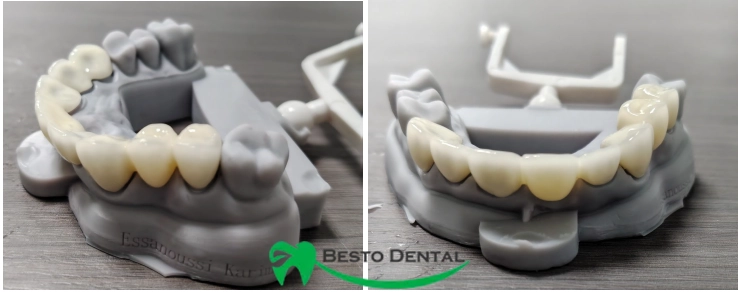
The retainer (abutment crown) covers the prepared supporting tooth. The space is filled with the artificial tooth called the pontic. All parts of the retainer are attached to the connector, which is where the retainer attaches to the pontic. In this scenario for instance, #23 and #26 are the abutment teeth, while #24 and #25 are the missing teeth, the bridge structure would be: #23 Retainer – #24 Pontic – #25 Pontic – #26 Retainer. (You can refer to the actual product image above for a clearer understanding.)
These three components should be viewed as one continuous framework rather than as separate crowns; the table below outlines the function of each component and important considerations prior to design.
| Item | Definition | Clinical Applications |
|---|---|---|
| Retainer / Abutment Crown | The crown that fits over the prepared abutment tooth | Foundation for support and retention of the bridge; its fit, position, and the condition of the abutment tooth determine overall support and force transfer; the number, alignment, and periodontal support of the abutments affect the structural path of the bridge. |
| Pontic | A tooth-like structure made of artificial material to replace the missing tooth | Restores form, function, and appearance; does not directly support the edentulous ridge; it is supported by the retainers via the connectors; must balance occlusion, aesthetics, and soft tissue health; in the anterior region, it must look natural and doesn’t have to be too thick in the interproximal areas; in the posterior region, it must be able to withstand more occlusal loads and be easy to clean. |
| Connector | The part that joins the retainer to the pontic and connects adjacent pontics | It is in the interproximal area and acts as a structural connection between units, makes the entire bridge a rigid unit, transfers occlusal forces, and also fills interproximal space; therefore, it is compatible with periodontal health, cleaning access, and anterior aesthetics. |
3. Types of Zirconia Dental Bridges
In the cases we handle, zirconia bridges are classified in two main ways: by the material configuration of the restoration itself, and by how the bridge is supported and retained clinically. The classification by material configuration is based on how the zirconia is used within the restoration. The main types are:
| Type | Main Characteristics | What to Keep in Mind |
|---|---|---|
| Full Contour Zirconia Bridge | The entire restoration, including the visible tooth surface, is milled from zirconia. No porcelain layering. | Highest strength. Ideal for posterior spans, implant-supported bridges and bruxism patients. The esthetics are all good but not as easy to layer. |
| Layered Zirconia Bridge | A zirconia substructure provides strength, with porcelain layered on top for esthetics. | Excellent shade matching and characterisation – particularly anterior. Needs increased interocclusal space and has a slight risk of porcelain chipping. |
Among the different options, full-contour monolithic zirconia is the most popular choice for posterior bridges and implant restorations, as it does not have the risk of porcelain chipping. Layered zirconia is better when the case calls for the degree of esthetic detail that monolithic zirconia can’t provide, such as multi-unit anterior bridges that require shade matching across multiple units.
Sometimes a hybrid approach is employed: full contour zirconia for the posterior portion of a bridge and a cut back with porcelain layering for the anterior portion, thus combining the best of both worlds in one bridge restoration.
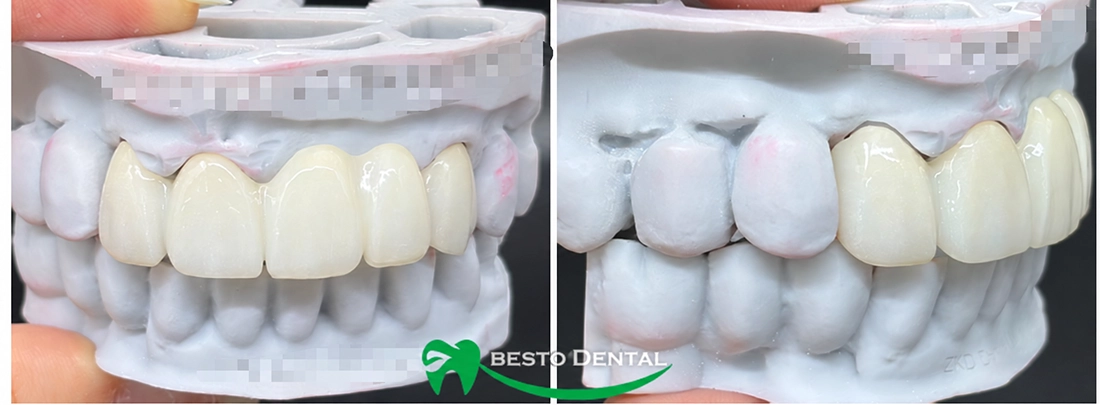
The classification by support and retention is based on what holds the bridge in place and how the span is structured. The main types are:
| Type | Main Characteristics | What to Keep in Mind |
|---|---|---|
| Natural Tooth-Supported Bridge | Retainers are cemented onto prepared natural teeth on one or both sides of the gap. | The most traditional approach. Requires adequate crown height and healthy abutment teeth. |
| Implant-Supported Bridge | The bridge is screwed or cemented onto dental implants placed in the edentulous area. | Used when multiple adjacent teeth are missing or when the abutment teeth are not suitable. Requires sufficient bone volume for implant placement. |
| Conventional Fixed Bridge | Retainers on both ends of the span, with pontics in between. | The most common configuration. Distributes load across two abutments. |
| Cantilever Bridge | A retainer on one side only, with the pontic extending beyond it. | Used when only one suitable abutment tooth is available next to the gap. The cantilever design places more stress on the single abutment. |
| Short Span Bridge (3-unit) | One pontic supported by two retainers, or a single retainer in cantilever design. | The most predictable configuration for zirconia. Well-supported by clinical evidence. |
| Long-Span / Multi-Unit Bridge | Four or more units, with multiple pontics between retainers. | Connector design becomes critical. 3Y zirconia is usually preferred for its higher strength. |
| Full-Arch Bridge | Replaces all teeth in one arch, supported by multiple implants. | A complete rehabilitation. Requires careful planning of implant positions and load distribution. |
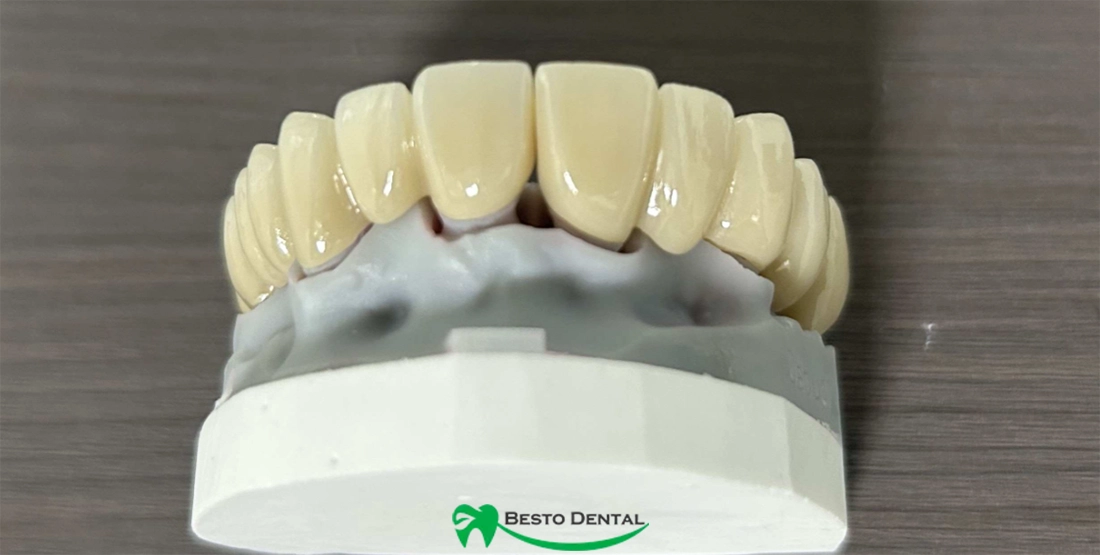
4. Materials For Zirconia Dental Bridges
There are three types of zirconia for dental bridges: 3Y Zirconia, 4Y Zirconia, 5Y Zirconia. Each has a different grade of yttria stabilizer in the material. The amount of yttria is what dictates the strength-to-translucency ratio and corresponds to the clinical cases a particular grade of zirconia can safely perform.
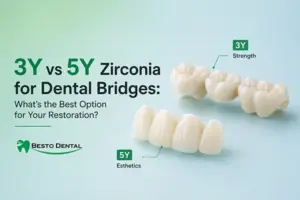
We have written a dedicated article: “3Y vs 5Y Zirconia for Dental Bridges: What’s the Best Option for Your Restoration?” about dental bridge materials; you can read it to learn more important information about dental bridges.
BestoDental fabricates a dental bridge case almost every day, and we suggest choosing 3Y for long-span posterior bridges, implant-supported multi-unit bridges, and bruxism cases. Consider 4Y for anterior 3-unit and short-span posterior bridges with esthetic considerations, but strength requirements are paramount. Consider using 5Y only in single-unit or very short-span anterior restorations where translucency is the most important property, and be mindful of its limitations in load-bearing restorations.
In practice, however, few people specify the materials in such minute detail; generally, they simply refer to them as monolithic zirconia bridges or layered zirconia bridges.
5. Zirconia Dental Bridge Fabrication Process
A zirconia bridge is fabricated using a digital workflow from the clinical impression to the final, verified restoration. Here is the complete sequence:
| Stage | What Happens | What to Keep in Mind |
|---|---|---|
| Impression / Scan | A conventional impression or intraoral scan captures the prepared teeth, the edentulous area, and the opposing arch. | Intraoral scanners have limitations for bridge restorations and may only be suitable for short-span cases. Conventional impressions are still preferred for long-span or implant-supported bridges. |
| Bite Registration | The relationship between the upper and lower arches is recorded and transferred to the laboratory. | An inaccurate bite registration will produce a bridge with occlusal interferences, requiring adjustments or remakes. |
| Case Assessment | The technician evaluates the scan data, checks preparation quality, identifies the margin locations, and determines the design approach. | This is the point where any missing information, such as shade selection or special contour requests, needs to be confirmed before design begins. |
| CAD Design | The bridge is designed digitally, including the framework, connector dimensions, pontic shape, and occlusion. | Connector cross-section must be planned according to the span length and location. Insufficient connector dimensions are a common cause of fracture. |
| Zirconia Milling | The design is transferred to a milling machine, and the bridge is cut from a pre-sintered zirconia blank. | Pre-sintered zirconia is in a chalk-like state and must be handled carefully. Milling accuracy affects the final fit after sintering. |
| Sintering | The milled bridge is sintered at high temperature, during which the zirconia densifies and shrinks to its final dimensions. | Sintering shrinkage is approximately 20 to 25%. The milling must account for this. Sintering parameters affect strength, translucency, and shade. |
| Staining / Glazing / Layering | The sintered bridge is characterized with stains, glazed for surface finish, or layered with porcelain if a layered design is used. | Shade matching in multi-unit anterior bridges requires careful layering techniques. A flat shade application will look artificial next to natural teeth. |
| Fit and Occlusion Check | The finished bridge is checked on the model for marginal fit and occlusal contacts. | Marginal gaps above clinical tolerance will lead to cement washout and recurrent decay. |
| Final Quality Check | Dimensions, surface finish, color, connector integrity, and pontic contours, etc., are verified before shipping. | This is not a formality. Connector cracks or marginal irregularities that escape this check will cause problems at try-in. |
When submitting case information for zirconia dental bridges, the dental lab requires the most complete details possible; for instance, if the tooth shade has not been confirmed or there are questions regarding the pontic position, we will contact the client for clarification before proceeding with fabrication. In some cases, professional clients specify the pontic position for us.
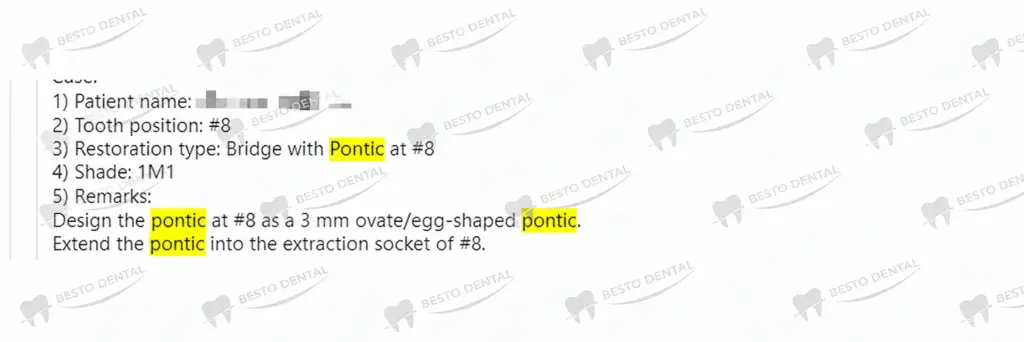
In addition, some clinicians who care about anterior bridge esthetics specifically request that the interproximal area between pontics not be too thick, too square, or overly closed. There should be reasonable space for the gingival papilla and for a floss threader to pass through, so that the embrasure shape looks natural and the patient can maintain hygiene. This is a design preference that should be stated when the case is submitted, not corrected after the bridge is finished.
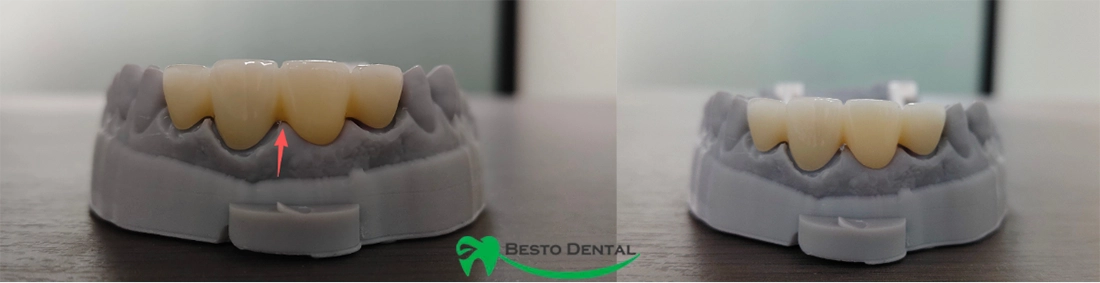
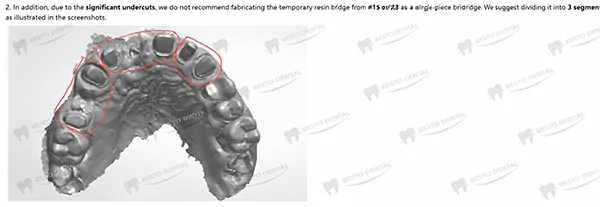
Another point to note is that when the bridge span is too long, fabricating the entire bridge as a single unit may create excessive undercuts and make it difficult for the restoration to seat properly. In this situation, the bridge may need to be divided into two or more segments. The laboratory will evaluate the actual case and provide recommendations accordingly.
6. Zirconia Dental Bridge Clinical Applications
Among the cases we handle, zirconia bridges are most frequently used to replace missing posterior teeth and restore multiple missing teeth in partially edentulous patients, depending on span length, posterior or anterior replacement, natural teeth or implants as supporting structures, and short or long spans. We have summarized below some of the most common clinical situations for zirconia bridges.
| Specific Clinical Situation | How the Product Is Used | Main Considerations |
|---|---|---|
| Single posterior tooth missing with healthy adjacent teeth | A three-unit bridge with two retainers and one pontic replaces the missing molar or premolar. | Full-contour 3Y or 4Y zirconia is typically selected. Connector size should be planned for posterior occlusal loads. |
| Multiple adjacent posterior teeth missing | A multi-unit bridge spanning three or more missing teeth, supported by natural teeth or implants. | 3Y zirconia is preferred for its higher strength. Connector cross-sections must be increased proportionally to the span. |
| Single anterior tooth missing with intact adjacent enamel | A resin-bonded zirconia cantilever bridge with a single retainer wing bonded to the adjacent tooth. | Minimally invasive. Requires excellent adhesive technique. Zirconia surface treatment and cement selection are critical. |
| Multiple anterior teeth missing | A three-unit or longer anterior bridge with full-coverage retainers. | High translucency 4Y or 5Y zirconia may be considered for esthetics. Shade matching across multiple units is the primary challenge. |
| Full arch edentulism | An implant-supported full-arch zirconia bridge replacing all teeth in one jaw. | Requires careful implant position planning and load distribution analysis. Monolithic zirconia is preferred to avoid porcelain chipping across a large span. |
| Patients with metal sensitivity | Zirconia bridges are used as a metal-free alternative to porcelain fused to metal. | Zirconia is well tolerated by oral tissues and is a suitable option when metal restorations are contraindicated. |
| Bruxism patients needing posterior restoration | Full-contour monolithic zirconia bridges are used because there is no porcelain to chip. | Occlusal scheme and night guard protection still need to be considered. Material strength alone does not eliminate the consequences of parafunction. |
7. Zirconia Dental Bridges FAQs
We have compiled some of the questions our customers frequently ask when outsourcing zirconia dental bridges and provided answers based on actual cases and laboratory experience, helping you better understand what to consider during case submission, design confirmation, and fabrication.
1)Can I specify the pontic design for my zirconia bridge?
Yes. When submitting the case, you can specify the Pontic Design, such as an Ovate Pontic, Modified Ridge Lap Pontic, or Hygienic Pontic. You can also provide photos, design drawings, or specific soft-tissue contact requirements.
The laboratory will design the pontic based on the shape of the edentulous ridge, available soft-tissue space, hygiene requirements, and esthetic requirements. If the pontic design you specify is limited by the actual intraoral conditions, the laboratory will usually confirm with you before fabrication and provide appropriate adjustment recommendations. If you are unsure what information to provide, contact us for guidance.
2) Can I review the zirconia bridge design before it goes into production?
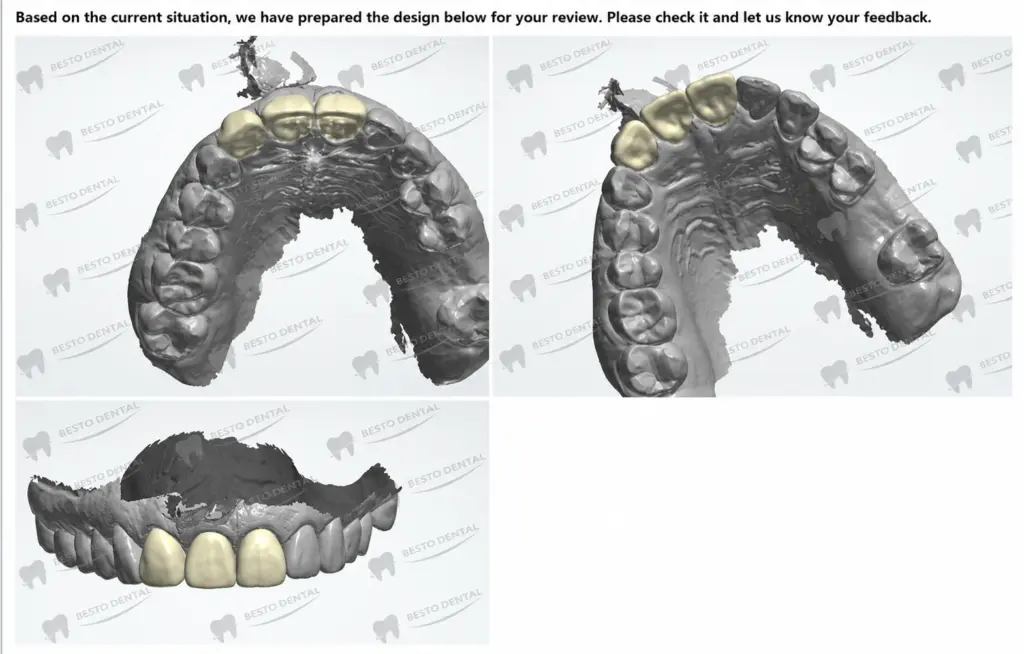
Yes. You can request the design file from the lab before fabrication. For complex cases, Bestodental can provide the CAD design for your review and approval before production starts.
3) Is a zirconia bridge suitable for a patient with bruxism?
Zirconia is a very strong material, and the full-contour monolithic zirconia restoration does not suffer from the problems of chipping of porcelain as observed in layered zirconia restorations in patients with bruxism. But the strength of the material does not eradicate the parafunction. A night guard is still recommended, and the occlusal scheme should be designed to distribute the forces as evenly as possible.
4) Can a zirconia bridge be used in the anterior region?
Yes, but it does matter what the material is. Due to its opacity, solid 3Y zirconia is not recommended for anterior bridges. Zirconia with high translucency levels (4Y or 5Y) can be used in the anterior region; 5Y is limited to short spans or single units because of its lower strength. Another possibility for anterior cases where the most esthetic detail is desired is a layered zirconia bridge featuring a 3Y or 4Y substructure and porcelain layering.
5) What happens if the zirconia bridge does not fit properly at try-in?
If you find that the zirconia dental bridge does not seat properly, has poor marginal fit, or has issues with proximal contacts or occlusion during try-in, please do not cement it. You can send the specific issues, intraoral photos, or new scan data to the laboratory so that the technician can determine the cause.
For issues that can be adjusted, the laboratory will provide appropriate adjustment recommendations. If the issue cannot be resolved through adjustment, a new scan or impression may be required, and the bridge may need to be remade.
6) Can a zirconia bridge be repaired if it fractures?
Zirconia is not easy to repair intraorally. When a connector breaks, the bridge will generally need to be replaced. Unlike porcelain-fused-to-metal bridges, in which a porcelain chip may be repaired with composite, it cannot be repaired with composite in this case. When the connector is the correct size, zirconia is fracture-resistant; should a fracture occur, replacement is generally the most viable solution.
7) Can I have a temporary dental bridge made to try out before the final one is produced?
Certainly. You can have a temporary bridge made for the interim period; for the material, you might choose PMMA, which offers better cost-effectiveness.
8. Conclusion
In this guide, the authors have discussed the basic structure of zirconia bridges, the most common bridge types and designs of the pontics, the types of zirconia materials used, clinical applications of zirconia bridges, and the most important considerations in case planning and laboratory fabrication of zirconia bridges. Once you are aware of these factors, you can be more thorough in case documentation, communicate design specifications more accurately with your dental lab, and have reasonable expectations of the final product before you start the production process.
If you’re considering outsourcing zirconia restorations but aren’t sure where to begin, you may want to check out our Zirconia Dental Lab Outsourcing Guide.