A patient who would like to have a tooth replaced and who always asks you if there’s a way they don’t have to have metal in their mouth. Or perhaps you’ve seen a thin biotype and worried that the shadow of a titanium implant would detract from the appearance. It is at these times that zirconia implants are talked about.
This guide discusses what zirconia dental implants are, their material, their design and manufacture, and when they are clinically appropriate.
You will learn the materials used for zirconia implants and why they are used; how the manufacturing process affects the performance of zirconia implants; and you will know the clinical situations in which zirconia implants are likely to perform best.
1. What Are Zirconia Dental Implants?
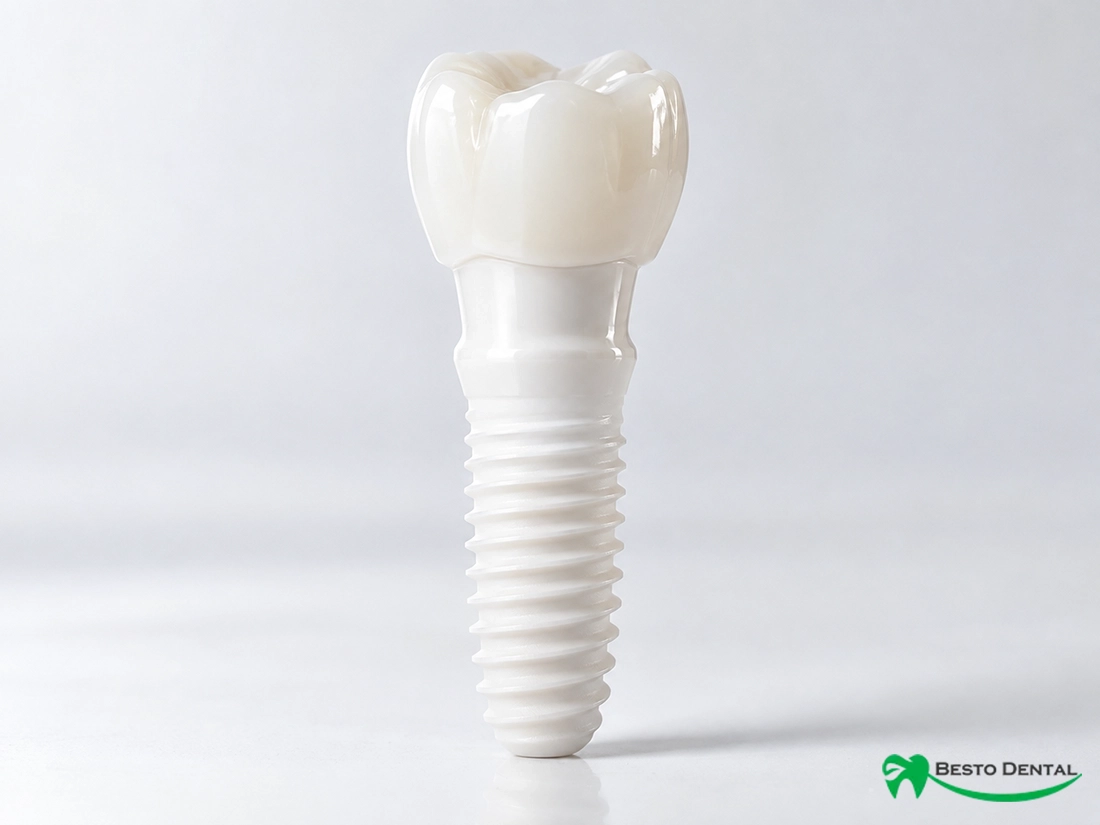
A zirconia dental implant is an artificial tooth root made primarily of zirconia ceramic that is placed into the alveolar bone to support prosthetic restorations such as crowns and bridges. The implant may be a one-piece design, where the implant body and abutment are joined as one, or a two-piece design, where the abutment attaches separately.
The implant body is white and tooth coloured as it is made of ceramic. One of the primary reasons zirconia implants are noticeable in esthetic zones is that when light passes through thin or translucent gum tissue, there is no dark shadow beneath. In terms of its use, it is secured into bone as with a titanium implant and used for the same type of restoration above the gum line.
The major advantages of zirconia dental implants are:
- Metal-free composition: The entire implant is ceramic and will be attractive to patients who do not want any metal in their body or who have been diagnosed as sensitive to titanium.
- Natural white color: No grey show-through under thin gums, making it easier to get an aesthetic look without any show-through.
- Presence of good soft tissue response: Good clinical material suggests that zirconia implants can lead to better integration of the soft tissue and reduced peri-implant inflammation than titanium implants.
- Mechanical strength – Zirconia ceramics have good flexural strength, which is especially high for yttria-stabilized types, appropriate for carrying functional loads.
- Low plaque affinity: The ceramic surface may not have much affinity for plaque buildup, and this can help to lower inflammation around the implant area.
- Biocompatible: Zirconia is biocompatible and will not give rise to an adverse reaction to either bone or soft tissue.
- Electrochemical corrosion resistant: Unlike metal-based implants, Zirconia does not undergo electrochemical corrosion over time.
In clinical applications, single tooth replacement (particularly in the anterior area where esthetics is most important) is the most common application of zirconia implants. They also are commonly employed for patients with metal allergies or those with a thin gum line and patients who opt for metal-free restorations. The flexibility of positioning and angulation correction is provided by a two-piece system, while a one-piece system is simpler, particularly for simple single-tooth cases. But titanium implants are still the most popular in clinical application.
2. What Materials Are Zirconia Dental Implants Made From?
Dental implants of zirconia are generally produced from high-strength ceramics, such as the most common yttria-stabilized zirconia. Y-TZP (Yttria-Stabilized Tetragonal Zirconia Polycrystal) is a popular material system.
Y-TZP is mainly composed of zirconium dioxide (ZrO₂) with a small amount of yttria (Y₂O₃) added to stabilize the material’s crystal structure. This results in higher strength and fracture resistance properties and higher long-term structural stability as compared to traditional ceramic materials.
In practical use, zirconia implant materials are valued for several reasons:
- High mechanical strength for supporting functional loads
- Good fracture resistance compared with conventional ceramics
- Excellent biocompatibility
- White ceramic color, which can be advantageous in esthetic areas
- An alternative to titanium implants; it is metal-free.
- High corrosion resistance, as zirconia is not like normal metal;
Not all zirconia implants are made from the same material formulation, however. The mechanical and clinical performance of different implant systems may vary according to their yttria content, the composition of zirconia, surface treatment, and manufacturing process.
3. Zirconia Dental Implants Design Principle
There are two basic designs of zirconia implants: one-piece and two-piece systems. Their selection will impact surgical workflow, long-term restorative options, and the spectrum of clinical scenarios they are capable of addressing.
The zirconia one-piece implant features a monobloc design, combining the body of the implant with the abutment. There is no connection interface between separate components, which eliminates the microgap where bacteria can accumulate and simplifies the overall design. One advantage of one-piece implants is that they do not need to heal caps or healing abutments, which can be beneficial during the healing period.
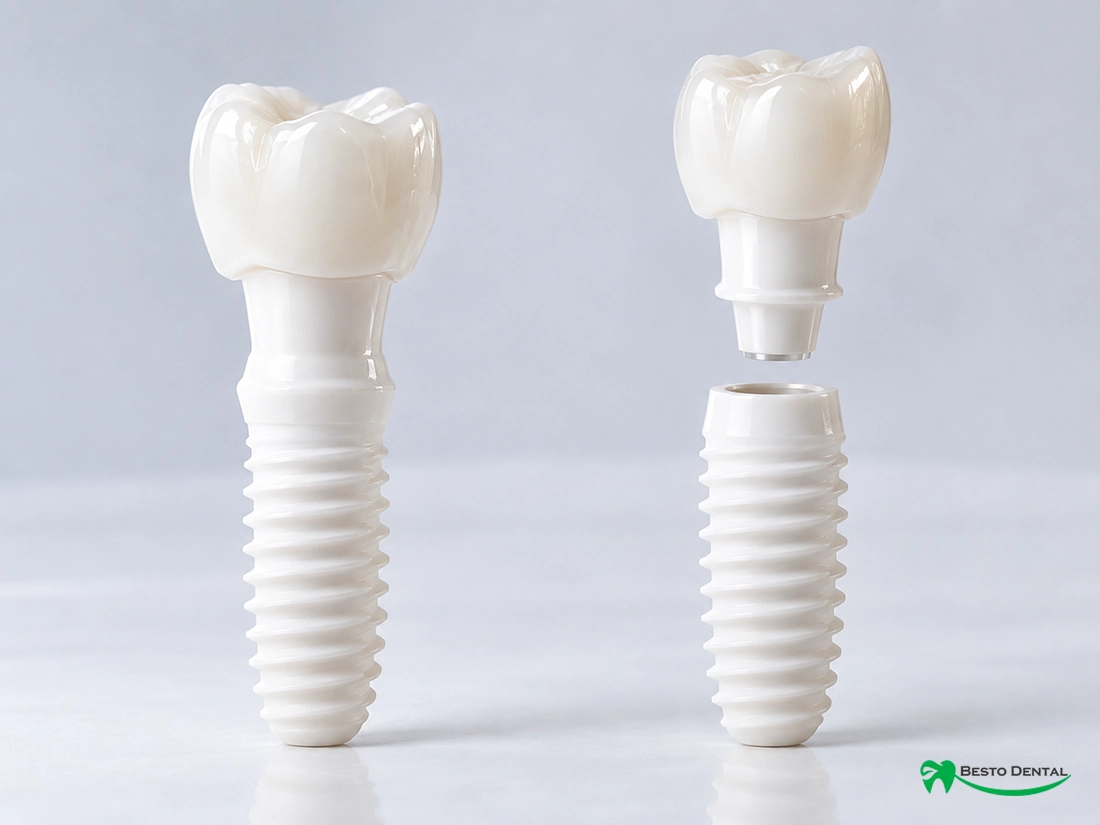
The body of the implant is separated from the abutment by a two-piece zirconia implant, attached to the abutment by either a screw or an adhesive interface. This design provides the restorative dentist greater freedom to optimize the angle of the abutment and the position of the final restoration without relying on the implant position. Technically, screw-retained abutments on zirconia implants are a challenging issue, as the material is more brittle than titanium and the connection area is a known stress concentration. Two-piece systems are still evolving, and their performance can be maintained for more than five years compared with one-piece designs.
4. Zirconia Dental Implants Fabrication Process
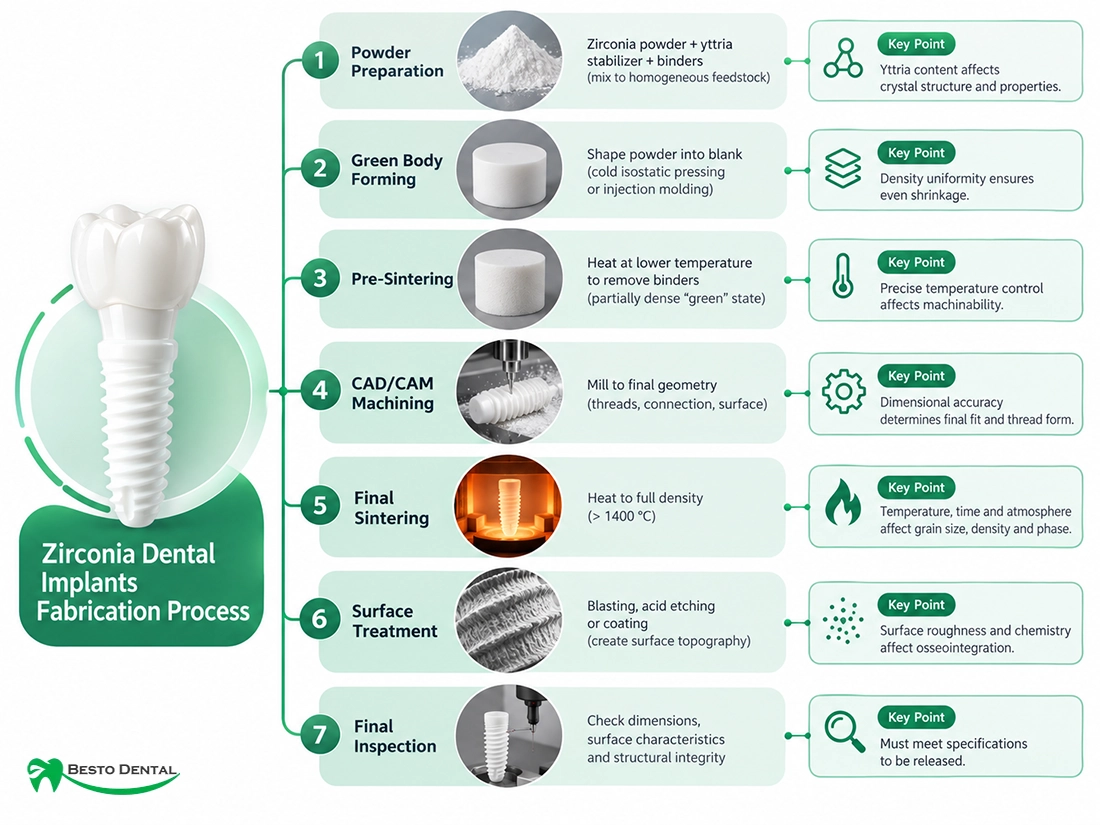
Here we have compiled the main fabrication flow table of zirconia dental implants.
| Stage | What Happens | What to Keep in Mind |
|---|---|---|
| Powder Preparation | The powder of zirconia is mixed with yttria stabilizer and binders to make a homogeneous feedstock. | The crystal structure and mechanical properties are directly related to yttria content and distribution. |
| Green Body Forming | The powder mixture is pressed into a blank or near-net shape by cold isostatic pressing or injection molding. | The uniformity of the density at this step will affect the uniformity of the shrinkage of the sintered part. |
| Pre-Sintering | The shaped blank is first heated to a lower temperature to remove the binders and convert it to a partially dense “green” condition. | The pre-sintering temperature has to be carefully controlled, or under- or oversintering will cause the machinability to be affected. |
| CAD/CAM Machining | The pre-sintered blank is milled into the implant’s macro and micro geometry by CAD/CAM machines | The accuracy of the dimensions here impacts the form of the thread, fit of the connection, and surface features. |
| Final Sintering | The machined part is heated to a full density of the material, usually above 1400 °C | Grain size, density, and composition of phases are affected by sintering temperature, time, and atmosphere. |
| Surface Treatment | The surface is blasted, etched in acid or coated in order to develop the necessary topography for osseointegration to occur. | Surface chemistry and topography influence the behavior of the cells in the bone. |
| Final Inspection | All finished implants are dimensioned, surface-treated, and tested for structural integrity. | At this time, any non-specification results will not allow the implant to be released |
In BestoDental real production, one of the most common issues is that the customer’s implant system information is incomplete or the digital library for that specific system is not available. When this happens, we cannot proceed with design until the correct scan body and library are confirmed. This is why having the full implant system details on hand before starting the restorative workflow saves significant back-and-forth.
5. Indications & Selection Considerations for Zirconia Dental Implants
To help you quickly identify the clinical situations where a zirconia implant is the most suitable choice, we have summarized the following key points for your quick reference.
| Consider Zirconia Implants When… | Evaluate More Carefully When… |
|---|---|
| ☑ Anterior or highly esthetic region | ☑ Posterior region with very high occlusal load |
| ☑ Thin or translucent gingival tissue | ☑ Severe bruxism or other parafunctional habits |
| ☑ Patient specifically prefers a metal-free implant | ☑ Complex multi-unit or full-arch rehabilitation |
| ☑ Single-tooth replacement | ☑ Significant prosthetic angulation correction is required |
| ☑ Implant position and angulation are favorable | ☑ Implant position is difficult or restorative flexibility is limited |
| ☑ Adequate bone volume is available | ☑ Limited bone volume requires very narrow implant dimensions |
| ☑ Adequate restorative and occlusal space is available | ☑ Prosthetic space is severely limited |
| ☑ Soft-tissue esthetics are a major concern | ☑ Heavy functional loading is expected |
| ☑ A compatible one-piece or two-piece zirconia system is available | ☑ The selected system has limited abutment or restorative component options |
| ☑ The laboratory has the required scan body, library, and components | ☑ Digital libraries or restorative components are unavailable |
| ☑ The selected zirconia implant system has appropriate clinical documentation for the indication | ☑ The intended indication is outside or close to the limits specified by the implant manufacturer |
These are not treatment protocols, but rather considerations for selection. The use or not of zirconia implant in a specific patient is based on a clinical evaluation of the patient and should be decided based on the zirconia implant’s indications for use and the available clinical evidence for that specific indication.
6. Zirconia Dental Implants FAQs
Although zirconia dental implants are not a common choice for implant restoration, we have compiled a list of frequently asked questions for your reference.
1) When outsourcing zirconia implant restoration to a laboratory, what information do I need to provide in one go?
Beyond the intraoral scan data, you need to provide:
- implant brand,
- implant system,
- implant platform/ diameter,
- whether it is a one-piece or two-piece design,
- abutment type,
- scan body information,
- available digital library,
- restoration type,
- screw-retained or cement-retained preference,
- occlusal space,
- and implant angulation.
These pieces of information, when known in advance of the laboratory beginning design, will help avoid having to wait until the design is finished for the information to become available and/or agreeable.
2) What is the biggest difference between a zirconia implant and a titanium implant?
The most obvious difference is the material.
| Zirconia Implant | Titanium Implant | |
|---|---|---|
| Material | Ceramic | Metal |
| Color | White / Tooth-colored | Gray |
| Clinical history | Relatively shorter | Very mature |
| System options | Fewer | Many |
| Restorative flexibility | Relatively limited | Very high |
| Esthetic advantage | More pronounced | Possible gray show-through |
| Electrochemical corrosion | No conventional metal corrosion concerns | Metal-related corrosion is discussed |
| Connection forms | Greater variation between systems | Very mature |
3) Can a zirconia implant only be restored with a zirconia crown?
No. A zirconia implant is an implant that is used in the alveolar bone which is made of zirconia. Does not imply that the top layer of the restoration should be zirconia as well. The type of implant system and the type of restorative technique and clinical needs will determine the material used for the restoration, ranging from a Zirconia Crown, Lithium Disilicate / e.max Crown to a PFM Crown.
Zirconia implants can also be used for the support of Implant-Supported Bridges. It is dependent upon the type of restoration provided by the implant system, the type of connection, occlusal loading, esthetic demands, and restorative space.
4) Is a zirconia implant the same as a zirconia abutment?
They are distinct, and the two ideas can be easily confused. When the “artificial tooth root” that is inserted into the bone is zirconia, it is called a Zirconia Implant. A zirconia abutment generally is a Titanium Implant + Zirconia Abutment. That is, the implant remains titanium, but the abutment that sits on top of it is zirconia. So, these two terms should not be replaced by each other.
7. Conclusion
This article offers a systematic review of materials, designs, and manufacturing processes for zirconia implants and offers a series of “quick reference” tables to help with clinical selection. By reading this article, you will get a better understanding of the characteristics and selection criteria of the different types of zirconia implants, which will facilitate your communication with dental laboratories when outsourcing cases and let you choose the best implant option for specific clinical scenarios.