When selecting materials for dental cases, many people tend to confuse Multilayer Zirconia with Layered Zirconia. We previously had a customer who could not clearly distinguish between these two materials, which resulted in restorations that did not achieve the desired outcome.
In this Multilayer Zirconia Guide, we will give an in-depth introduction to multilayer zirconia and also learn the difference between Multilayer Zirconia and Layered Zirconia.
In this guide, you’ll learn the meaning of multilayer zirconia, how it works, the various types, its manufacturing process, and its applications.
1. What Is Multilayer Zirconia?
Multilayer zirconia is a dental zirconia material composed of multiple integrated layers with gradual variations in shade, translucency, and/or strength from the cervical to the incisal region. Unlike layered zirconia, where a technician builds up porcelain on top of a zirconia framework, multilayer zirconia carries its aesthetic gradient within the material itself. There is no separate veneering layer.
How the disc is made is the key to its operation. In production, the Zirconia is arranged with a high yttria content and high translucency in the incisal part and a lower yttria content and a more opaque, warmer shade in the cervical part. If a restoration is milled from this disc and subsequently sintered, the gradient will be maintained in the final restoration. The cervical area naturally looks warmer and more opaque, and the incisal area lets more light through, mimicking the optical behavior of a natural tooth.
Here are the key benefits of multilayer zirconia:
- Inherent colour gradient: The colour changes from cervical to incisal, instead of being applied on the surface. This will ensure that the gradient remains level following occlusal adjustments or polishing.
- No porcelain veneer, no chipping risk: There is no interface that allows chipping to occur. The entire restoration is made of one solid zirconia piece.
- Less need for manual staining: The multi-layer discs have a built-in shading range, and the technicians spend less time adding shades to the surface of the discs, resulting in a more consistent case colour.
- The translucency in the incisal zone – The higher the amount of yttria, the higher the translucency that it brings to the incisal layer, and this is particularly useful for anterior restorations as it is similar to the translucency of natural enamel.
- It can be used in a broad spectrum of applications, such as anterior and posterior crowns, bridges, implant-supported prostheses, etc.
- Excellent masking ability in the cervical region: Discolored abutments or dark implant parts are often a challenge in aesthetic cases, and good masking ability in the cervical area is offered by the more opaque cervical layer.
In the clinical application, anterior single crown, premolar crown, dental bridges, implant crown, and full arch implant restoration are performed by the dentist using the multilayer zirconia. It is used when the patient or clinician demands the strength of a monolithic restoration and wants something that appears more natural than a traditional single-shade zirconia. It lies between the layered zirconia, which has the highest aesthetic ceiling but has a chipping risk, and the monolithic zirconia, which has the highest strength and limited aesthetic gradient.
If you would like to learn more about layered zirconia and monolithic zirconia, please check out our Layered Zirconia guide and Monolithic Zirconia guide.
2. Structure of Multilayer Zirconia
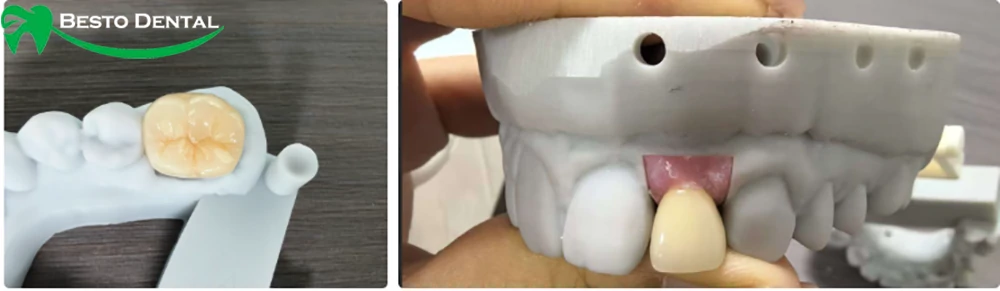
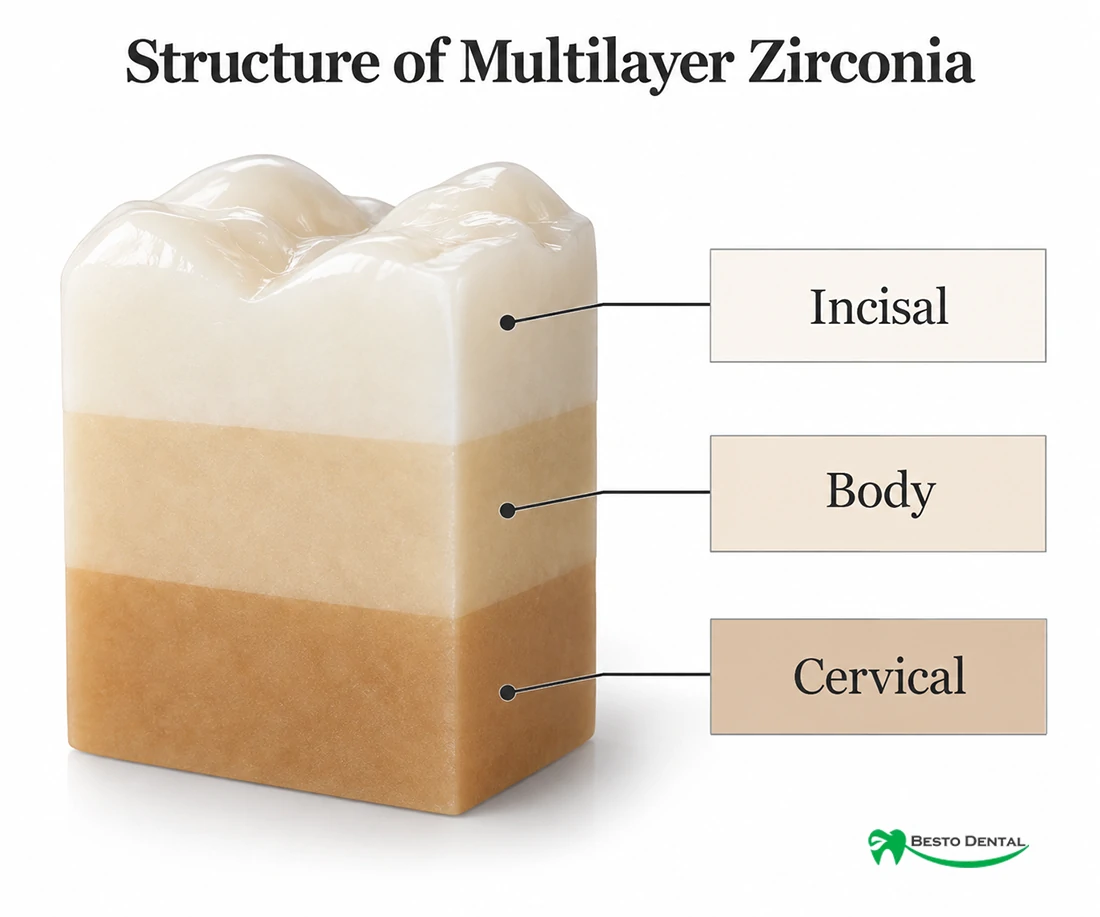
Multilayer zirconia has three distinct structural zones within a single milled restoration: the cervical layer, the body layer, and the incisal layer. These zones are not separate pieces bonded together. They are continuous within the same zirconia disc, with a gradual transition in composition from one zone to the next.
| Zone | Position | Characteristics |
|---|---|---|
| Cervical | The portion that sits near the gum line | Deeper, warmer color; lower translucency; higher opacity for masking |
| Body | The middle portion of the restoration | Relatively uniform color; moderate translucency; the main functional mass of the restoration |
| Incisal | The cutting edge or occlusal surface | Highest translucency; stronger light transmission; lighter and more enamel-like appearance |
The cervical zone replicates the natural tooth’s cervical third, which is warmer and less translucent. Its lower translucency also helps mask the underlying abutment or implant. The body zone bears most of the restoration’s structural load and provides the base color. The incisal zone is designed for light transmission; research shows it has the highest translucency (translucency parameter ≈ 2.33) and the lowest contrast ratio among the three zones, whereas the cervical zone has higher lightness and chromaticity.
Transitions between zones are gradual, not abrupt, because a sharp interface between layers of different composition could concentrate stress. Studies confirm that interfaces in multilayer zirconia do not form a weak link, so the gradient does not compromise the restoration’s structural integrity.
3. Multilayer Zirconia Fabrication Process
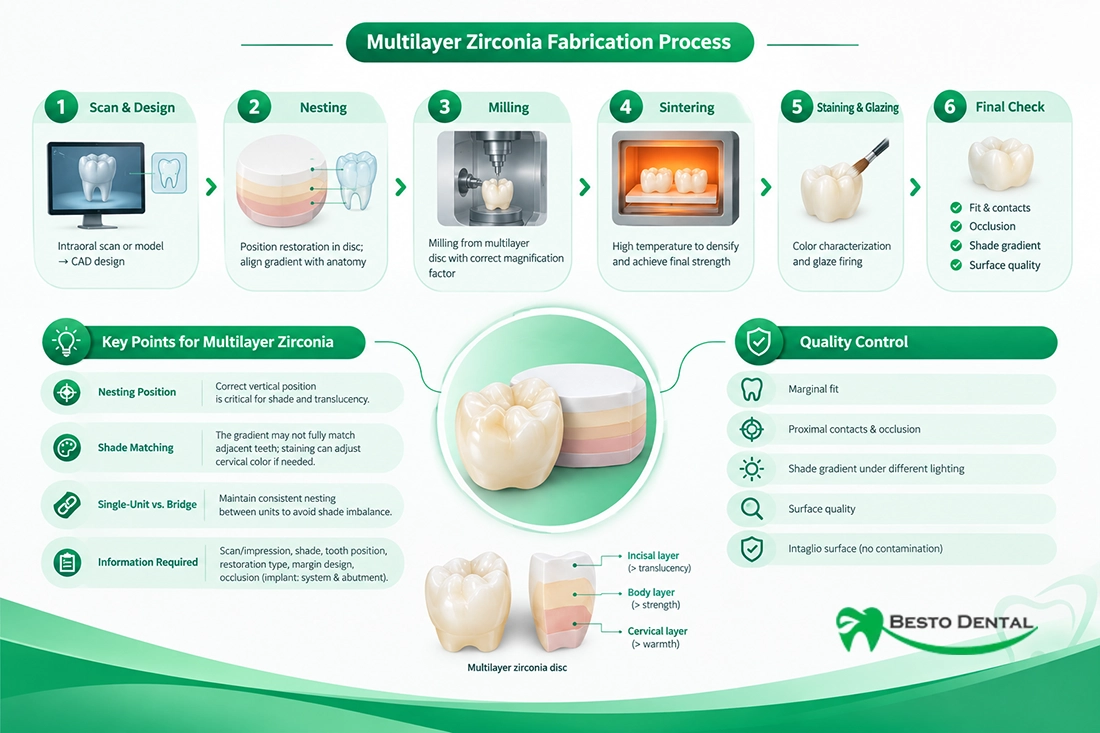
The fabrication of multilayer zirconia follows a sequence similar to monolithic zirconia, but with one critical additional step: positioning the restoration within the disc so that the gradient aligns correctly with the anatomy of the tooth. Here is the fabrication flow of multilayer zirconia:
| Stage | What Happens | What to Keep in Mind |
|---|---|---|
| Scan and design | The clinician provides an intraoral scan or model; the technician designs the full-contour restoration in CAD software | The design must take into consideration the final occlusal relationship and the proximal contacts; the dimensions of connectors in bridges must be chosen to suit the span and the material used. |
| Nesting | The technician places the restoration in the multilayer disk in the CAD software and matches the cervical, body, and incisal areas of the disk with the corresponding areas of the restoration. | It is the most important step for multilayer zirconia; the correct nesting position is directly related to the resulting shade and translucency. |
| Milling | The restoration is milled from the multilayer zirconia blank using a CAM machine | The magnification factor of the blank needs to agree with the sintering protocol; otherwise, the dimensions will be inaccurate. |
| Sintering | The milled restoration is heated to a high temperature to densify the zirconia and reach its final strength | Strength and shade are influenced by sintering temperature and cycle consistency, and differences in the furnace temperature distribution may result in translucent differences throughout the restoration. |
| Staining and glazing | Stain is applied for fine color characterization, then a glaze layer is applied and fired | The natural gradient of the multilayer discs can be diminished by excessive staining and this will obscure the built-in gradient. |
| Final check | The restoration is inspected for fit, contacts, occlusion, shade, and surface quality | The intaglio surface should be free of contamination; any remaining debris can affect cementation |
Nesting is the step that most directly distinguishes multilayer zirconia from other zirconia restorations. Because the disc contains a gradient in both color and translucency, the vertical position of the restoration within the disc determines how the gradient maps onto the final tooth.
If the incisal area of the restoration is positioned too low in the disc, it may capture less of the translucent incisal layer and appear more opaque. If the cervical area is positioned too high, the restoration may lose the warmth and depth that the cervical zone provides. In multi-unit bridges, inconsistent nesting between units can create visible shade imbalance after sintering.
4. Clinical Applications of Multilayer Zirconia
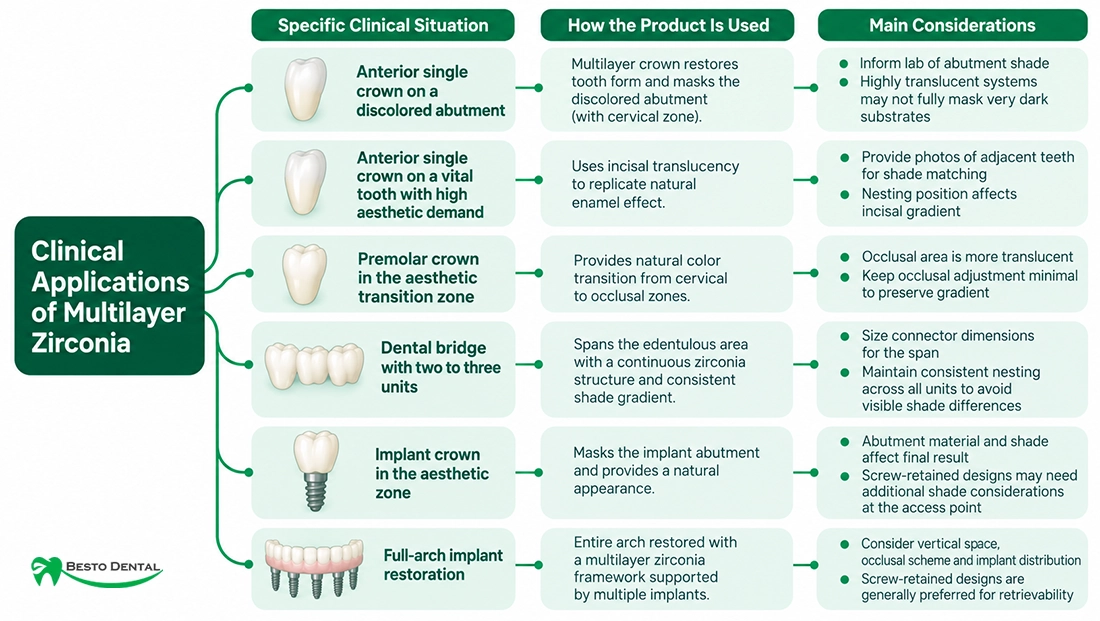
Multilayer zirconia is most commonly used in anterior single crowns, premolar crowns, dental bridges, implant crowns, and full-arch implant reconstruction in the cases that we handle. Requirements will vary according to the position of the tooth, condition of the abutment, and esthetic desires of the case.
| Specific Clinical Situation | How the Product Is Used | Main Considerations |
|---|---|---|
| Anterior single crown on a discolored abutment | The multilayer restoration replaces the missing tooth structure while the cervical zone masks the discolored abutment underneath | The abutment shade must be communicated to the laboratory; highly translucent multilayer systems may not provide adequate masking on very dark substrates |
| Anterior single crown on a vital tooth with high aesthetic demand | The restoration uses the incisal zone’s translucency to replicate the natural enamel effect of the adjacent teeth | Photographs of adjacent teeth are helpful for shade matching; the nesting position determines how much of the incisal gradient is captured |
| Premolar crown in the aesthetic transition zone | The multilayer restoration provides a natural color transition between the cervical and occlusal zones | The occlusal surface may fall in a more translucent zone; occlusal adjustment should be minimal to preserve the gradient |
| Dental bridge with two to three units | The restoration spans the edentulous area with a continuous zirconia structure has a shade gradient on the units | Connector dimensions must be sized for the span, and it is important that all units are nested together so as to not have any visible shade difference. |
| Implant crown in the aesthetic zone | The multi-layer restoration camouflages the implant abutment and creates a natural appearance | The final result will be influenced by the material used for the abutments and the shading; screw-retained designs may need to take extra shade at the access point |
| Full-arch implant restoration | The entire arch is restored by a multi-layer zirconia framework that is supported by several implants | The outcome will be affected by vertical space, occlusal scheme, and implant distribution; for retrievability, screw-retained designs are preferred |
In fact, based on BestoDental’s experience, Multilayer Zirconia is generally used less frequently in actual cases than Layered Zirconia and Full-Contour Zirconia. The main reason is that these two types of restorations have more clearly defined applications.
The beauty of Multilayer Zirconia is that the zirconia blank itself already delivers a gradual change of shade and translucency from cervical to incisal regions, so there is no need to do extensive porcelain veneering for this. But these factors may be the pre-set gradient for the zirconia blank; the height of the restoration in the blank and the crown height can all influence the final aesthetic outcome. Multilayer Zirconia is typically less flexible for adjustments as compared to Layered Zirconia, particularly in terms of adjusting for highly aesthetic cases with complex shades, incisal translucency, or individualized characteristics.
For real-life situations, therefore, Multilayer Zirconia is more frequently employed for restorations that do not need complex individualized porcelain layering, but only a natural shade gradient.
5. Multilayer Zirconia FAQs
We have summarized some frequently asked questions about multilayer zirconia for your reference.
1) What is the difference between multilayer, layered, and monolithic zirconia?
The simplest method of remembering the distinction is to keep in mind how the aesthetics are achieved.
| Name | Core Meaning |
|---|---|
| Layered Zirconia | A zirconia framework with porcelain built up on top by a technician |
| Monolithic Zirconia | A restoration milled entirely from a single zirconia block, with only stain and glaze on the surface |
| Multilayer Zirconia | A monolithic zirconia restoration milled from a disc that contains a built-in gradient of color and translucency |
2) Is multilayer zirconia suitable for posterior bridges?
Posterior bridges can be made with multilayer zirconia; the nesting strategy is important. If the occlusal surface of a posterior bridge is used to bear significant loads, and if this occlusal surface is in the incisal zone of the disc, which is weaker in flexural strength, the restoration may be more susceptible. The lab should place the restoration in the higher strength area for posterior bridges or use a multi-layered disc with a higher strength profile rating.
3) Can multilayer zirconia be used for bruxism patients?
In the case of multilayer zirconia, there is no veneering porcelain, which gives it almost the same chipping resistance as monolithic zirconia. That makes it a reasonable option for bruxism patients who want a more natural appearance than a single-shade monolithic restoration. However, the incisal zone‘s lower flexural strength should be considered if the patient‘s parafunctional habits place heavy loads on the incisal edges. A night guard may still be recommended.
4) Does multilayer zirconia require staining after milling?
The technician does not have to create a full colour with surface stains as the multilayer discs have a shade gradient built in. A fine-tuning of the color and characterisation is usually, however, done by applying some surface staining. The objective is to improve and not to replace the built-in gradient. If there is too much staining, then the natural gradient will be lost, and the use of a multilayer disc may be defeated in the first place.
5) How do I know if a multilayer zirconia case is right for my patient?
Multilayer zirconia can be used when the case requires a monolithic restoration for strength and chipping resistance, but the patient or clinician is looking for a more natural appearance than offered by single-shade zirconia. Depending on the degree of discoloured abutments, a more opaque multilayer system may be indicated, while in cases with good substrate colours and high aesthetic requirements, a more translucent system may be indicated.
In a case where you are not certain, BestoDental will recommend a suitable material based on the details of the case by contact us. BestoDental also confirms the specific materials with the client before fabrication.
6) Can the shade of a multilayer zirconia restoration be adjusted after sintering?
Staining and glazing can be used to smooth out the color after sintering, but this will only have a superficial effect rather than an inherent gradient. Making the shade adjustment an appreciable amount off may result in creating an artificial effect or not being a perfect match with the adjacent teeth. That is why it is important to verify the shade and disc type before milling.
6. Conclusion
In this guide, we introduced Multilayer Zirconia, including its material structure, shade and translucency gradient, different types, fabrication process, and common clinical applications. We also explained the key differences between Multilayer Zirconia, Layered Zirconia, and Full-Contour Zirconia, including how their structures and fabrication methods affect strength, aesthetics, and material selection.
This can help you select the appropriate zirconia restoration based on the clinical and aesthetic requirements of each case and communicate your material and aesthetic expectations more accurately with your dental lab.