You are planning to have a dental crown made, and the laboratory asks you to choose between monolithic zirconia, layered zirconia, and multilayer zirconia. What are the differences between them, and how should you decide? We have created this guide to monolithic zirconia to help you make informed choices regarding materials and restoration designs when outsourcing zirconia restorations, as well as to provide insight into the laboratory’s fabrication processes.
This guide will help you understand what full zirconia is, its structure, the different types of zirconia, how it is made, and where it is best clinically used.
By the end of reading, you will be more knowledgeable about the composition of monolithic zirconia, how the zirconia manufacturing process affects performance, and the most clinically successful applications of zirconia.
1. What Is Monolithic Zirconia?
Monolithic zirconia is a dental restoration that is made from a single block of zirconia without a layer of veneering porcelain. The whole crown/birdge is made of a single material. It’s the difference between monolithic zirconia and layered zirconia, which has a porcelain coating over a zirconia framework. It is also often called Full-Contour Zirconia in clinical and lab settings, and many times the two are used synonymously.
The method of its operation is simple. CAD/CAM technology is used to mill a zirconia block into the entire shape of the crown or bridge, which is then sintered at high temperature to achieve full strength and density. Because there is no porcelain-to-zirconia interface, there is no layer that may chip or delaminate. The material itself carries out both the structural and surface functions.
The main advantages of monolithic zirconia are:
- Resistance to chipping: Layered zirconia restorations eliminate the most prevalent failure mode, which is resistance to chipping, since there is no veneering porcelain layer. It is a single piece entirely, and there’s not any interface on which fractures can begin.
- High flexural strength: Monolithic zirconia preserves the entire mechanical properties of zirconia material; thus, no compromise should be made in the design of the zirconia framework to accommodate the addition of a porcelain layer.
- Appropriate for bruxism patients: Monolithic zirconia is one of the most predictable material options when the occlusal force is high, or the patient is found to have a history of restoration fractures. Ceramic for bruxism cases with the highest strength is solid zirconia.
- Less wear on opposing enamel: Monolithic zirconia generates less wear on opposing enamel if it is well polished than feldspathic porcelain or metal-ceramic restorations.
Faster production process: The production process is shortened by eliminating the porcelain layering, firing, and adjustment. - Cost-effective: Monolithic zirconia restorations typically use less material and are simpler to produce than layered zirconia.
- Good for implant-supported restorations: Clinical studies have demonstrated favourable results for monolithic zirconia on implant-supported crowns and bridges, and a lower rate of chipping in comparison to veneered zirconia.
- Acceptable aesthetics for posterior use: Although not as realistic as layered porcelain, modern translucent grades of zirconia provide natural translucency that works very well for many posterior and premolar cases.
In clinical practice, monolithic zirconia is used in posterior crowns, posterior bridges, implant-supported crowns and bridges, and full-arch implant fixed restorations. It is particularly prevalent if the patient has bruxism, has a history of restoration fractures, or when the restoration is to be placed in a high-load area where chipping resistance is more important than maximum aesthetics.
2. Structure of Monolithic Zirconia
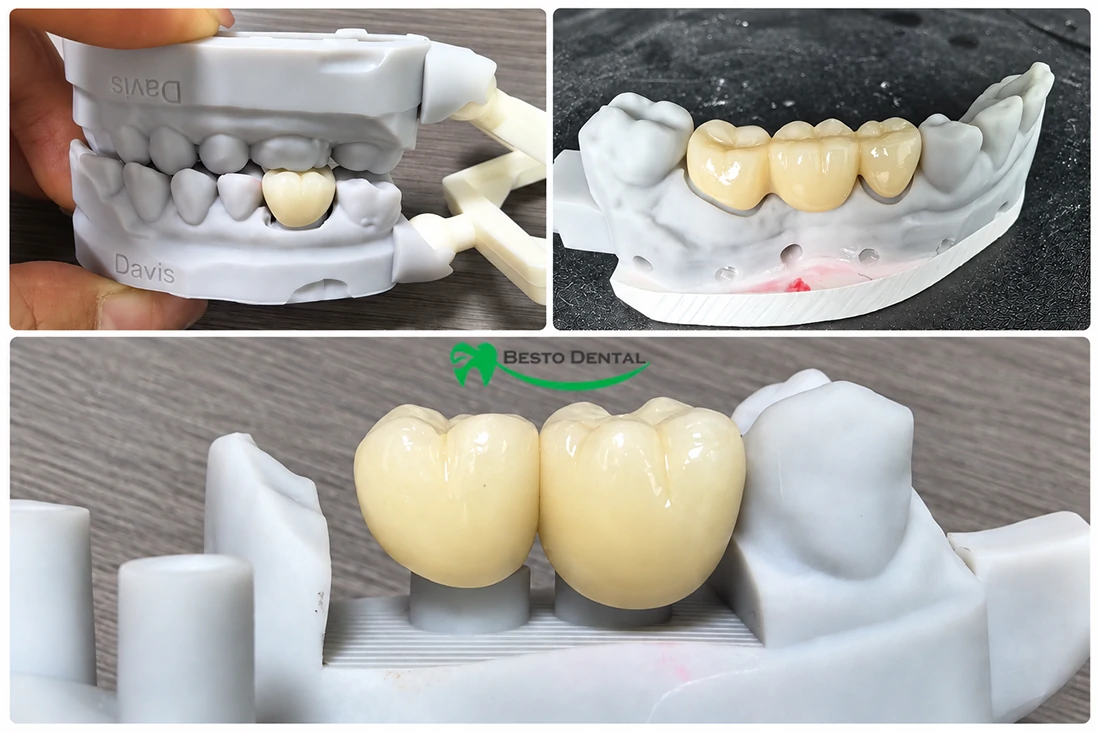
The structure of monolithic zirconia is simple by design: it is a full-contour zirconia restoration with only stain and glaze applied to the surface. The entire restoration is milled from a single zirconia blank in its final anatomical shape.
The only additions to the milled zirconia surface are the stain and glaze layers. Stain is used to change the color and add surface character to the ceramic, and glaze is used for a smooth and shiny surface finish. These layers are extremely thin and are bonded to the surface of the zirconia, but are not part of the structure. The restoration is completely supported by the zirconia body.
This single-material structure is precisely what gives monolithic zirconia its advantage in high-load situations. There is no weak link at a material interface, no unsupported porcelain that could fracture under occlusal force, and no risk of delamination between layers.
3. Types of Monolithic Zirconia
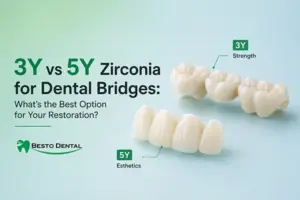
There are three common types of monolithic zirconia: 3Y, 4Y, and 5Y. It is a family of zirconia grades distinguished primarily by their yttria content. Higher yttria content increases translucency but reduces mechanical strength. There are three main grades currently used in our laboratories:
| Type | Main Characteristics | What to Keep in Mind |
|---|---|---|
| 3Y Zirconia | Highest flexural strength and fracture toughness among the three grades; lowest translucency | The standard choice for posterior crowns, bridges, and full-arch restorations where load-bearing capacity matters most |
| 4Y Zirconia | Moderate strength with improved translucency compared to 3Y | A good compromise for cases requiring strength and a more esthetic result; commonly used for monolithic crowns across a range of positions |
| 5Y Zirconia | Highest translucency; approximately 20% to 25% more translucent than 3Y but 40% to 50% lower in flexural strength | Best suited for anterior or premolar restorations with lighter occlusal loads; not ideal for high-load posterior bridges or bruxism cases |
If you would like to learn more about the options regarding 3Y, 4Y, and 5Y, we have written a dedicated article: 3Y vs. 5Y Zirconia for Dental Bridges for your reference.
Our clients sometimes want to know whether 5Y zirconia can be used for posterior crowns because it looks more natural. Based on our real-life experience, translucency is not the limiting factor in the posterior region; load-bearing capacity is. A 5Y restoration in a molar position may look good initially, but the reduced fracture toughness means it is more vulnerable under chewing forces. For posterior cases, especially bridges, 3Y or 4Y is typically the more predictable choice.
4. Monolithic Zirconia Fabrication Process
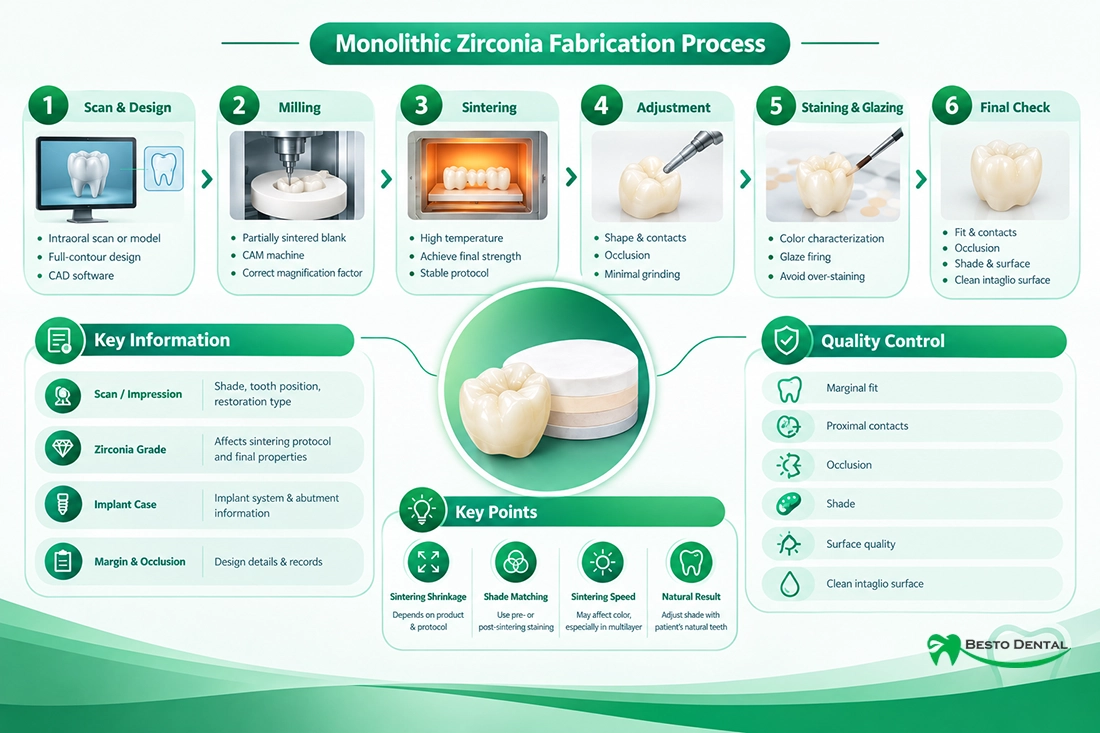
Compared to the layered zirconia mentioned in our layered zirconia guide, it eliminates a crucial step: the need for technicians to manually layer porcelain over a large surface area. Consequently, the production process is generally simpler and more consistent, and the turnaround time is shorter. The overall flow is shown below:
| Stage | What Happens | What to Keep in Mind |
|---|---|---|
| Scan and design | The clinician provides an intraoral scan or model; the technician designs the full-contour restoration in CAD software with the complete anatomical shape | The design must account for the final occlusal relationship and proximal contacts; connector dimensions in bridges need to be appropriate for the chosen zirconia grade |
| Milling | The restoration is milled from a partially sintered zirconia blank using a CAM machine | The blank’s magnification factor must match the sintering protocol; using the wrong factor can cause dimensional inaccuracy after sintering |
| Sintering | The milled restoration is heated to a high temperature to densify the zirconia and reach its final strength | The sintering protocol affects different zirconia grades differently; rapid sintering improved the fit of 3Y crowns but worsened the fit of 4Y crowns in one study |
| Adjustment | The technician adjusts the length, shape, contacts, and occlusion on the sintered restoration | Occlusal adjustments should be minimal; excessive grinding on the functional surface can compromise the material’s integrity |
| Staining and glazing | Stain is applied for color characterization, then a glaze layer is applied and fired | Speed sintering can cause color changes in multilayer zirconia containing both 3Y and 5Y layers, so stain selection may need adjustment |
| Final check | The restoration is inspected for fit, contacts, occlusion, shade, and surface quality | The intaglio surface should be free of contamination; any remaining investment or debris can affect cementation |
Sintering causes the greatest dimensional change. Zirconia blanks are milled in a partially sintered state and shrink during sintering. The amount of shrinkage depends on the specific zirconia product and sintering protocol.
Staining and glazing affect both aesthetics and surface quality. Speed sintering can cause color changes in multilayer zirconia containing both 3Y and 5Y layers. In single-layer zirconia, the color difference between conventional and speed sintering is not significantly affected by yttria content. Usually, if the case has specific shade requirements, our clients will discuss this with us.
Another common challenge is that the prescribed shade and adjacent natural teeth may not match under different lighting. A monolithic zirconia can sometimes be pre-sintered stained for a more natural colour gradient; this is done prior to the sintering process and will penetrate the material. The surface can be stained and glazed with the aim of changing the colour after the sintering process, but the result is not as deep as it would be if the colour were changed during the sintering process.
Before the restoration leaves the laboratory, BestoDental technician verifies marginal fit on the die or model, proximal contacts, occlusion, and shade against the prescription, and inspects for surface defects. The intaglio surface is also checked for residual contamination that could affect cementation.
5. Clinical Applications of Monolithic Zirconia
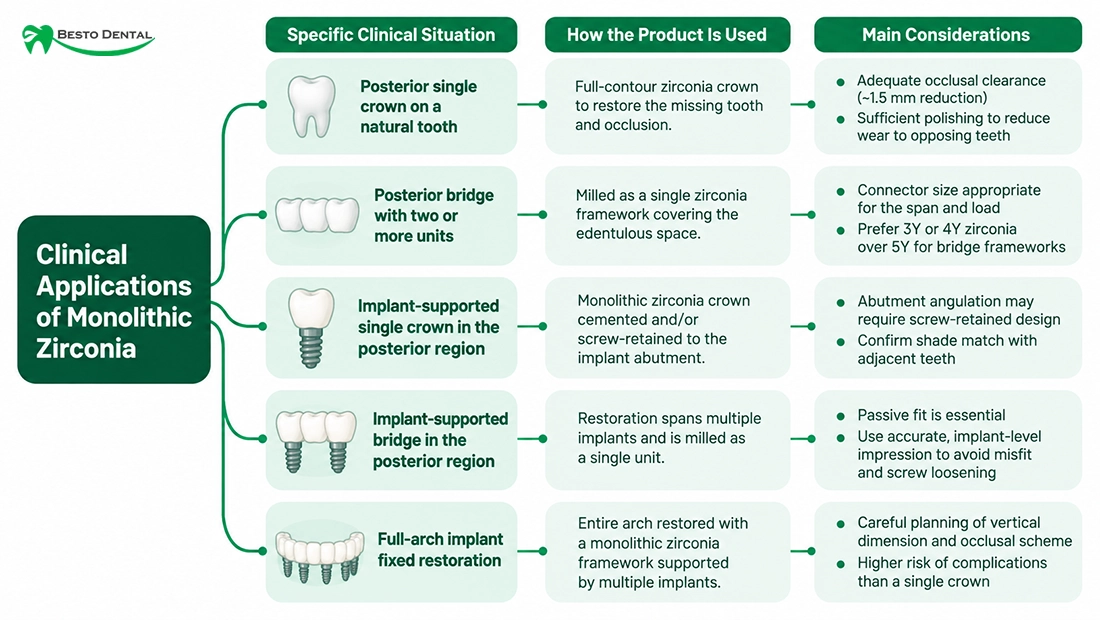
Our cases that use monolithic zirconia are mostly for posterior crowns, posterior bridges, implant-supported crowns and bridges, and full-arch implant fixed restorations.
| Clinical Applications | Suitable Situations |
| Posterior Crowns | The most common application. Suitable for molars and premolars that withstand relatively high occlusal forces. |
| Posterior Bridges | Can be used for posterior fixed bridges, especially in cases requiring higher strength. The span should be determined based on the specific zirconia material and restoration design. |
| Anterior Crowns | High-translucency zirconia can be used for some anterior cases, but cases with high esthetic requirements usually require more careful material selection. |
| Implant Crowns | Commonly used for posterior implant restorations and can be fabricated as screw-retained or cement-retained restorations. |
| Implant Bridges | Can be used for multi-unit implant-supported fixed restorations. |
| Full-Arch Implant Restorations | Can be used for certain full-arch fixed implant restorations, with higher requirements for material strength and framework design. |
| Bruxism / Heavy Occlusion Cases | Since there is no traditional veneering porcelain layer, the risk of veneering porcelain chipping can be reduced. |
| Limited Occlusal Space Cases | A relatively conservative restoration design can be used within the minimum thickness specified by the material manufacturer. |
The most typical applications include Posterior Crowns, Posterior Bridges, Implant Restorations, and High Occlusal Load Cases.
It is important to note that Monolithic Zirconia is not limited to posterior restorations. Today’s high-translucency zirconia can also be used for anterior restorations. However, for highly esthetic anterior cases such as #8 and #9, where there are high requirements for translucency, incisal characterization, halo effects, opalescence, and customized shade effects, Layered Zirconia usually provides more flexibility for hand-layered esthetic characterization. Monolithic Zirconia, on the other hand, offers greater overall strength and stability while reducing the risk of veneering porcelain chipping. If you are unsure which material to choose for your case, you can contact us for an assessment.
6. Monolithic Zirconia FAQs
BestoDental has compiled a list of frequently asked questions based on real cases for your reference.
1) Why is Monolithic Zirconia so commonly used?
Its biggest advantage is its high strength. Since there is no outer layer of veneering porcelain, the risk of porcelain chipping is low. This is especially important for posterior teeth, where occlusal forces are relatively high. With Layered Zirconia, the outer porcelain layer may chip under heavy occlusal forces.
Monolithic Zirconia does not have this porcelain layer, giving the restoration greater overall structural integrity.
2) What are the drawbacks of a monolithic zirconia?
The monolithic form of zirconia is not as transparent as the layered form, and may not be appropriate for the anterior section where translucency and colour variations are significant. A slightly “chalkier” appearance may also be apparent in some patients, especially anterior thin and highly translucent teeth, with layered restorations. Furthermore, a well polished zirconia will not contribute to wear of opposing teeth, while a glaze will wear more quickly and polishing after occlusal adjustments is essential.
3) If there is not enough restoration space, can I switch from layered zirconia to monolithic zirconia?
Yes. Unlike layered zirconia, monolithic zirconia is free of the need to be paired with a porcelain layer, so it requires a smaller space. Fully monolithic zirconia is ideally indicated in patients who want to have a tooth colored restoration and do not have enough preparation space, and is also suitable for bruxers. If a limited preparation is needed, monolithic zirconia might be an alternative. The laboratory needs to confirm the thickness of zirconia that will be used and that it has sufficient space.
4) Would you recommend the use of monolithic zirconia for a patient with bruxism?
One of the most recommended ceramics is monolithic zirconia. Solid zirconia is recommended for the posterior teeth and is the strongest ceramic for bruxism cases. But bruxism can still be a factor to consider and a night guard might be needed to preserve the restoration and any opposing teeth. It is important to carefully assess oral habits before treatment.
8)Would monolithic zirconia be appropriate for long span bridges?
Monolithic zirconia may be utilized in bridges; however, span length and connector dimensions must also be suitable for the grade of the zirconia. Longer spans are more likely to cause stress in the connectors and in the restoration as a whole. In general, 3Y or 4Y zirconia is more commonly used than 5Y due to its higher fracture toughness for long span bridges. The case should be sent to the laboratory, and its dimensions and framework are determined to be suitable for the span.
7. Conclusion
This article explains the structure, fabrication process, material characteristics, advantages, limitations, and clinical applications of Monolithic Zirconia, including its use for posterior crowns, bridges, implant restorations, high-occlusal-load cases, and selected anterior restorations.
For dentists and dental laboratories outsourcing zirconia restorations, understanding these basics can make case communication much clearer. You can better determine whether Monolithic Zirconia is suitable for a case, select the appropriate zirconia material, and provide the laboratory with clearer requirements for tooth position, shade, translucency, occlusion, restoration design, and esthetic expectations. This helps the laboratory understand exactly what you need before production begins.