We all know that zirconia is one of the most commonly used materials in dental restorations. But do you clearly understand the differences between layered zirconia, monolithic zirconia, and multilayer zirconia? In upcoming articles, we will discuss each of these three types of zirconia in turn; today, let’s start with layered zirconia.
This guide will discuss what layered zirconia is, how it works, how it is manufactured, where it is commonly used in clinical practice, and some things to consider when prescribing it.
At the end, you will know what layered zirconia is, you will be aware of how it can be affected by the manufacturing process, and you will be aware of the clinical situations that it has a tendency to excel in.
1. What Is Layered Zirconia?
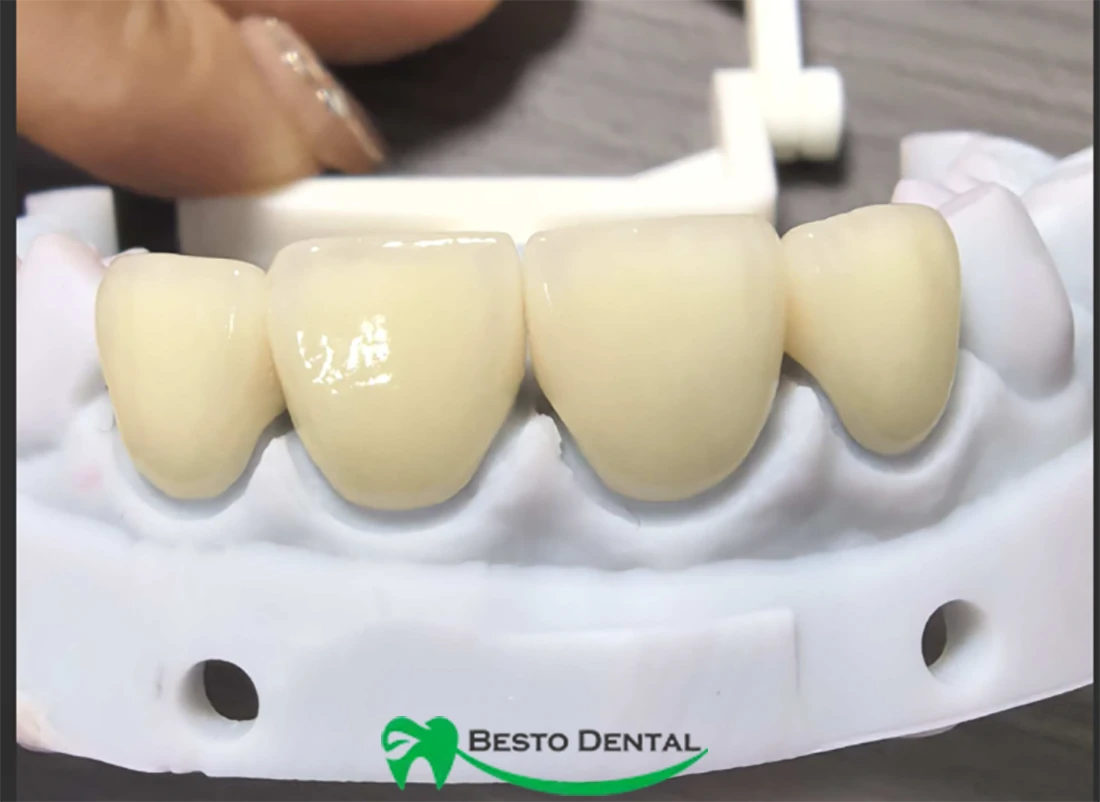
Layered Zirconia is a dental restoration that uses zirconia as the inner coping or framework, with veneering porcelain layered over its surface to enhance translucency, color depth, and overall esthetics. Imagine it’s as if it’s a sturdy core structure with a pretty face that’s wrapped around it. The zirconia substructure gives structure, color, translucency, and surface detail to the veneering porcelain, making this restoration look like a real tooth.
The zirconia coping is milled to fit the prepared tooth, and the dental technician builds up the various layers of zirconia powder on top of the prepared tooth. Each layer is fired in a ceramic furnace, and the depth of colour and natural light effects achieved can not be obtained in one block of material. The result is a restoration that is optically realistic and is not cracked like zirconia.
Here are the main advantages of layered zirconia:
- Lifelike aesthetics: The use of layered porcelain creates a lifelike appearance because the degree of translucency is different from the cervical portion to the incisal edge. It is particularly important at places from where it can be looked upon at a distance.
- Fine detail: A skilled tech can reproduce the characteristics of natural teeth, including subtle surface textures, incisal halos, and mamelon effects.
- Reliable fracture resistance: The zirconia structure below provides the structure and strength to the restoration without depending upon porcelain.
- Good masking: Discolored abutments or dark implant components can be masked well with the zirconia core, often a challenge in aesthetic cases.
- Repairable surface: When the porcelain surface chipping occurs, it may be possible to repair the surface in the chair or in the lab without having to replace the entire restoration.
- Fine control of shade matching: The technician can achieve fine control in matching shades in the porcelain because it is hand-built.
In clinical practice, layered zirconia is a choice for anterior crowns, anterior bridges, premolar restorations, and implant crowns or bridges in aesthetic zones most commonly in practice. It is beneficial when the case calls for the structural stability and aesthetics of a monolithic restoration, which can be more difficult to achieve.
2. Structure of Layered Zirconia
Layered zirconia is a bilayered material comprising a zirconia core and a porcelain outer layer, each with a distinct purpose.
| Layer | Function |
|---|---|
| Zirconia framework/coping | Provides the main strength and structural support |
| Veneering porcelain | Shapes color, translucency, incisal effects, and tooth form |
| Stain/glaze | Final adjustment of shade, surface texture, and gloss |
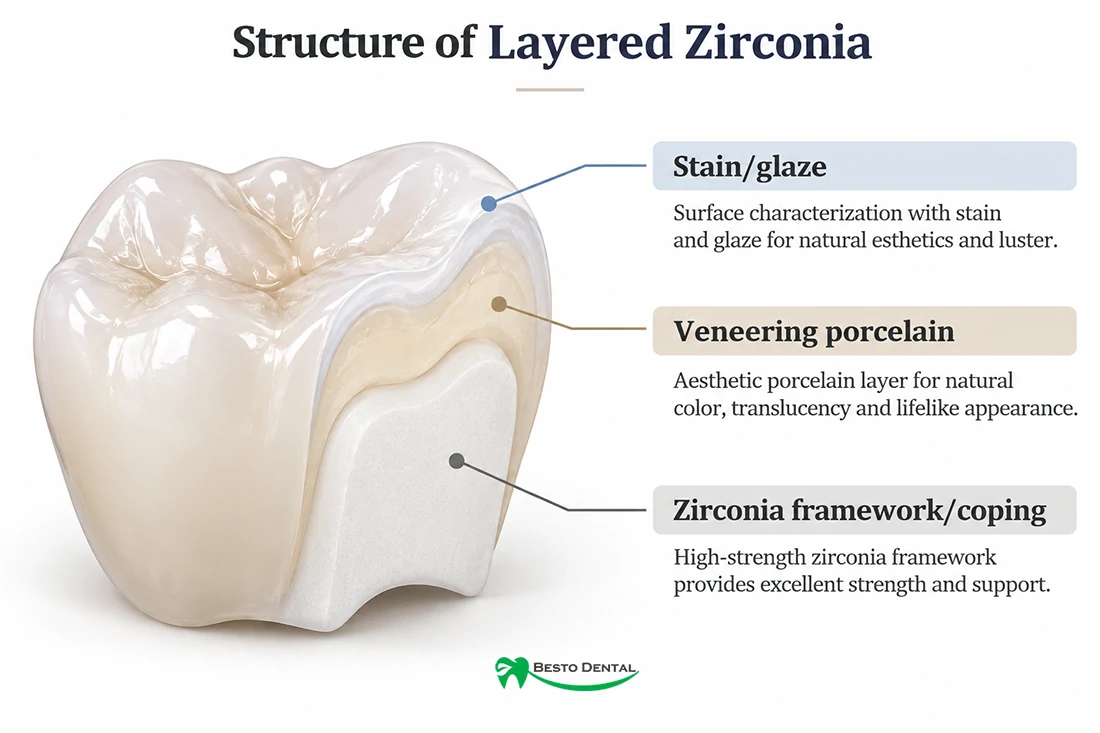
The different layers have varying roles in the entire restoration: mechanical, structural, color, translucency, surface texture, and gloss. This layering system makes it possible to have zirconia restorations with both the mechanical properties of zirconia and custom esthetic properties of porcelain, suitable in cases where both strength and esthetic properties are important.
3. Materials for Layered Zirconia
We previously mentioned that multilayered zirconia comes in two structural types; let us therefore discuss the material from these two perspectives. Layered zirconia comprises two kinds of material: Zirconia framework and veneering porcelain.
Yttria Stabilized Tetragonal Zirconia Polycrystal (Y-TZP) is virtually always the material used for the framework. Within that category, there are 3Y, 4Y, and 5Y concentrations of yttria. These are not individual material types but rather individual grades, and each grade is at a different position on the strength-to-translucency spectrum. The porcelain that is used to layer zirconia is generally a low-fusing feldspathic ceramic designed for use with zirconia frameworks. A lithium disilicate-based ceramic can be used for overpressing in some cases, or most often, feldspathic porcelain can be hand-layered.
Below is a brief comparison of the two primary frameworks and veneers available:
| Material | Main Characteristics | Common Considerations |
|---|---|---|
| 3Y-TZP (zirconia framework) | Highest flexural strength and fracture toughness among the Y-TZP grades | Lowest translucency; requires full porcelain coverage to achieve acceptable aesthetics; the standard choice when the framework will be fully veneered |
| 4Y-TZP (zirconia framework) | Moderate strength with improved translucency compared to 3Y | Sits between 3Y and 5Y on both strength and translucency; suitable for cases where the framework contributes more to the final shade |
| 5Y-TZP (zirconia framework) | Highest translucency among the Y-TZP grades | Lowest mechanical properties; better suited for anterior restorations with lighter loads; framework shade may affect the final color of thin porcelain layers |
| Feldspathic veneering porcelain | Coefficient of thermal expansion matched to zirconia; broad shade range; supports layering and characterization | Chipping remains the primary failure mode; porcelain must be adequately supported by the framework and not exceed 1.5 mm of unsupported thickness |
| Lithium disilicate (overpress) | Higher strength than feldspathic porcelain; suitable for overpressing techniques | Limited shade customization compared to hand-layered feldspathic porcelain; not all zirconia framework designs are compatible |
BestoDental deals with layered zirconia cases on a daily basis. In our lab, material selection for layered zirconia is not primarily about brand matching; it depends on the strength- translucency trade-off among framework grades (3Y/4Y/5Y) and CTE matching with the veneering porcelain, and is ultimately determined by restoration site, load, and porcelain thickness. The yttria content of the zirconia framework determines its position on the strength–translucency spectrum; the primary factor in veneering porcelain selection is CTE matching with zirconia.
Clinically, the choice among 3Y, 4Y, 5Y, and corresponding veneering porcelains is then made according to restoration site, load, and porcelain thickness.
| Material / Factor | Key Parameter | Characteristics | Clinical Choice |
|---|---|---|---|
| 3Y-TZP | 3 mol% Y₂O₃; nearly 100% tetragonal phase | Highest flexural strength and fracture toughness; relatively opaque, can mask discoloration | Commonly used for posterior layered crowns/bridges; core provides strength, porcelain provides aesthetics |
| 4Y-TZP | Between 3Y and 5Y | Balanced strength and translucency | Considered when framework shade needs to contribute to aesthetics; less common than 3Y for layered frameworks |
| 5Y-TZP | 5 mol% Y₂O₃; approx. 50% cubic phase | Significantly improved translucency; reduced strength and toughness | Not recommended for high-load posterior layered restorations |
| Veneering porcelain | CTE should be close to zirconia, approx. 10.8 × 10⁻⁶ K⁻¹ (25–500°C) | Reduces interfacial residual stress, lowering risk of cracking or delayed chipping | VITA VM9: 8.8–9.2; GC Initial Zr: 9.4; both within usable range |
| Porcelain thickness | Generous space → thicker porcelain; tight space → thinner porcelain | Thicker: better color/translucency control; thinner: framework shade more visible | May consider a more translucent or lighter framework, but only if occlusal load permits |
If you would like to learn more about how to correctly choose between 3Y, 4Y, and 5Y, you can check out our other article: 3Y vs. 5Y Zirconia for Dental Bridges.
4. Layered Zirconia Fabrication Process
The fabrication of layered zirconia follows a sequence that starts with digital design and ends with a finished, characterized restoration. We have summarized the production process into the following key steps.
| Stage | What Happens | What to Keep in Mind |
|---|---|---|
| Design | Technician designs zirconia coping based on scan or model, leaving room for porcelain on the facial and incisal surfaces | The framework should evenly support the porcelain; otherwise, there is a risk of unsupported porcelain and chipping of the framework |
| Mill and sinter | The zirconia framework is CAD/CAM milled from a blank and then sintered at high temperature to achieve full density and strength | Sintering temperature and cycle consistency are directly related to the final strength and shade of zirconia |
| Cutback | The technician reduces the framework in areas where porcelain will be added, typically on the facial and incisal surfaces for anterior cases | The correct amount of cutback provides an adequate amount of space for the technician to build up porcelain; there is an aesthetic control limitation if there is not enough cutback. |
| Layer porcelain | Different porcelain powders are applied in layers to build up color, translucency, and tooth form | The thickness of porcelain should be even and supported; unsupported porcelain thicker than 1.5 mm is a known risk factor for chipping. |
| Fire and adjust | The layered restoration is fired, and then length, shape, contacts, and occlusion are adjusted by the technician | Firing cycles must match the porcelain system; improper cooling rates can introduce residual stress at the interface |
| Stain, glaze, final check | Surface characterisation, gloss control, and final surface inspection of fit, shade, and function. | At the last check, the marginal fit, contact tightness, occlusion, and shade match should be checked. |
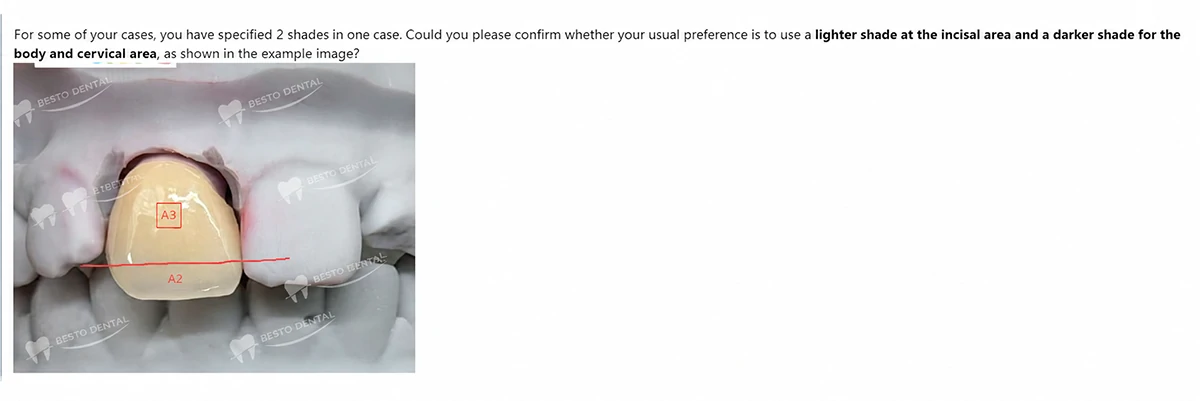
Therefore, it is recommended that you clearly specify the restoration’s shade using the standard VITA Shade Guide when submitting the case for the first time. If you desire a natural gradient effect with distinct color variations across the cervical, body, and incisal regions, please provide shade information for each of these three areas so that the laboratory can accurately replicate your requirements during fabrication. BestoDental will confirm with you before proceeding with actual production.
5. Clinical Applications of Layered Zirconia
Layered zirconia is primarily used in clinical cases that require both the strength of zirconia and high aesthetic appeal—such as single crowns or bridges in the anterior region, premolar restorations, and implant-supported crowns or bridges in the aesthetic zone.
| Specific Clinical Situation | How Layered Zirconia Is Used | Main Considerations |
|---|---|---|
| Single anterior crown with high aesthetic demand | The zirconia framework supports a layered porcelain build-up that recreates natural translucency and incisal character | Adequate incisal and facial reduction is needed; the technician needs a clear shade prescription and preferably photographs of adjacent teeth |
| Anterior bridge with one or more pontics | The zirconia framework covers the edentulous area, and the layer of porcelain covers the pontic and retainers | Connector size should not be smaller than necessary for the span; the design of the pontics should ensure proper tissue contact and cleaning |
| Premolar restoration in the aesthetic transition zone | Layered zirconia offers a natural color blend with strength, while a monolithic is less | The case may be able to have a little less reduction than an anterior case, but there is still a need for porcelain support |
| Implant crown in the aesthetic zone | The zirconia framework hides the abutment and the implant; the porcelain layering will be able to match the natural teeth surrounding the implant | The final shade will be influenced by the color and material of the abutments; the technician may have to change the shade of the framework or change the opaque layer |
| Implant bridge in the anterior or premolar region | Visual consistency is achieved through the framework that is designed in multiple implant units and involves multiple layers of porcelain | The implant angulation and abutment position affect the type of framework; sufficient space for porcelain needs to be verified |
Layered zirconia is often proposed as the solution for anterior implant crowns. The most common problem is that the underlying implant abutment (titanium or a darker zirconia) can influence the final color and brightness of the restoration.
Sometimes, the shade of the abutments is neglected. The technician should adjust the framework shade or add more masking to make up for the color if the abutment is much darker than the prescribed restorative shade. This may not be achieved after fabrication, and the shade and the material used for abutments should be discussed with the laboratory at the prescription level.
Soft tissue profile is another factor to consider. The gingival margin around an anterior implant crown is frequently thin and fragile, and the restoration should support a natural profile of the gingival margin while not exerting any pressure on the tissue. It affects the whole design of the frame and the contour of its crown or pontics. In these cases, layered zirconia is frequently chosen, but the final decision relies on the clinical assessment of the condition of the abutments, tissue architecture, and the patient’s aesthetic desires.
For a broader overview of zirconia crown types, materials, manufacturing methods, and clinical applications, see our Zirconia Crowns Guide.
6. Layered Zirconia FAQs
To help you gain a more comprehensive understanding of layered zirconia, we have compiled the questions customers care about most and provided detailed answers based on practical circumstances.
1) What are the space and tooth preparation requirements for layered zirconia?
Layered zirconia is a bilayered zirconia, which requires a greater reduction than a monolithic zirconia crown. A rule of thumb is at least 1 mm of reduction at the axial wall and 1.5-2 mm in the incisal/occlusal reduction. This allows sufficient space for zirconia framework and porcelain over the top. The preparation will be too thin if insufficient space is left, or the framework too small if not. Both thin preparation and undersized framework will impact the final result.
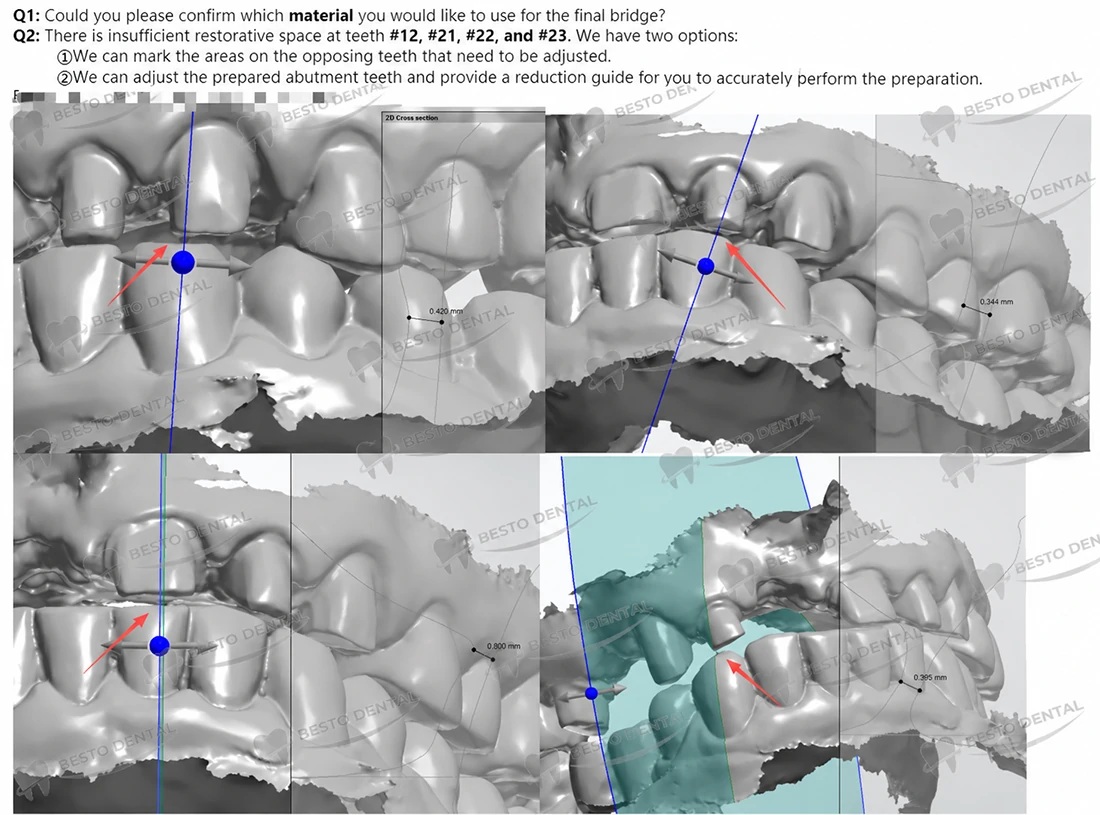
2) What if my tooth preparation is insufficient?
If the preparation does not meet the minimum requirements, the professional lab will provide you with timely feedback regarding this issue. BestoDental will generally provide you 2 options. One option is to prepare the opposing tooth and mark the contact area so the dentist can adjust the design accordingly. Another option is to prepare the abutment further and provide a new reduction guide.
3) What information do I need to provide when sending a layered zirconia case to the laboratory?
The scan or impression, the shade, the tooth position and type of restoration, margin design details, and any special requirements for esthetics should be provided. Include information about the implant system and abutment if there is an implant. Photographs of the surrounding teeth may be of assistance in cases involving shade matching, particularly anterior cases. You will have less final work to do when the information you send is more precise.
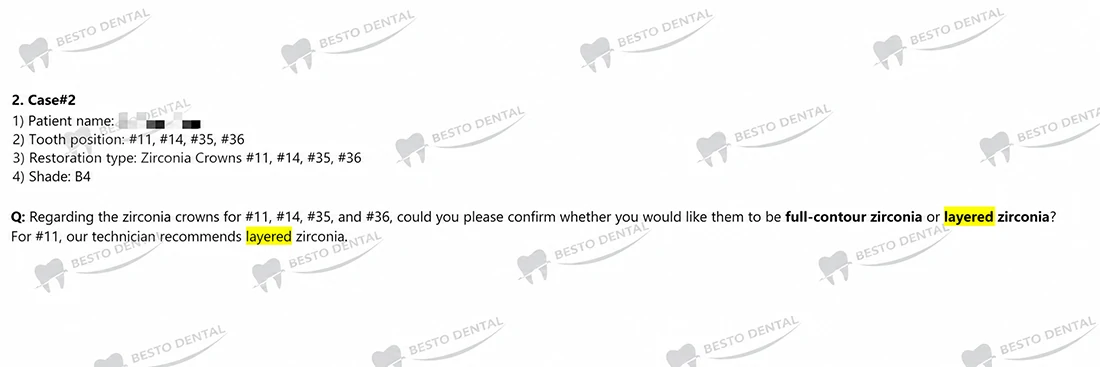
4) Which is better: full-contour zirconia versus layered zirconia?
In the event that you’re uncertain about any choices, you can have the laboratory complete the determination. These can be evaluated by the lab, and it may recommend the appropriate preparation space, occlusion, aesthetic considerations, or abutment condition. Production can begin once a specific design is recommended by the laboratory if none is specified.
5) Can a layer of zirconia be used on patients who grind their teeth?
The main body of the layered zirconia is formed of zirconia, while the outside is made of porcelain, which is more prone to chipping out when exposed to heavy occlusal forces. A monolithic zirconia design might be a more predictable long-term option for patients with bruxism and/or a history of restoration fractures. When using layered zirconia again, it is important to thoroughly analyze the occlusion and the porcelain support.
6) Can layered zirconia be used for long-span bridges?
For bridges, it is possible to use layered zirconia, but the requirements for the length of the bridge span and connector dimensions are suitable for the material. As the length of the span increases, the connectors and the porcelain-to-zirconia interface are subjected to increased stress. The lab should review the case and determine if this framework design is suitable for the porcelain layering over the entire span.
7. Conclusion
Layered Zirconia combines a strong zirconia framework with an esthetic veneering ceramic, allowing the restoration to balance structural support with more natural translucency, color depth, and surface characterization.
This guide has covered the structure of Layered Zirconia, how it differs from Monolithic and Multilayer Zirconia, its common fabrication process, advantages and limitations, and its main clinical applications in crowns, bridges, and esthetic restorations.
By understanding these fundamentals, dentists and dental laboratories can better determine when Layered Zirconia is appropriate, what factors may affect esthetics and long-term performance, and what information should be communicated before production. This helps dentists better understand what to expect in terms of material selection, restoration design, shade requirements, and laboratory fabrication when outsourcing zirconia restorations.