As you send a case to a dental lab for a cast partial denture, you might want to know how the framework should be designed. What material should be used? Whether there is enough room, and whether the lab can properly interpret the clinical information into a properly designed and fabricated restoration? These are precisely the things our clients are concerned about.
This guide discusses the principles of the main design components, materials used, and the fabrication of a cast partial denture in order to increase your understanding of the most important steps involved after a case is sent to the lab.
At the completion of this guide, you will be familiar with the impact that the key framework components have on support, retention, and stability, and will understand the difference between the practical applications of cobalt-chromium and titanium materials, as well as the clinical information and fabrication details to be confirmed with the lab before production can begin.
1. What Is a Cast Partial Denture?
A cast partial denture is a removable denture that is constructed around a metal framework that has been custom cast. The framework is placed over the remaining natural teeth and the edentulous areas, and it holds the artificial teeth in place, as well as the pink acrylic base over the missing gum tissue.
The metal framework provides the structure to a cast partial. The framework is based on prepared tooth surfaces; it clutches onto the abutment teeth and spreads chewing forces throughout the arch. A metal framework is used to construct the acrylic base and artificial teeth. Imagine it as the metal structure is the bones and the acrylic and teeth are the skin and soft tissue above.
This type of partial denture is rigid, stable, and long-lasting thanks to the metal structure it is supported by. It is not supported by the acrylic, which is why cast partials are able to withstand biting forces and have a longer lifespan than acrylic partials.
The major advantages of cast partial dentures are:
- Rigid support/stability: This cast metal structure provides rigid support and a stable base for the chewing forces, which keeps stress off any individual abutment tooth.
- Accurate fit: The framework is cast from an accurate model, ensuring a close fit to the teeth and tissues for greater comfort and retention.
- Durability: The metal framework will not deform or fracture when subjected to normal chewing forces, and the service life of cast partials is longer than that of acrylic-only partials.
- Thinner and lighter design: With the high strength of Co-Cr alloys, a thinner and lighter design is possible without compromising rigidity. This will reduce oral congestion.
- Adaptable and reparable: It can be readjusted, and teeth or clasps can be attached afterward when the patient’s dental condition changes.
- Low cost in multi-missing teeth: A cast partial is more economical for more than one missing tooth than implants or multi-tooth fixed bridges.
In clinical practice, cast partial dentures are considered for partially edentulous arches in which the remaining teeth can provide adequate support and retention for a removable prosthesis. They may also be an option when fixed or implant-supported treatment is not preferred or not suitable, or when the remaining dentition requires additional support.
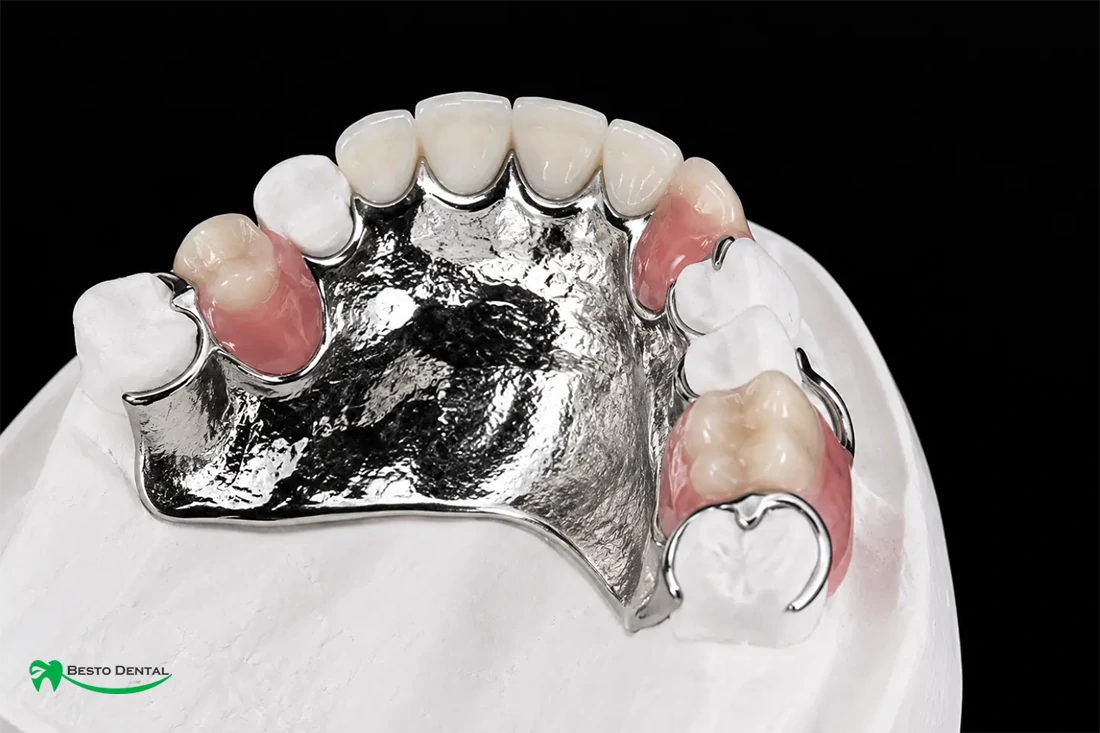
To help you better distinguish between cast partials and acrylic partials, we have prepared the following comparison table:
| Cast Partial | Acrylic Partial | |
|---|---|---|
| Main Structure | Co-Cr Metal Framework | Acrylic |
| Strength | High | Relatively low |
| Thickness | Can be relatively thin | Usually relatively thick |
| Stability | Relatively good | Relatively average |
| Support Type | Tooth-supported + mucosa-supported | More reliant on mucosa |
| Clasp | Mostly part of the metal framework | Wire clasp is common |
| Adjustment / Adding Teeth | Relatively complex | Relatively easy |
| Fabrication Complexity | High | Low |
| Cost | High | Low |
| Common Uses | Long-term restoration | Temporary/transitional or economical restorations are also common |
2. Cast Partial Denture Design
A cast partial denture consists of multiple components, each serving a distinct function; therefore, design is a crucial aspect of the process.
| Framework Component | Main Function |
|---|---|
| Major Connector | Connects components across the arch into one rigid unit and distributes forces |
| Minor Connectors | Link clasps, rests, and the denture base to the major connector |
| Rests | Provide vertical support and prevent the denture from sinking into the tissue |
| Direct Retainers / Clasps | Engage undercuts on abutment teeth to resist dislodgment |
| Indirect Retainers | Resist rotation of the denture around the fulcrum line, mainly in distal extension cases |
| Denture Base Retentive Mesh | Provides mechanical retention for the acrylic denture base and connects the edentulous area to the framework |
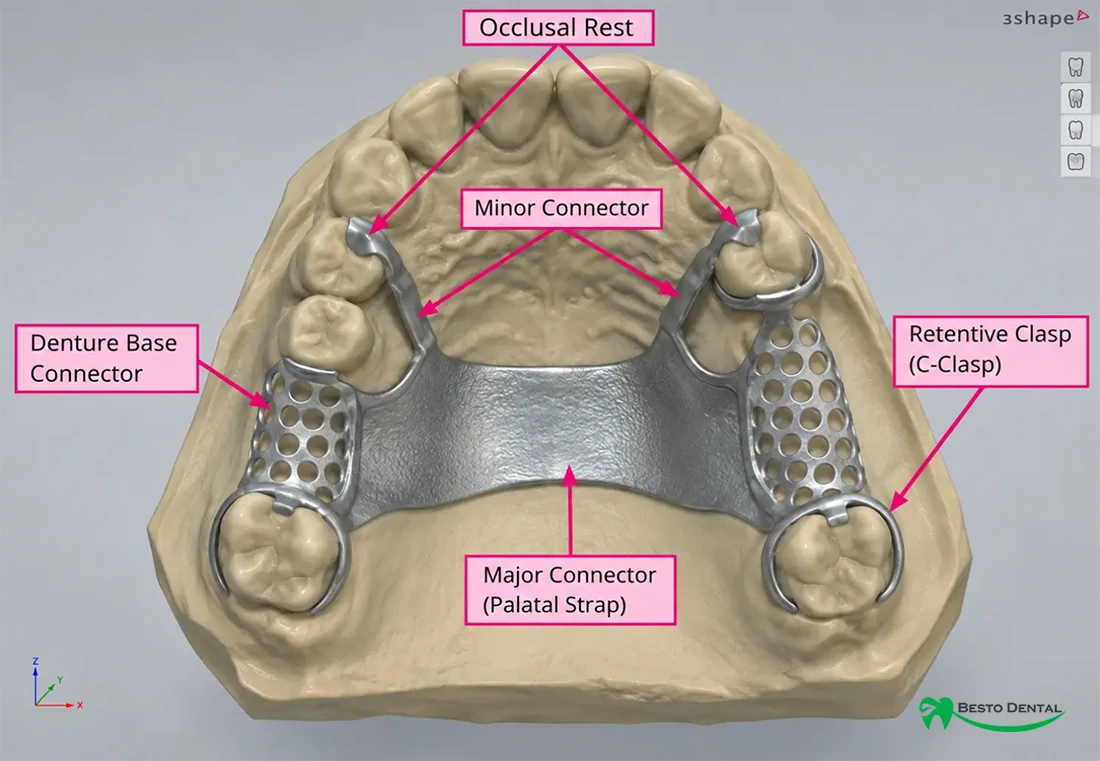
Every cast partial framework is designed around three core functions: support, retention, and stability. These three functions work together, and the framework design must balance them for each case.
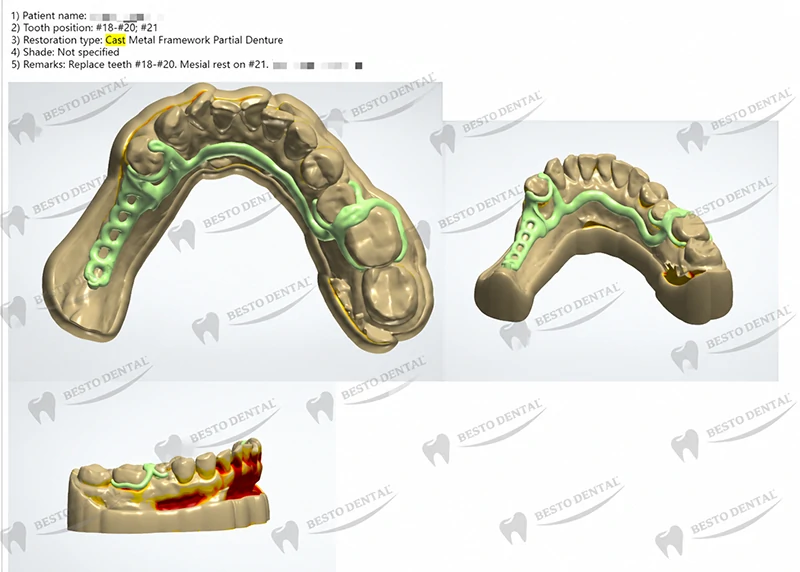
Framework design starts with accurate clinical information. BestoDental technicians evaluate the master model or digital scan data to determine the proposed path of insertion, the contours of the abutment teeth, the available undercuts, the edentulous areas, and the space available for each framework component. The path of insertion is especially important because it determines where the clasps will engage and how the framework will seat onto the teeth.
BestoDental will send the design drawing of the metal framework to the client for review; we will proceed with fabrication only after confirmation.
3. Materials for Cast Partial Denture
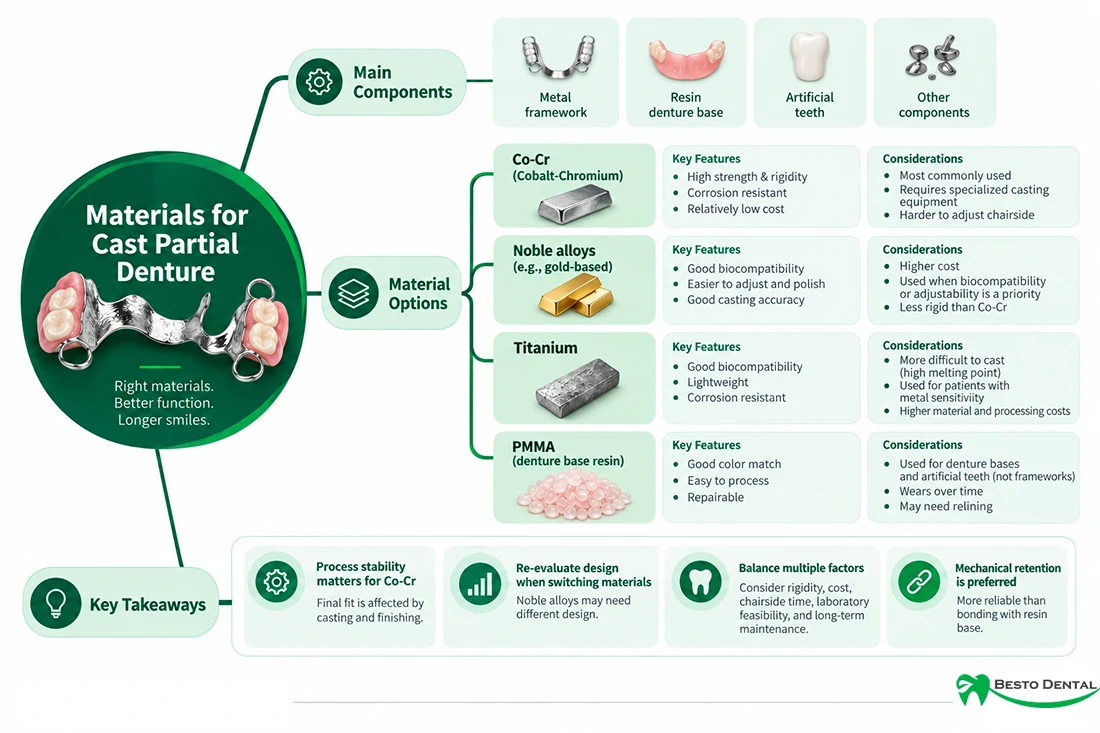
Cast partial dentures usually include a metal framework, a resin denture base, artificial teeth, and other components; from a material standpoint, they can be broadly divided into the metal framework and the resin portion.
In routine orders from our overseas clients, Co-Cr is the most common material. Normally, Co-Cr alloy is used for the framework, and noble alloys and titanium are used for specific requirements. The denture base and artificial teeth usually use PMMA (polymethyl methacrylate), as well as prefabricated teeth from brands such as Ivoclar and Yamahachi. We covered this in detail in the earlier Complete Denture Guide. The table below provides a quick comparison of material options.
| Material | Main Characteristics | Common Considerations |
|---|---|---|
| Co-Cr (Cobalt-Chromium) | High strength, high modulus of elasticity, corrosion resistant, relatively low cost; can be cast thin while maintaining rigidity | Most commonly used framework material; requires specialized casting equipment; harder to adjust chairside than noble alloys |
| Noble alloys (e.g., gold-based, palladium-based) | Good biocompatibility, easier to adjust and polish, good casting accuracy; softer than Co-Cr | Higher cost; used when biocompatibility or adjustability is a priority; less rigid than Co-Cr, so framework design may need to be modified accordingly |
| Titanium | Good biocompatibility, lightweight, corrosion resistant | More difficult to cast than Co-Cr due to high melting point; used for patients with metal sensitivity; higher material and processing costs |
| PMMA (denture base resin) | Good color match to gingival tissues, easy to process, repairable | Used for denture bases and artificial teeth, not frameworks; wears over time and may need relining as the alveolar ridge changes |
4. Cast Partial Denture Fabrication Process
A sequence of steps is involved in the fabrication of a cast partial denture. The metal structure is constructed first, followed by the acrylic base and acrylic teeth. Here’s how it works, step-by-step.
| Step | Stage | Key Actions | Purpose / Notes |
|---|---|---|---|
| 1 | Digital Impression / Scanning | Intraoral scan or physical impression; lab receives scan data or poured model. | Basis for framework design; accuracy is critical for all later steps. |
| 2 | Framework Design | Plan path of insertion, mark rest seats, design clasp arms, outline major/minor connectors, plan meshwork. | Customized for each case based on clinical information. |
| 3 | Blockout and Model Duplication | Block out areas not to be reproduced; duplicate master model to create refractory cast. | Prevents unwanted metal contact; refractory cast is heat-resistant for waxing and casting. |
| 4 | Wax Pattern Fabrication | Build framework in wax on refractory cast; replicate exact shape and thickness of all components. | Wax pattern is the blueprint for the final casting and must be precise. |
| 5 | Investing and Casting | Invest wax pattern; burn out wax; cast molten Co-Cr alloy; break away investment. | Creates the cast metal framework. |
| 6 | Finishing and Polishing | Clean framework, cut sprues, finish and polish; check fit on master model. | Produces a smooth, hygienic surface and verifies fit. |
| 7 | Framework Try-In | Send framework to clinic; dentist checks fit, rest seating, clasp adaptation, and comfort; adjust if needed. | Critical verification before acrylic work; easier to adjust or remake before processing. |
| 8 | Occlusal Registration and Tooth Setup | Dentist records bite; lab sets artificial teeth on framework and builds wax rim. | Establishes occlusion and tooth position. |
| 9 | Wax Try-In | Evaluate appearance, bite, and fit with teeth set in wax. | Allows dentist and patient to approve before final processing. |
| 10 | Resin Processing | Replace wax with heat-cured PMMA; pack and cure under heat and pressure; acrylic flows through mesh. | Forms the final denture base and bonds it to the framework. |
| 11 | Finishing and Quality Control | Trim, polish, check fit and occlusion; verify framework/acrylic bond and design specs. | Ensures the finished cast partial meets requirements before delivery. |
If the dentist has specific clinical requirements, those should be included in the case information. For example, in some cases, our clients prefer to avoid visible metal on the buccal side, so the clasp design and framework placement need to account for that. In other cases, the available undercut may be shallow, so the clasp design must be modified to provide adequate retention without excessive force. The more clinical information the dental lab has, the closer the finished product will be to the result you desire. Of course, don’t forget the shade either.
5. Cast Partial Denture Clinical Application
In the cases we handle, partial dentures are most commonly employed when the partially edentulous arch requires a removable prosthesis that is able to replace a long span of missing teeth, stabilize remaining teeth, and/or close a defect. The clinical requirements depend more on what is going on in the mouth than on the number of missing teeth,mobile abutments, unhealed resection site, tilted teeth, or a posterior edentulous area that will be supported partially by mucosa.
The table below covers the majority of cast partial denture applications seen in practice.
| Specific Clinical Situation | How the Product Is Used | Main Considerations |
|---|---|---|
| Multiple posterior teeth missing, with remaining teeth insufficient for a fixed bridge | A cast framework will provide occlusal distribution over multiple abutments and edentulous areas and replace missing posterior teeth | Modifications to cast impressions, including abutment distribution, rest seat preparation, common path of insertion, occlusal clearance and whether any posterior extension area is without a distal abutment and needs an altered cast impression |
| Periodontally compromised abutment teeth with partial edentulism | The framework splints mobile teeth or replaces missing teeth, and may include other stabilizing elements such as lingual plating, continuous rests, etc. | The first step is to control periodontal inflammation, followed by assessment of the crown to root ratio, bone support, oral hygiene, and splinting to adjacent sound teeth or the use of crowns |
| Maxillary defect after resection or trauma with missing teeth | The frame is used to hold an obturator in place and to replace teeth that close communication between the oral and nasal/sinus cavities | Size and location of the defect, open versus closed defect, impression technique, soft tissue sensitivities, coordination with surgeon, and hygiene access |
| Anterior tooth loss with posterior teeth available as abutments | A cast framework can be used to replace the anterior teeth, but it will not be as noticeable as the metal. | Lip support, anterior esthetics, clasp placement, shade matching, and possible use of attachments or lingual retention |
| Tilted, drifted, or supraerupted remaining teeth with a poor common path of insertion | The framework is designed with a modified path of insertion, guide planes, or restoration of selected abutments to create a workable removable prosthesis | Diagnostic casts and survey are essential; abutment recontouring or crowns may be required, and forced seating can damage teeth and the framework |
| Unilateral posterior edentulism with no distal natural abutment | The framework and base restore missing posterior teeth, with support shared between abutment teeth and the residual ridge | Functional or altered cast impression, base extension, avoiding torque on the abutment, and patient tolerance of a posterior extension base |
| Patient needs a removable prosthesis retained by precision attachments rather than visible clasps | The framework carries extracoronal or intracoronal attachments and replaces missing teeth with improved esthetics | Abutment crown preparation, available space, path of insertion, attachment maintenance, cost, and patient ability to clean around attachments |
| Long edentulous span in one arch with opposing natural dentition or fixed prosthesis | The framework restores arch continuity and distributes occlusal forces | Occlusal scheme, framework rigidity, abutment protection, and verification of fit at framework try-in |
6. Cast Partial Denture FAQs
In practical cast partial denture cases, we’ve found that clients often focus on the following questions, so we’ve compiled them here for your reference.
1) Do you fabricate complete cast partial dentures or metal frameworks only?
In most labs, both are available. You can order the metal dental framework only, or a complete cast partial denture with the framework, acrylic base, and denture teeth.
2) Can a metal framework be combined with Valplast or flexible clasps?
Yes, in suitable cases. A metal framework can provide the main support and stability, while flexible clasps may be used in selected areas where improved esthetics are needed. The final design depends on the abutment teeth and available retention.
3) Can visible metal clasps be avoided in the anterior area?
In many cases, yes. The clasp position can be adjusted, or flexible clasp options can be considered to reduce visible metal. However, the final design still needs to provide adequate retention and stability.
4) Do I need to specify where the rests should be placed?
Not always. The laboratory can propose rest positions based on the case design. However, if you have already prepared specific rest seats or have a preferred design, it is important to clearly indicate their locations when sending the case.
5) How do you decide between metal and flexible clasps?
The choice depends on the position of the abutment teeth, available undercuts, retention requirements, and esthetic concerns. Metal clasps usually provide more predictable rigidity and retention, while flexible clasps may be considered in visible areas when the case design allows.
7. Conclusion
This guide has covered the main components and design principles of cast partial dentures, commonly used framework materials, the typical fabrication process, and several practical questions that often arise when outsourcing these cases.
After reading this guide, you should have a clearer understanding of how a cast partial denture is planned and fabricated, what information should be provided before production, and which design details are worth confirming with your dental laboratory. This can help reduce unnecessary communication, avoid preventable remakes, and make cast partial denture cases more predictable from prescription to delivery. If you are looking to quickly find a suitable laboratory for outsourcing cast partial dentures, we have listed 10 excellent labs for your reference in the article Top 10 Full Cast Restoration Labs in the World.