You want to replace a patient’s existing complete denture with a new one while maintaining the current tooth arrangement. Can the laboratory reproduce it accurately? Can the existing bite and VDO be maintained or adjusted? Is a try-in available before final processing? And can the case be fabricated as a fully milled denture? By the end of this guide, you will have the answers to these questions.
This guide systematically covers key aspects of the complete denture process, including the various types of conventional, immediate, overdenture, implant-retained, and transitional dentures, properties of base materials and artificial teeth available by brand, and the step-wise clinical and lab procedures involved in the process that determine the success or failure of the final result.
By the end of the reading, you will know what you need to know about the specific indications for each denture type based on the stage of healing, bone support, and patient expectations; you will know how each type of base material and tooth material affects performance, in terms of durability, fit, aesthetics, and the future need for relining; you will also know the essential checking points during the process of jaw relation recording, wax try-in, and bite verification that prevent the most common causes of patient dissatisfaction and laboratory remakes.
1. What Is a Complete Denture?
A complete denture is a removable dental restoration used to replace all natural teeth in either the upper or lower jaw or both. It is made up of a flesh coloured acrylic base, which lies directly on the gums and underlying bone, and a complete set of artificial teeth is attached to this base.
Unlike a partial denture that attaches to adjacent dentition, a complete denture is totally dependent on the form of the ridge, muscle control, and the thin layer of saliva that is between the base and the mucosa. The lower arch is horseshoe-shaped, has a small area of retention, and is stabilized more by the muscles. The lower arch is dependent more on the muscles because it has a small area of retention and is horseshoe-shaped. When used, the chewing forces of the artificial teeth are transmitted through the denture to the residual ridge as evenly as possible with minimal stress to any one area of the denture base.
The advantages of a full denture are more than just the replacement of missing teeth.
- Restored chewing capacity: Replaces occlusal surfaces necessary for food mastication to restore patients’ capability of eating a diversified diet, providing appropriate nutrition.
- Facial structure: Restores lip and facial support when natural teeth are missing, reduces facial wrinkles, and provides a more natural facial profile.
- Better clarity of speech: Replaces speech structures that the tongue comes in contact with when speaking, especially the consonant sounds where the tongue needs to touch the teeth.
- No surgery required: This replacement is more affordable than implant-supported restorations, and patients with financial limitations can afford it.
- Non-invasive and reversible: involves no bone drilling and no preparation of adjacent teeth; makes no permanent changes to the tissues.
- Relatively quick turnaround: The process from impression to delivery of the denture is between 4-6 weeks depending on the situation, and immediate dentures are provided for patients who do not require time for the healing phase.
- Modifiable to the changing anatomy: This allows for the complete prosthesis to be relined, rebased, or repaired if the residual ridge recedes over time, allowing for the functional lifespan of the prosthesis to be extended without a remake.
- Can be upgraded for the future: Provides a baseline restoration that can be converted to an implant-retained overdenture if the patient’s bone and budget allow.
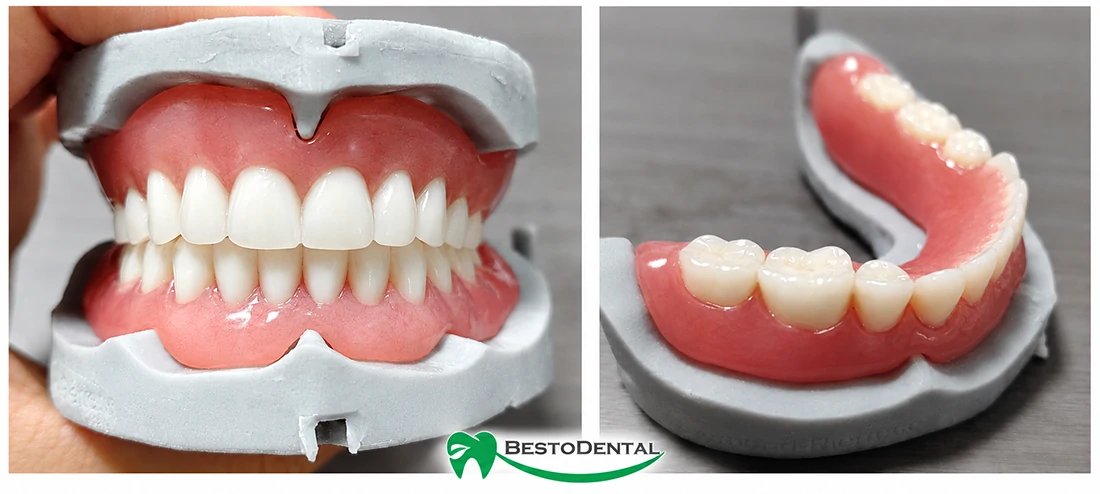
Complete dentures are indicated for patients who have lost all their natural teeth in an arch as a result of advanced periodontal disease, extensive decay, traumatic injury, or long-term wear. They are also a temporary solution for patients who need a second appointment for implant placement, providing a temporary restoration in the meantime until they can get the implants placed.
2. Types of Complete Dentures
Full dentures come in several forms, each tailored to different clinical scenarios. The right choice depends on the patient’s healing stage, bone support, aesthetic expectations, and whether implants are part of the plan. Among BestoDental’s clients, the immediate complete denture is the most frequently requested option. Here is a well-defined list of the principal types.
| Type | Key Differences |
|---|---|
| Conventional Complete Denture | Fabricated after full tissue healing (typically 2–3 months post‑extraction). This is the standard, long‑term prosthesis, offering a precise and stable fit. |
| Immediate Complete Denture | Inserted on the day of the extraction, so that the patient does not have to endure a toothless time. However, these dentures typically need to be relined or adjusted within the next few months because of the continuing bone and gum remodeling. |
| Overdenture | Retains 1 or more natural tooth roots, adding support and retention with implants. This helps maintain alveolar bone and stability of the prostheses. |
| Implant‑Supported / Implant‑Retained Overdenture | An overdenture that uses an implant as a support base and involves the use of attachments like Locator, Ball, or Bar systems. This provides better retention and chewing ability than traditional designs. |
| Interim / Transitional Complete Denture | A temporary denture for use during intermediate treatment phases. It preserves the beauty and utility until the final permanent restoration is designed and/or made. |
Which type is the best? The decision should be based on the patient’s oral health, budget, and long‑term expectations. Immediate dentures are ideal for those who want to avoid a visible toothless stage, but patients should anticipate follow‑up adjustments as healing progresses. For those seeking maximum stability and longevity, implant‑retained solutions are excellent, though they involve surgery and a higher initial investment.
3. Materials of Complete Dentures
A complete denture consists of two structures: the denture base and the denture teeth. They both have different materials, and the selection makes a difference in terms of durability, fit, and patient comfort as well as appearance.
1) Base Materials
The base is required to be strong enough to resist chewing forces, but also be compatible with oral tissues. The most frequently used ones are:
| Material | Key Features |
|---|---|
| PMMA (Polymethyl Methacrylate) | The industry standard since the 1930s. Available as heat‑cured (conventional) or CAD/CAM milled (stronger, more precise). Repairing & polishing is easy. |
| Metal Frameworks | Usually cobalt‑chromium or titanium. Reused for reinforcement and/or as thin, rigid frameworks, particularly in implant-supported cases. Titanium is a bit lighter and hypoallergenic, with a price around 40% higher. |
| Flexible Thermoplastics (e.g., polyamide/nylon) | Very flexible and will not break with normal use, but may be hard to relain or repair. More popular for partial dentures than full arches. |
Heat‑cured PMMA continues to be the most convenient and economical solution for routine cases. For extra strength or precision, milled PMMA or metal-reinforced bases are preferred.
2) Teeth Materials
In practice, dental laboratories rarely specify the material of artificial teeth by type alone. We select by brand. There are several different types of teeth available from leading Manufacturers, with varying degrees of wear resistance and aesthetics. The most common brands indicated are: Ivoclar, Yamahachi, Shofu, VITA, and Kulzer.
When the client does not specify the preferred brand, BestoDental will proactively communicate with the client for production in order to choose the most suitable brand for the client’s functional and aesthetic expectations. If you would like more information about the materials, please contact us to request a material list.
4. Fabrication Process of Complete Dentures
A full denture procedure alternates between the clinic and the lab. They are all dependent upon the accuracy of the previous step, and a reliable outcome depends on accuracy at each step.
1) Key stages of Complete Dentures
The key stages and what happens at each are listed below.
| Stage | What Happens | Why It Matters |
|---|---|---|
| Primary Impression | The clinician takes an initial impression with a stock tray and alginate. | Captures the full vestibular depth to guide custom tray fabrication. |
| Master Cast & Custom Tray | The laboratory pours a study cast and fabricates a custom tray from acrylic or light‑cured resin. | The tray must have proper spacing and tissue stops for the final impression. |
| Final (Functional) Impression | The clinician uses the custom tray with border moulding and precision material (e.g., PVS) to record functional tissue contours. | This defines the peripheral seal, which is the foundation of retention. |
| Master Cast & Record Base | The laboratory pours the final impression in Type 4 stone and makes a record base with wax rims. | The record base must fit the cast perfectly; any distortion carries through all later steps. |
| Jaw Relation Recording | The clinician adjusts wax rims for lip support and occlusal plane, records facebow transfer and bite registration (vertical dimension and centric relation), and selects tooth mould, shade, and occlusal scheme. | This is the most technique‑sensitive clinical step. Errors in bite registration cannot be corrected after processing. |
| Tooth Arrangement (Set‑Up) | The laboratory mounts casts on an articulator and arranges artificial teeth in wax according to the prescribed specifications. | The arrangement must follow the curves of Spee and Wilson and provide balanced occlusal contacts. |
| Wax Try‑In | The clinician evaluates the wax‑up intraorally for aesthetics, phonetics, lip support, and vertical dimension. | This is the last chance to make changes easily. Once approved, the design is fixed. |
| Flasking & Dewaxing | The laboratory invests the wax‑up in a flask, then removes all wax by boiling. | Complete wax elimination is critical to avoid contamination and poor bonding. |
| Packing & Curing | The laboratory packs heat‑cured PMMA resin into the mould and cures it under controlled heat and pressure. | Proper curing minimises porosity and residual monomer, ensuring strength and tissue compatibility. |
| Remount & Finishing | The laboratory deflasks, remounts on an articulator to correct processing errors, and polishes all surfaces to a high gloss. | Remounting corrects dimensional changes that occur during curing. |
| Delivery & Adjustment | The clinician inserts the denture, checks retention, stability, and occlusion, and makes necessary adjustments. | Initial dentures rarely fit perfectly; multiple adjustment visits over 2–4 weeks are routine. |
2) Digital Denture Fabrication
In the complete denture cases we handle, one of the most common questions from clients is whether the denture can be fully milled. For this reason, digital denture fabrication is worth discussing separately. After the clinical records are digitized, the denture is designed in CAD software and manufactured either by milling or 3D printing, replacing several conventional processing steps.

| Method | How It Is Fabricated | What to Keep in Mind |
|---|---|---|
| Milled Denture | The denture is designed in CAD software and manufactured from pre-polymerized denture base and tooth materials using CAD CAM milling | Depending on the system, the base and teeth may be milled separately and bonded together. Material system, tooth setup, occlusion, and final design should be confirmed before milling |
| 3D Printed Denture | The digitally designed denture base and teeth are produced with compatible denture resins using additive manufacturing | Printing material, post-processing, bonding of the teeth and base, and the intended use of the restoration need to be considered |
Instead of using a conventionally processed acrylic base with prefabricated denture teeth, the denture base and tooth components are produced through a coordinated CAD CAM milling system. This allows an approved digital denture design to be reproduced directly from the stored design data.
3) 4 points deserve special attention
Beyond the standard workflow, based on our daily experience, 4 practical points deserve special attention.
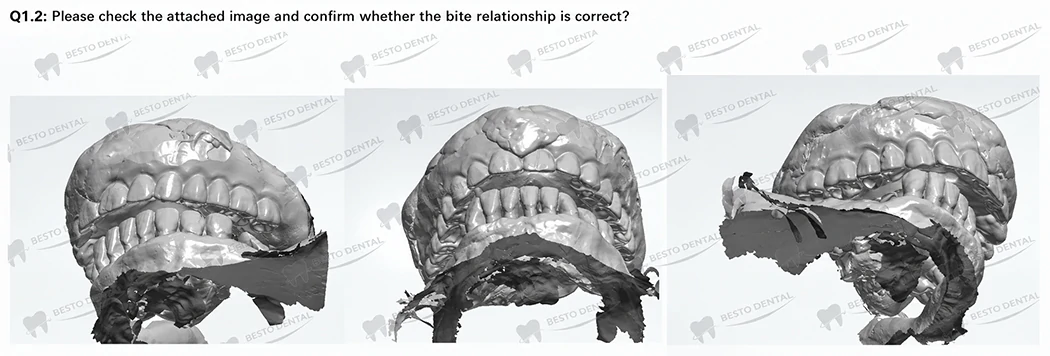
a. Bite Confirmation Before Processing
Occlusion is the single most important factor in complete denture success. If the client does not specify the occlusal scheme, or if the laboratory is uncertain about the recorded jaw relation, BestoDental will send a digital design photo of the occlusion to the client for approval before the next step. This prevents costly remakes after the denture is already processed, saving time and ensuring the patient’s bite is correct.
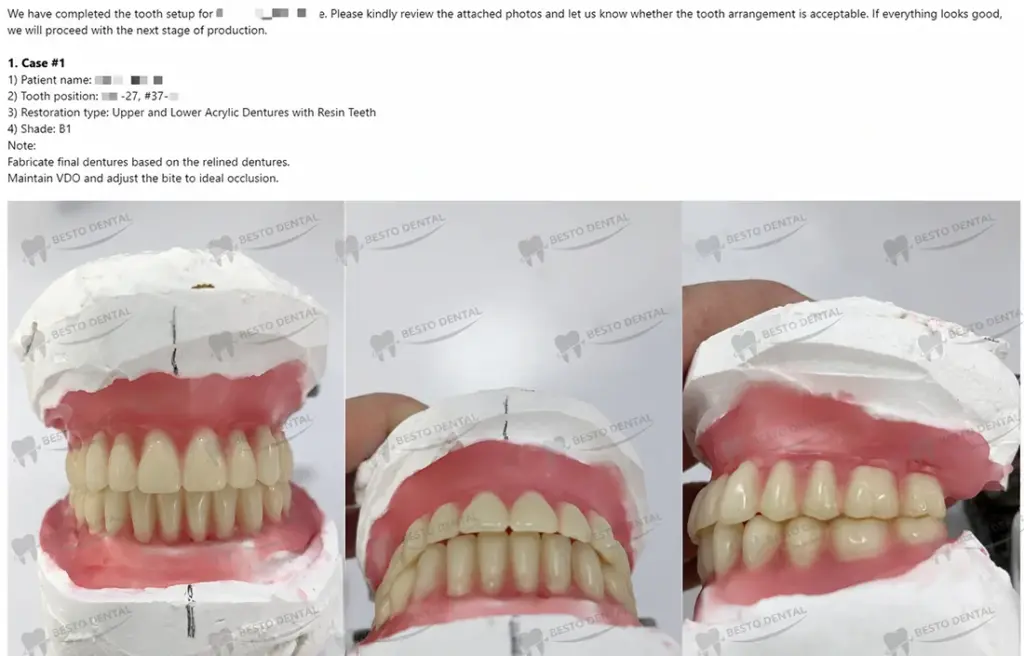
b. Teeth Set-up Confirmation
Additionally, for cases involving uncertainty, you can request that the laboratory send images of the tooth arrangement for your approval during that stage, thereby reducing the likelihood of rework.
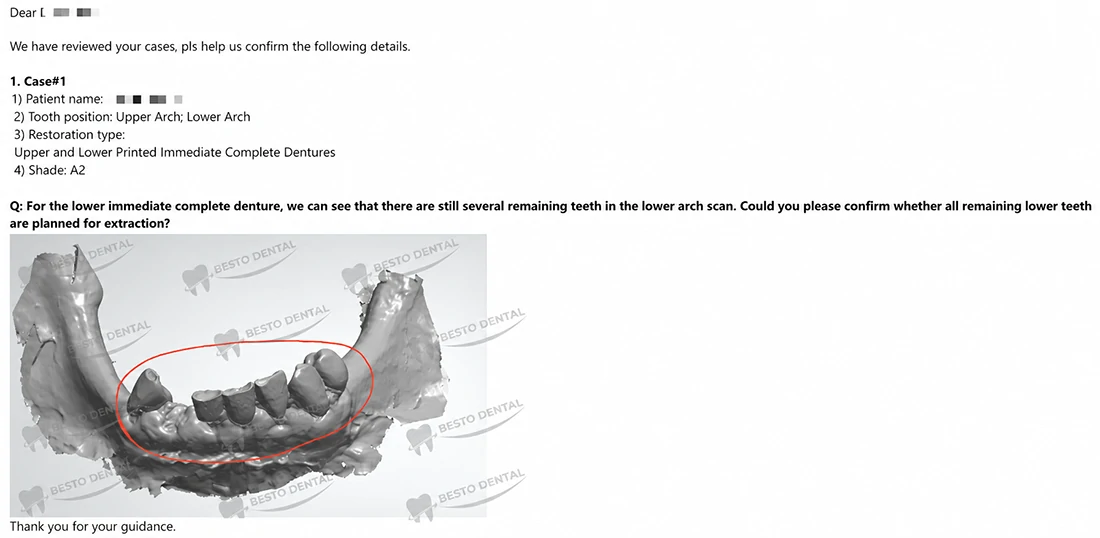
c. Natural Teeth Must Be Removed
A complete denture is designed for an edentulous arch. If the digital scan or cast shows remaining natural teeth, lab must immediately contact the client to confirm whether those teeth should be extracted before proceeding. Fabricating a denture over existing teeth is clinically invalid and will lead to a failed restoration.
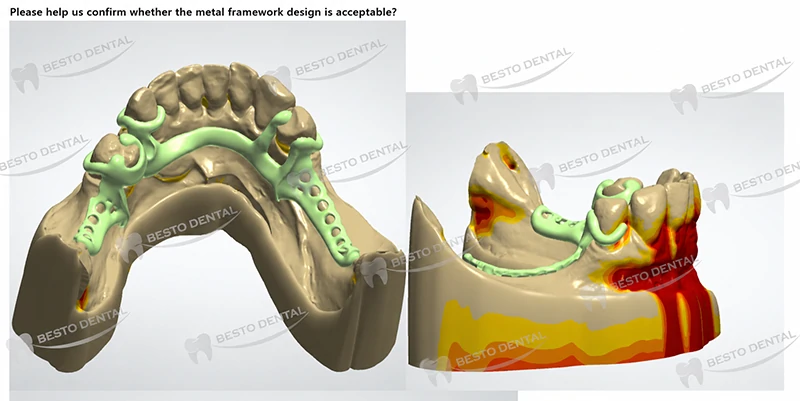
d. Metal Framework (Reinforcement)
Sometimes a metal framework is attached to the denture base, which is usually cobalt-chromium (Co‑Cr) or titanium, to increase rigidity, fracture resistance, and stability. This will add to the final price. If the client has any special requirements (e.g., a requirement for a specific alloy type, framework design, or attachment system), BestoDental can supply a digital drawing of the framework for the client to approve at the design stage, which would ensure that the framework meets the functional and aesthetic requirements of the client before manufacturing.
If the lab uses this carefully structured workflow and discusses these key decision points early, you can collaborate to provide a well-fitting, long-lasting, and aesthetic complete denture with fewer remakes and more satisfied patients.
5. Clinical Applications of Complete Dentures
In the cases we handle, complete dentures are most commonly used for patients who have lost all natural teeth in the upper arch, lower arch, or both arches. They may also be used when the remaining teeth are planned for extraction or when an existing complete denture needs to be replaced.
| Specific Clinical Situation | How the Complete Denture Is Used | Main Considerations |
| Completely Edentulous Arch | A complete denture replaces all teeth and associated missing oral structures in the upper or lower arch | Ridge anatomy, soft tissue condition, available restorative space, jaw relationship, and denture retention should be evaluated |
| Completely Edentulous Upper and Lower Arches | Upper and lower complete dentures are made together to restore both arches | Vertical dimension, centric relationship, tooth arrangement, occlusion, and coordination between the two dentures are particularly important |
| Remaining Teeth Planned for Full Extraction | An immediate complete denture is fabricated before extraction and inserted after the remaining teeth are removed | The final post extraction tissue condition cannot be recorded directly in advance, so planned extractions and available pre extraction records must be communicated clearly |
| Existing Complete Denture Requires Replacement | A new denture replaces an old, worn, poorly fitting, or otherwise clinically unsuitable prosthesis | The dentist should identify which features of the existing denture should be maintained and which should be changed, such as tooth position, vertical dimension, occlusion, or esthetics |
| Temporary Restoration During Implant Treatment | A complete denture may serve as a removable provisional restoration during selected stages of implant treatment | Implant sites, healing conditions, pressure areas, and the treatment plan may affect the denture design and required adjustments |
Immediate denture cases require particular attention because the laboratory usually designs the restoration while some or all of the teeth to be extracted are still present in the submitted records. The prescription should therefore clearly identify which teeth will be removed and which, if any, will remain.
The laboratory can digitally remove the planned extraction teeth and design the denture for the anticipated edentulous arch. However, because soft tissue and ridge contours change after extraction and healing, subsequent clinical adjustment or relining may be necessary.
6. Complete Denture FAQs
We’ve gathered the most common denture questions from our customers and answered them for you, in detail, based on our experience.
1) What is the difference between milled denture teeth and prefabricated denture teeth?
Milled denture teeth are produced from CAD CAM tooth materials according to the digital denture design, while prefabricated denture teeth are manufactured in standard molds and then selected and arranged for the individual case.
The main difference is how the teeth are produced and integrated into the denture workflow. Milled teeth allow the laboratory to reproduce the approved digital setup directly, while prefabricated teeth are selected according to available tooth molds, sizes, shades, and brands.
2) Can I request a specific denture tooth brand, such as Ivoclar?
Yes. You can specify a preferred denture tooth brand when submitting the case to the dental laboratory.
Common requests may include brands such as Ivoclar or Yamahachi. The laboratory should confirm the required brand, shade, tooth mold, and availability before production, especially when a specific tooth system is important to the case.
3) Can a dental laboratory provide a try in before the final complete denture?
Yes. A dental laboratory can provide a try in before final processing when you need to evaluate the tooth arrangement, midline, esthetics, VDO, or occlusion.
You can check the try in clinically and send any required adjustments back to the laboratory before the final denture is produced. This is especially useful for cases where the tooth setup or jaw relationship needs to be confirmed before finalization.
4) Can a complete denture be made directly from an intraoral scan?
Yes, but only when the digital records provide enough information for the laboratory to design the denture reliably.
For a complete denture, the scan should capture the edentulous ridge and relevant soft tissue anatomy, and the laboratory also needs an accurate jaw relation or bite record. Upper and lower scans alone may not provide enough information if the vertical dimension, centric relationship, or functional anatomy cannot be determined.
5) What information is required for an immediate complete denture case?
You should clearly identify which remaining teeth are planned for extraction and which teeth, if any, will remain.
The laboratory also needs usable arch scans or impressions, bite information, shade, and any specific requirements for tooth position or esthetics. This information is important because the denture is often designed before the final post-extraction ridge condition exists.
6) Can a new complete denture copy the tooth position and bite of an existing denture?
Yes. An existing denture can be scanned or otherwise used as a reference when you want to preserve certain features of the current prosthesis.
You should indicate which details should be maintained and which should be changed, such as tooth size, tooth position, midline, vertical dimension, occlusion, or overall esthetics. This helps the laboratory distinguish useful reference information from features that need correction.
7) What should be provided if the VDO or bite needs to be changed?
If the new denture requires a different vertical dimension of occlusion or a new jaw relationship, the laboratory needs a clinical record that represents the intended position.
This may be provided through wax rims, a bite registration, or another reliable jaw relation record. The laboratory should not estimate a major VDO or bite change from the existing denture or arch scans alone unless the dentist has provided clear instructions and supporting records.
8) Can an existing crossbite be maintained in a new complete denture?
Yes. An existing crossbite can be reproduced when it is clinically intended and clearly communicated to the laboratory.
You should provide an accurate bite record and note that the crossbite is to be maintained rather than corrected. This is especially important because the laboratory may otherwise interpret an unusual occlusal relationship as something that needs adjustment.
In the complete denture cases handled at BestoDental, specific instructions such as maintaining an existing crossbite or preserving a particular tooth arrangement are typically confirmed before final production when the submitted records could be interpreted in more than one way.
7. Conclusion
This guide has covered the main types of complete dentures, the materials used for denture bases and artificial teeth, and the fabrication processes used in both conventional and digital workflows. It has also explained important case considerations such as jaw relation records, tooth setup, try-in confirmation, immediate denture requirements, and communication with the dental laboratory.
When outsourcing a complete denture case, clear clinical records and instructions are essential. Providing accurate scans or impressions, bite information, shade, tooth arrangement requirements, and any special occlusal or esthetic instructions helps the laboratory select the appropriate workflow and manufacture the denture according to your treatment plan.