A patient needs a fixed restoration for one or more missing teeth; that’s when these questions will cross your mind: Which teeth or implants can provide support? How should the pontic and connectors be designed? Should the restoration use zirconia, PFM, or another material, and is a bridge appropriate for the clinical situation in the first place?
This guide explains the essential structures, material options, and clinical indications of dental bridges, helping you evaluate bridge cases more systematically before treatment planning and laboratory production.
By the end of this guide, you will know how the main components of a dental bridge work together; you will know how common bridge materials differ and what factors influence material selection; and you will know which clinical situations are generally suitable for different bridge designs and what case factors require closer evaluation.
1. What is a Dental Bridge?
A dental bridge is a fixed dental restoration employed to replace one or more missing teeth by supporting artificial replacement teeth with neighbouring natural teeth or dental implants. The typical bridge is composed of one or more pontics (replacing the missing tooth) and supporting restorations affixed to one or more abutment tooth/implant.
After being installed, a bridge will not be taken out by the patient. The space between the missing tooth and the adjacent teeth will be filled with the pontic, which is supported by the neighbouring teeth or implants. This will restore continuity of the dental arch and provide the patient with a fixed surface for biting and chewing. The design of each bridge is tailored to fit the space, surrounding teeth, bite and soft tissue conditions of the specific case.
Key benefits of dental bridges include:
- Fixed tooth replacement: The replacement remains stable in normal speaking and chewing without the need for removal and reinsertion by the patient.
- Reestablished occlusion: The missing tooth space, once filled, will help restore occlusion by allowing the forces of chewing to be distributed to the adjacent teeth and/or implants.
- Improved appearance: Pontics can be shaped and shaded to blend with the surrounding teeth, making bridges suitable for replacing visible missing teeth as well as posterior teeth.
- Maintained dental arch continuity: Replacing the missing tooth fills the open space and helps maintain proper contact and alignment within the restored area.
- Support for normal speech: Replacing missing teeth, particularly in the anterior region, can restore tooth surfaces that contribute to normal pronunciation and airflow.
- Multiple tooth replacement: A single connected restoration can replace one or several adjacent missing teeth when suitable support is available.
- Custom restoration design: The shape, shade, pontic form, contacts, and occlusion can be designed according to the patient’s remaining teeth, gingival contour, and clinical requirements.
A clinical dentist or prosthodontist prescribes dental bridges to the patient who needs a fixed restoration due to the lack of teeth. They are commonly used when one tooth is missing between two appropriate abutment teeth, multiple teeth are missing and a multi-unit bridge is needed, a tooth is missing in the front, where appearance is important, or when multiple teeth are missing and a dental implant is required to support a bridge. The final restoration is fabricated by a dental laboratory according to the dentist’s preparation, impression or digital scan, bite records, shade, and case requirements.
2. Structures of Dental Bridges
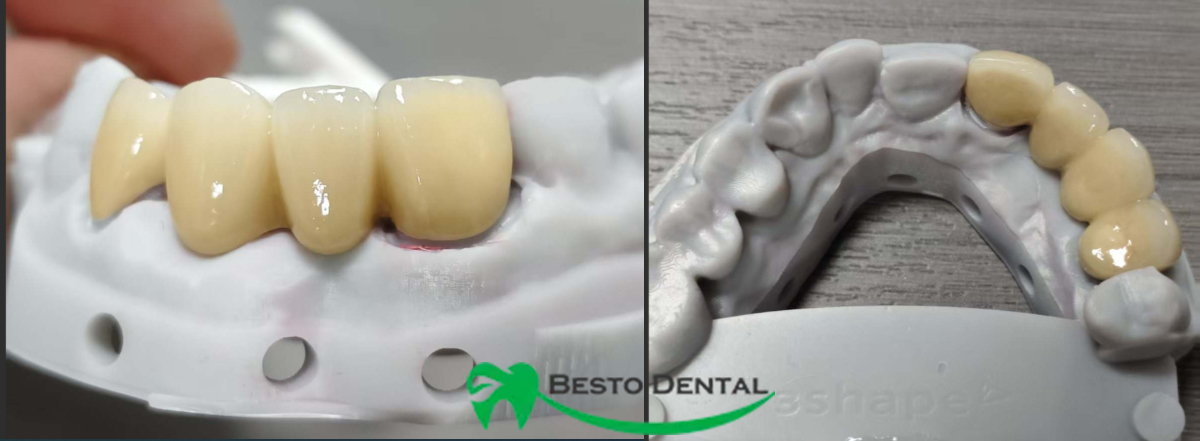
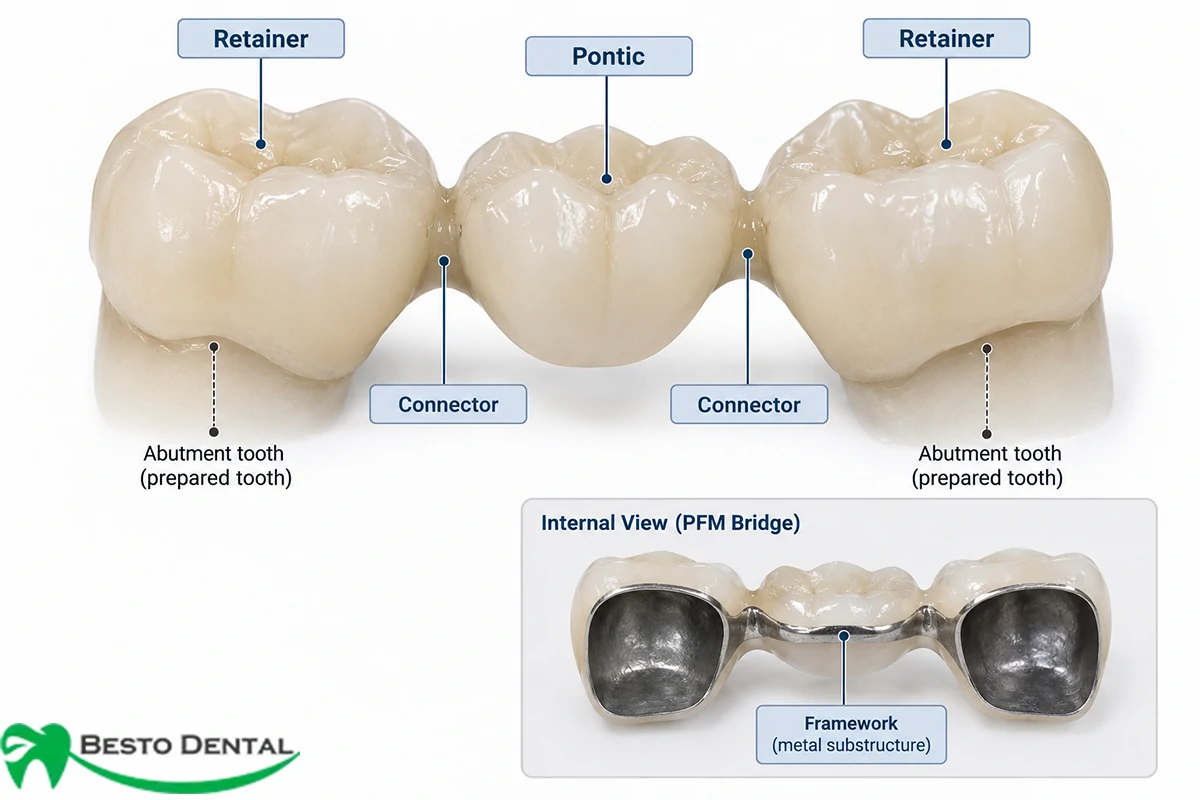
In a typical tooth-supported bridge, the main structural elements are the abutments, retainers, pontics, and connectors. Some bridge constructions also include an internal framework depending on the restorative material and design.
1) Abutments
Abutments are the natural teeth or implants that provide support for the dental bridge. In a conventional tooth-supported bridge, prepared teeth adjacent to the missing space serve as abutment teeth. In an implant-supported bridge, implants provide the underlying support.
2) Retainers
Retainers are the parts of the bridge that attach the restoration to its abutments. In a traditional bridge, they are commonly full-coverage crowns placed over prepared abutment teeth. For example, in a three-unit bridge replacing one missing tooth, the two outer units may be retainers while the middle unit is the pontic.
Like: Retainer | Pontic | Retainer
Retainers provide retention and help transfer functional forces from the bridge to the supporting abutments. Their fit, margins, preparation clearance, and relationship to the common path of insertion are therefore important considerations in laboratory design.
Not every bridge uses full coverage crown retainers. A Maryland bridge, for example, uses bonded wings attached to the lingual or palatal surfaces of adjacent teeth. This is a different retainer design even though its basic purpose remains the same.
3) Pontics
A pontic is the artificial tooth portion of a bridge that occupies the space of a missing natural tooth. Unlike an abutment-supported unit, a pontic has no natural root or implant directly underneath it. Functional forces received by the pontic are transferred through the connectors to the supporting units of the bridge.
Common pontic forms include:
| Pontic Design | Tissue Relationship | Typical Consideration |
| Modified Ridge Lap | Contacts the ridge mainly on the facial side | Balances appearance with access for cleaning and is commonly used in visible areas |
| Ovate Pontic | Extends into a shaped soft tissue depression | Creates a more natural emergence profile when the tissue conditions allow it |
| Conical Pontic | Has a small, rounded area of tissue contact | More suitable for selected posterior situations where esthetic demands are lower |
| Hygienic Pontic | Does not contact the residual ridge | Provides space beneath the pontic for cleaning and is mainly considered in selected posterior areas |
4) Connectors
Connectors are the structural areas that join retainers and pontics into a single bridge. They allow forces applied to one part of the restoration to be transferred through the bridge to the supporting abutments. Connector contours can be adjusted according to the clinical requirements and the dentist’s preferences. For example, some of BestoDental’s clients prefer greater clearance between the connector and gingival tissue to provide better access for daily cleaning.
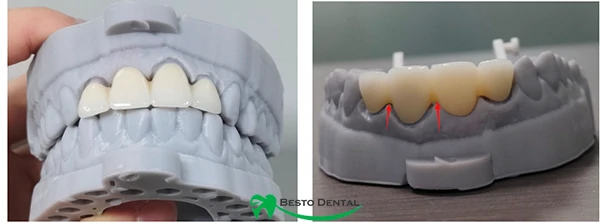
5) Framework
A framework is the internal supporting structure used in certain types of dental bridges, rather than a component present in every bridge. A PFM bridge, for example, has a metal framework that provides the underlying structural form, with porcelain applied over selected external surfaces.
3. Types of Dental Bridges
In reality at BestoDental, bridges can appear in very different forms even when they replace the same number of missing teeth. The clearest way to understand these differences is to classify dental bridges by support design and retention method.
1) By Support Design
| Type | Support Design | Main Characteristic | What to Keep in Mind |
| Traditional Bridge | Natural abutment teeth on both sides of the missing space | The pontic is supported by retainers on both sides | Requires suitable abutment teeth and sufficient restorative space |
| Cantilever Bridge | Natural abutment tooth or teeth on one side only | The pontic extends beyond the supporting abutment | Creates different force distribution and requires careful case selection |
| Maryland Bridge | One or more adjacent natural teeth through bonded wings | The pontic is retained with minimal preparation of the supporting teeth | Retention depends heavily on bonding surface, preparation design, and occlusion |
| Implant Supported Bridge | Two or more dental implants | Implants support the bridge instead of natural abutment teeth | Implant position, restorative space, connection design, and passive fit must be evaluated |
Among these, traditional bridges are one of the most commonly encountered tooth-supported designs. Implant-supported bridges are also widely used when several teeth are missing, and appropriate implants are available. Cantilever and Maryland bridges are more case-dependent.
2) By Retention Method
For implant-supported bridges, another important classification is how the restoration is retained on the implants.
| Type | How It Is Retained | Main Difference | What to Keep in Mind |
| Screw Retained Bridge | Fixed to implants or abutments with prosthetic screws | Can generally be retrieved by accessing the screws | Screw access position and implant angulation affect the restorative design |
| Cement Retained Bridge | Cemented onto implant abutments | No prosthetic screw access opening through the bridge itself | Abutment design, retention, restorative space, and management of excess cement require attention |
| Screw Cement Retained Bridge | Restoration is cemented to intermediary components and the assembly is screw retained | Combines cemented restorative interfaces with screw retrievability at the implant level | Component compatibility and the intended laboratory and clinical workflow must be clearly defined |
Implant angulation, available restorative space, screw access location, prosthetic design, and the clinician’s treatment plan can all influence the final retention method. We also covered this in detail in the article “Implant Crowns Guide,” so feel free to read it if you’re interested.
4. Materials of Dental Bridges
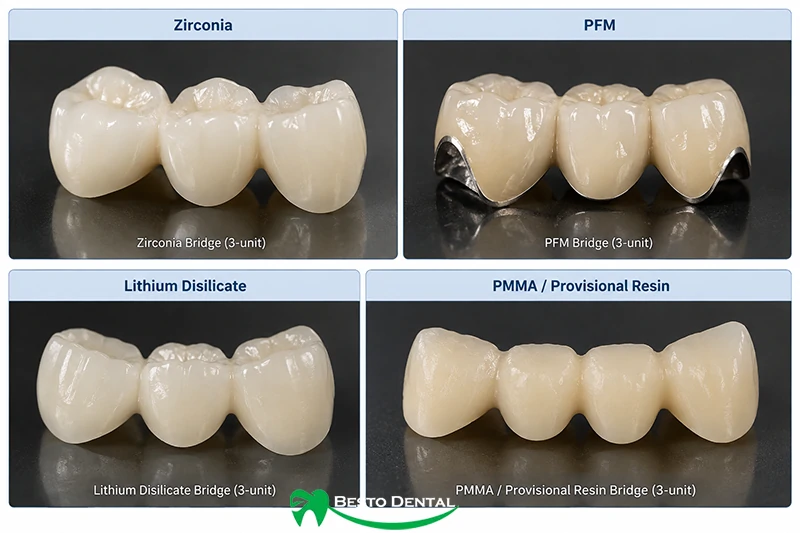
The most common material systems for definitive dental bridges are zirconia and porcelain fused to metal, or PFM. Lithium disilicate is used for more limited bridge indications, while PMMA and dental resins are primarily used for provisional restorations rather than definitive long-span bridges.
These materials differ not only in appearance, but also in strength, required restorative space, connector design, fabrication method, and suitability for different bridge spans. For this reason, material selection should be considered together with the position and structure of the bridge rather than based on esthetics alone.
| Material | Main Characteristics | Common Considerations |
| Zirconia | High-strength dental ceramic available in different strength and translucency levels; can be used monolithically or with veneering ceramic | Zirconia formulation, bridge span, connector dimensions, restorative space, and esthetic requirements should be considered together |
| PFM | Metal framework covered partially or fully with dental porcelain | Requires sufficient space for the metal and porcelain structure; framework design and porcelain support affect the final contour and esthetics |
| Lithium Disilicate | Glass ceramic with high translucency and strong esthetic potential | Bridge indications are more restricted than zirconia or PFM and depend on the specific material system and clinical situation |
| PMMA / Provisional Resin | Polymer-based material that is easy to mill or print for temporary restorations | Primarily intended for provisional use; occlusion, span, thickness, and expected period of use still need to be considered |
Zirconia strength and translucency need to be balanced. Zirconia is available in different formulations; for more information on zirconia, please refer to our other guide: 3Y vs 5Y Zirconia for Dental Bridges: What’s the Best Option for Your Restoration?
Lithium disilicates have more limited bridge indications. If the customer specifies EMAX as the material for the dental bridge, the bridge configuration, location, span, and indications of the specific material system should be verified before production. In practice, no single material is appropriate for every bridge configuration.
5. Manufacturing Process of Dental Bridges
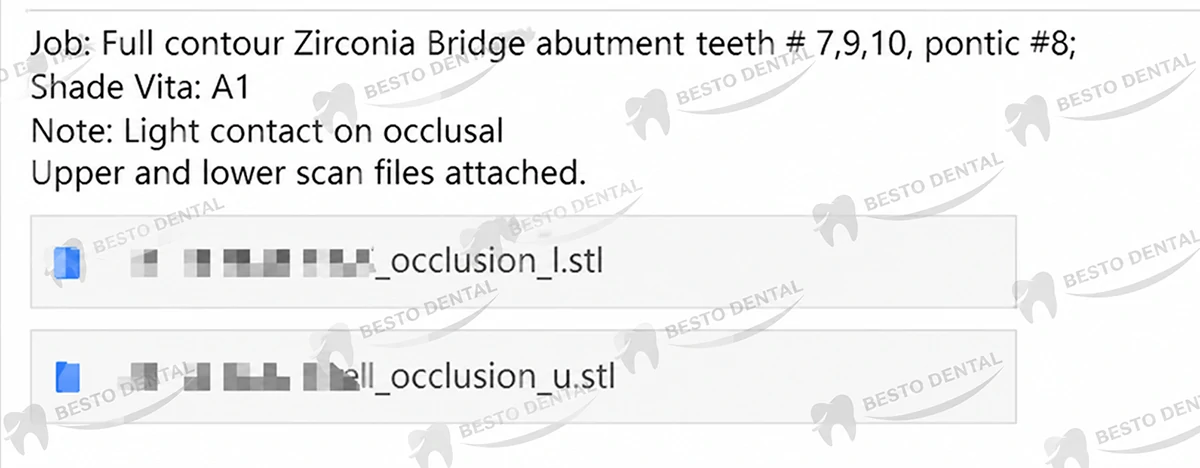
Once the dental lab receives and reviews your case, the processes of design, fabrication, finishing, and final inspection are carried out in sequence. We have summarized the key fabrication workflow in the table below for your reference.
| Stage | What Happens | What to Keep in Mind |
| Case Submission | The laboratory receives the digital scan or physical impression, bite record, prescription, shade, and bridge requirements | Abutment and pontic positions, material, shade, and special pontic or occlusal requirements should be clearly identified |
| Case Review | The scan or model is checked for margins, preparation space, insertion path, occlusion, and missing data | Unclear margins, insufficient clearance, incompatible abutment paths, or incomplete soft tissue data may need confirmation before design |
| CAD Design | The technician designs the retainers, pontics, connectors, contacts, occlusion, and external contours | Connector dimensions, bridge span, material thickness, pontic tissue contact, and insertion path directly affect the final restoration |
| Manufacturing | The bridge or framework is milled, printed, cast, or otherwise fabricated according to the selected material system | The manufacturing route depends on whether the case uses zirconia, PFM, or a provisional material |
| Finishing | The restoration is adjusted, polished, stained, glazed, or layered as required | Adjustments should not reduce critical connector dimensions or restoration thickness |
| Final Check | The completed bridge is inspected against the working model or digital case data | Marginal fit, seating, proximal contacts, occlusion, pontic relationship, shade, surface finish, and overall integrity are checked |
Before design begins, the laboratory normally needs:
- Digital scan or physical impression: Provides the preparations, adjacent teeth, opposing arch, and edentulous area.
- Bite record: Defines the occlusal relationship.
- Abutment and pontic positions: Clarifies which units provide support and which units replace missing teeth.
- Material and shade: Determines the manufacturing route and final appearance.
- Pontic requirements: Defines the required tissue relationship and pontic form.
- Implant system and connection details: Required for implant-supported bridge cases.
If the complete fabrication specifications cannot be confirmed from the submitted materials, BestoDental will clarify them before proceeding with the fabrication process.
6. Clinical Indications of Dental Bridges
In the cases we handle, dental bridges are most commonly used to restore one or more missing teeth with a fixed restoration. The following are the most common clinical indications for dental bridges.
| Specific Clinical Situation | How the Dental Bridge Is Used | Main Considerations |
| Single Missing Tooth Between Natural Teeth | A pontic replaces the missing tooth and is supported by suitable adjacent abutment teeth | The condition and position of the adjacent teeth, periodontal support, preparation requirements, and occlusion should be evaluated |
| Multiple Adjacent Missing Teeth | One or more pontics are incorporated into a multi unit bridge supported by natural teeth or implants | The length of the edentulous span, number and distribution of supporting units, and functional loading become increasingly important |
| Missing Anterior Tooth | A fixed bridge replaces the visible missing tooth and restores continuity of the anterior arch | Pontic position, gingival contour, smile line, available space, and relationship with adjacent teeth require particular attention |
| Multiple Missing Teeth with Implant Support | A bridge connects multiple units and uses strategically positioned implants as support, allowing several missing teeth to be restored without an implant for every tooth | Implant number, position, angulation, restorative space, and prosthetic connection must be evaluated before bridge design |
| Single Missing Tooth with Minimal Preparation of Adjacent Teeth | A resin-bonded bridge, commonly a Maryland bridge, may be used to replace the missing tooth using a bonded retainer rather than full-coverage crowns | Available enamel for bonding, occlusion, supporting tooth condition, and pontic position affect whether this approach is appropriate |
7. Dental Bridge FAQs
Dental bridge cases are among the most common types of restorations handled by BestoDental. Many clients ask similar questions during consultations, so we have compiled them here for easy reference.
1. What information should I send to the dental lab for a bridge case?
Give the top and bottom scans or impressions, the bit record, positions of the teeth, positions of the abutment, positions of the pontic, what material, shade, and other special requirements for occlusion/ pontic design. Photos, previous restoration references or additional clinical notes may also assist the lab to understand the desired result for a more complex case.
2. When will a dental lab ask for a rescan or new impression?
A rescan may be requested when preparation margins are unclear, important areas are missing, the bite cannot be reliably aligned, or the edentulous ridge and soft tissue information needed for pontic design is incomplete. For a bridge, incomplete data on one abutment can affect the fit of the entire connected restoration.
3. What if the abutment teeth do not have a common path of insertion?
The laboratory should identify this during case review before manufacturing. Minor discrepancies may sometimes be managed in the design, while significant discrepancies may require preparation adjustment. If clinical adjustment is necessary, the laboratory can indicate the areas that need additional reduction before the final bridge is produced.
4. What if there is insufficient occlusal space for the bridge?
The available space should first be checked against the selected material and restoration design. Depending on the case, BestoDental may offer the following possible solutions
- adjusting the preparation
- adjusting the opposing tooth
- changing the material or occlusal design
- or using a metal occlusal surface in selected PFM cases
The final approach should be confirmed with the customer before production.
5. Do I need to specify which teeth are abutments and which are pontics?
Yes, especially for multi-unit bridges. Listing only the tooth range or total number of units can create ambiguity. Clearly identifying each abutment and pontic allows the laboratory to establish the correct support, connector, and pontic configuration before CAD design.
6. Can I review the CAD design before the dental bridge is manufactured?
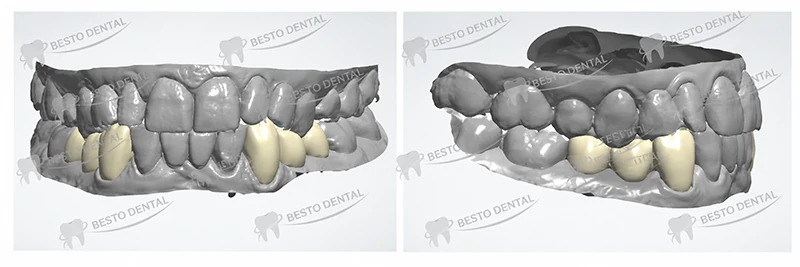
Yes, a design preview can be requested when confirmation is needed before production. It is especially helpful for complex bridges, long span, unique pontic designs, and esthetic and occlusal considerations. Remember, design confirmation is an extra communication stage in the production process.
7. What additional information is required for an implant-supported bridge?
In addition to the normal scan, bite, shade, and restoration requirements, the laboratory needs the
- implant system
- implant connection
- implant positions
- and intended restoration or retention method
Accurate implant scan data and compatible components are essential for designing the restoration correctly.
8. How should I communicate special pontic requirements to the dental lab?
Use the desired pontic design or tissue relationship in the prescription, for example, use the term “ovate pontic,” or “modified ridge lap” or “light tissue contact” or “tissue extension. In extremely esthetic anterior cases, a good set of clinical photographs and decisive soft tissue scans may give additional clues which are not always available at the prescription stage.
8. Conclusion
This guide has introduced the most important information about the main types, structures, materials, manufacturing process, and clinical indications of dental bridges, and the most important information that needs to be confirmed before manufacturing has been introduced.
Upon completion of this guide, you should be able to recognize the most common bridge types, understand the relationship between the various pieces of the bridge, know how the various materials can be used, be familiar with the most common laboratory steps in bridge case production, and understand what information should be shared with a dental lab in an outsourced case.