When your implant choices of All-on-4, All-on-6, and implant-supported overdenture, how do you choose? Fewer implants equate to less trauma but more load per implant; more implants equate to better load distribution but more time and cost.
This guide provides a practical overview of the entire landscape of implant restorations for the full arch, including the three treatment protocols, material options for temporary and permanent restorations, and the clinical indications.
By the end, you will be able to identify indications for each treatment option based on the number of implants and patient expectations, know what material is best for each phase of treatment, and some common questions.
1. What Is Full-Arch Implant Restoration?
A full-arch implant restoration is a type of prosthetic that involves a few dental implants in a fixed bridge to replace a full arch of missing teeth. It is made of two components, which are surgically attached to the jawbone (usually 4-6 implants are used) and the complete-arch bridge that firmly sits on the implants. This bridge is a unit of artificial teeth, and it will be screwed or cemented onto the implants, which the patient cannot remove without assistance.
Functionally, this restoration will simulate the appearance and masticatory power of a natural set of teeth. The implants function as a set of anchor posts, and the full arch bridge functions as a deck that securely rests on the anchor posts. When chewing and talking, the forces are transmitted through the bridge to the implants, and from there to the bone around the implants. The implants gradually become integrated with the jawbone over time, providing stable support for the dental crowns.
The implants are fused with the jawbone over several months and can then provide stable support for the dental crowns. After the fusion, the new teeth are as stable as natural teeth; they never slip, rock, or move as a removable denture does. The concept is not to replace each missing tooth – the concept is to rebuild the entire arch as one, to provide function and aesthetics.
Here are the main benefits of full‑arch implant restoration:
- Improved chewing ability: The implants pass the biting forces straight to the jawbone, so that patients can eat a good deal more food without being able to feel the biting force.
- Permanently in place and secure: The bridge never comes loose, slides, or falls out of the implants. Adhesives and pastes are not required.
- Maintains bone mass: The implants stimulate the bone continuously and prevent or slow bone loss that usually occurs after the loss of teeth. Saves healthy adjacent teeth: Unlike traditional bridgework, this method will not involve grinding down or altering neighbouring natural teeth.
- Natural appearance: The bridge is custom shaded and formed to the patient’s facial features and remaining teeth, creating a natural-looking smile.
- Simplicity of daily care: Cleaning and flossing around the bridge is comparable to that of natural teeth and requires no special soaking solutions, nor is it required to use strong adhesives.
- Shorter treatment times: If it is necessary to replace all missing teeth, then the patient would need to receive one implant for each tooth, whereas supporting a whole arch with four to six implants means fewer implants are placed and thus shorter treatment times.
In the clinic, this restoration is normally applied to individuals who require teeth to be restored in a single jaw (upper or lower), or both jaws. It is a safe and reliable solution for complete denture replacement, enabling patients to realize a natural smile and a secure bite without relying on denture adhesives or denture slippage.
2. Treatment Options for Full-Arch Implant Restorations
There are several primary treatment options for full-mouth implant restoration, including both fixed and removable solutions.
| Type | Simple Explanation | Common Materials / Structure |
| All-on-4 | A full arch supported by typically 4 implants | Zirconia / PMMA / Titanium framework |
| All-on-6 | A full arch supported by typically 6 implants | Zirconia / PMMA / Titanium framework |
| Full-Arch Zirconia Bridge | A full-arch zirconia restoration fixed to implants | Monolithic / Multilayer Zirconia |
| Titanium + Zirconia Restoration | A titanium structure provides support for the zirconia restoration | Titanium + Zirconia |
| Titanium + Acrylic/Composite | A titanium framework combined with acrylic teeth or composite material | Titanium + Acrylic / Composite |
| PMMA Full-Arch | A full-arch restoration made from PMMA | PMMA |
| Implant Overdenture | An implant-supported removable denture | Acrylic + Attachments / Bar |
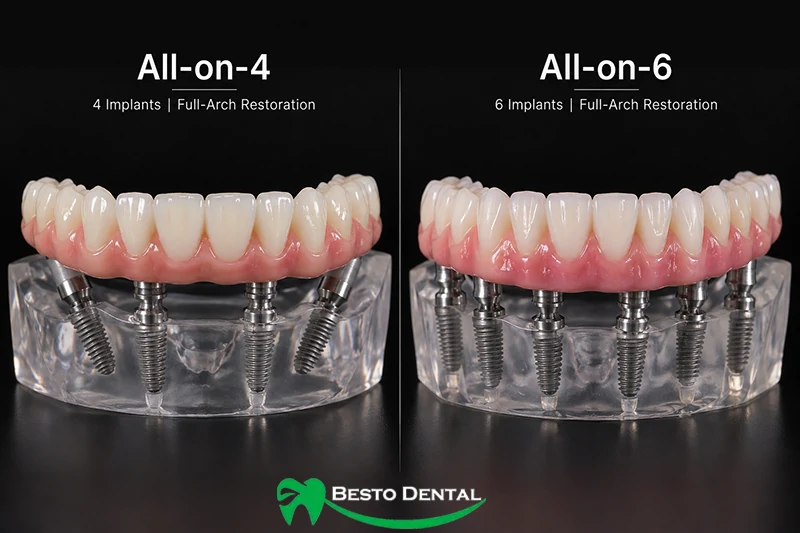
1) All-on-4 and All-on-6
All-on-4 and All-on-6 are the most common configurations for full-arch implant restorations.
Of course, full-arch restorations are not limited to exactly four or six implants. Depending on the patient’s bone condition, implant positions, available restorative space, and treatment plan, a full arch may also be supported by five, seven, eight, or another number of implants.
2) Implant Overdenture
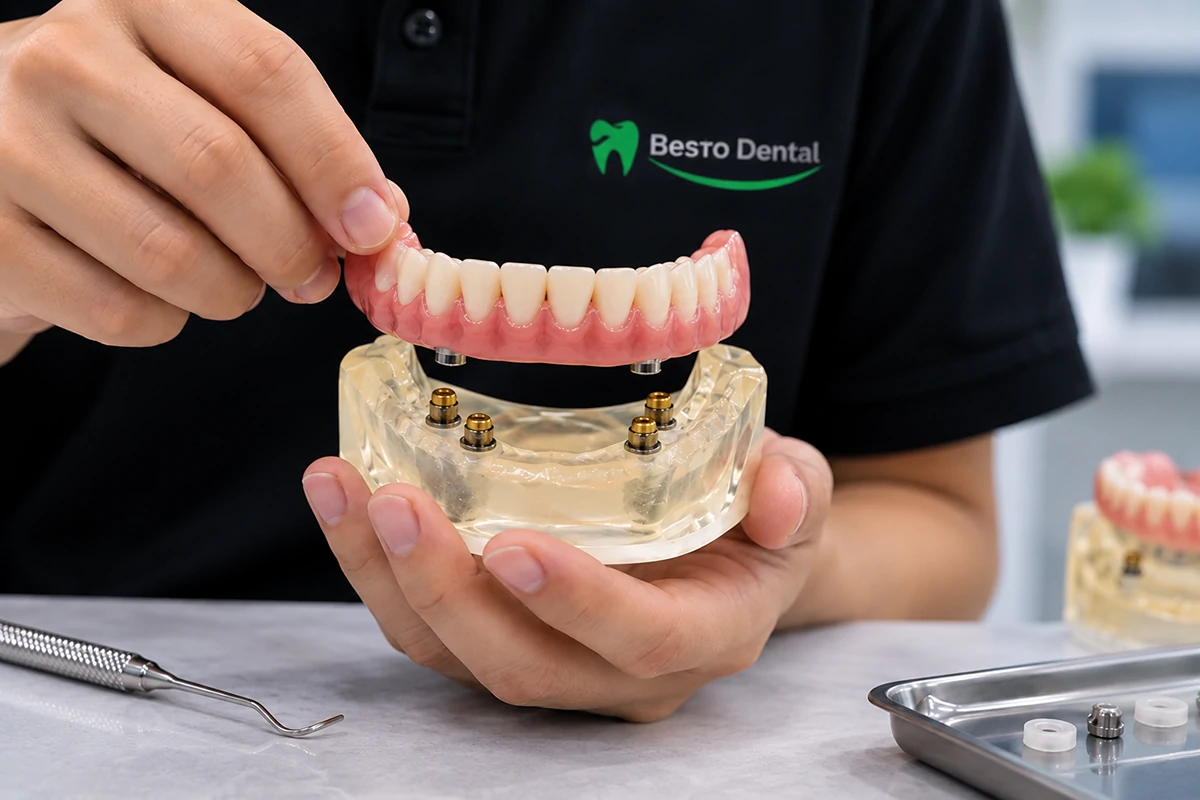
Unlike a fixed full-arch restoration, an implant overdenture is removable by the patient. The denture is retained and supported by implants through attachments such as Locator attachments or a bar, providing better retention and stability than a conventional complete denture.
The patient can remove the denture at home for daily cleaning.
Generally, 2-4 implants are needed, and it is less expensive. If the patient has less bone volume or is on a budget, consider implant overdentures. However, removable dentures will not be as stable and comfortable as fixed protocols, and patients must be more diligent in cleaning and upkeeping their dentures every day.
3. Materials Used for Full-Arch Restorations
The material for full-arch implant restorations plays a significant role in the strength, esthetics, longevity, and cost of the implant prosthesis. These are the materials that are used.
1) Zirconia
Fixed Full-Arch restorations made from zirconia are very common today. Advantages:
- High strength
- Wear resistance
- Less prone to staining
- Good esthetics
- Can be made as a one-piece full-arch structure
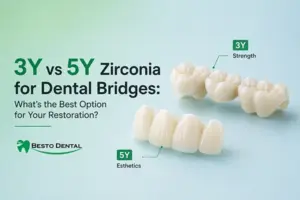
In particular, Multilayer Zirconia Full-Arch restorations can improve the esthetics of the anterior region through different levels of translucency and color gradation. However, Full-Arch Zirconia has relatively high requirements for design, sintering, passive fit, and occlusion. If you would like to learn more about the suitability of zirconia for different clinical cases, you can check out our article: 3Y vs. 5Y Zirconia for Dental Bridges: What’s the Best Option for Your Restoration?
2) PMMA
PMMA is very important in Full-Arch restorations; it’s cheaper than others. It is often used for: Prototype / Try-in / Temporary Full-Arch
In other words, a PMMA restoration can be made first, allowing the dentist and patient to verify Occlusion, VDO, Tooth length, Midline, Smile Line, Lip Support, Phonetics, and overall esthetics.
After these are confirmed, the final Zirconia Full-Arch restoration can be fabricated.
3) Titanium
Titanium is often used as an internal framework or bar. For example: Titanium Framework + Zirconia, or Titanium Bar + Acrylic/Composite Teeth. Its main function is to provide a stable metal supporting structure.
We have summarized the following table for your reference.
| Material | Primary Application | Key Advantages | Main Limitations / Cautions |
|---|---|---|---|
| PMMA (Polymethyl Methacrylate) | Temporary restoration during the healing period | Easy to fabricate; moderate cost; good biocompatibility; CAD/CAM milling significantly improves strength and precision; suitable for immediate‑loading protocols. | Intended for temporary use only; lacks long‑term wear resistance and strength for final restorations. |
| Zirconia | Final full‑arch restoration | Exceptional strength; excellent aesthetics and biocompatibility; available as monolithic (single‑block, high chip resistance) or zirconia‑titanium combination (strength + aesthetics). | Brittleness requires careful handling; clinical survival rates range from 88% to 100%; Satisfactory overall, but not without some risk. |
| Titanium Framework | Internal supporting framework (connecting multiple implants) | Excellent biocompatibility and corrosion resistance; high strength‑to‑weight ratio; CAD/CAM milling achieves high‑precision passive fit – critical for long‑span multi‑implant restorations. | Used only as an internal substructure; requires an outer layer (resin or ceramic) to mask metal colour and provide tooth/gum aesthetics. |
| Acrylic‑Composite Combinations | Traditional hybrid restorations (metal‑resin) | Lightweight prosthesis; easy to repair and adjust; more affordable compared to zirconia‑based options. | Inferior long‑term wear resistance and colour stability versus zirconia; best suited for low‑load areas or budget‑conscious cases. |
4. Full-Arch Implant Manufacturing Procedure
BestoDental has been deeply engaged in the dental prosthesis industry for over a decade; based on our practical experience, we have divided the full-arch implant manufacturing process into the following 10 key stages.
| Step | Procedure | Description |
| 1 | Case Review & Data Verification | Review the intraoral scans, bite records, scan body data, implant/MUA information, patient photos, and prescription to make sure the required information is complete. |
| 2 | Implant Position Verification | Verify the implant or MUA positions and confirm that the correct implant library and connection system are being used. |
| 3 | CAD Design | Design the full-arch restoration based on the implant positions, occlusion, VDO, tooth arrangement, gingival contour, screw channels, restorative space, and esthetic requirements. |
| 4 | PMMA Prototype / Try-In | A PMMA prototype may be milled for clinical try-in to verify the fit, occlusion, VDO, midline, tooth position, smile line, lip support, phonetics, and overall esthetics. |
| 5 | Design Adjustment & Approval | Adjust the CAD design according to the try-in results and clinical feedback before proceeding with the final restoration. |
| 6 | Final Restoration Manufacturing | Mill the final restoration in zirconia, titanium, PMMA, or other selected materials according to the approved design. |
| 7 | Sintering & Finishing | For zirconia restorations, complete sintering, staining, glazing, and polishing. Titanium frameworks or other structures are finished according to their respective manufacturing requirements. |
| 8 | Assembly | Assemble the restoration with the required Ti-bases, titanium framework, bar, or other prosthetic components when applicable. |
| 9 | Fit & Occlusion Verification | Check seating, passive fit, screw channels, contacts, occlusion, and the overall relationship between the restoration and implant connections. |
| 10 | Final QC | Perform the final inspection of fit, function, surface finish, shade, esthetics, and case requirements before shipment. |
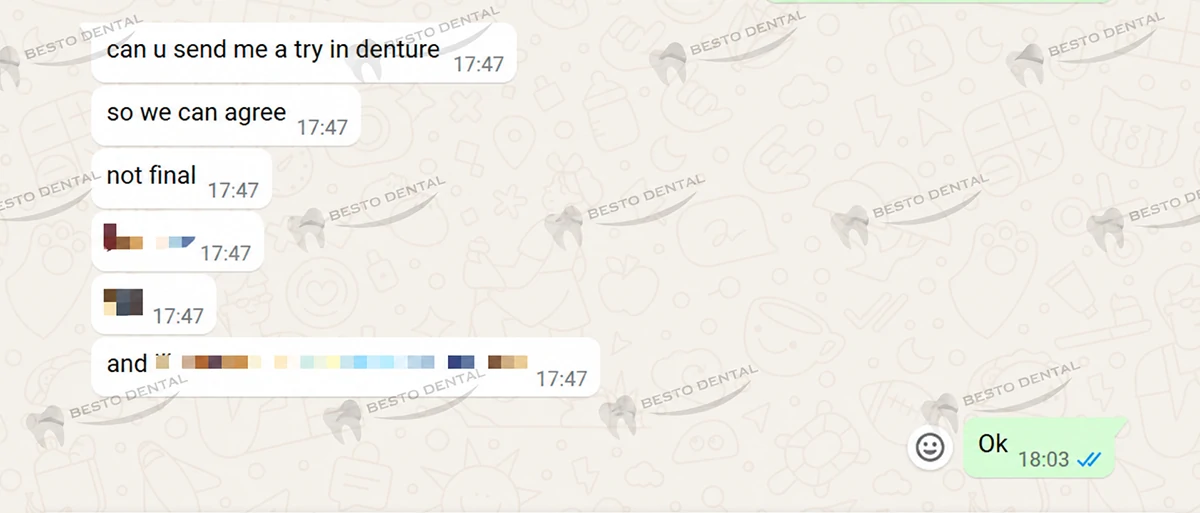
A PMMA prototype (or try-in) is not a mandatory step for every full-arch case, but it is highly valuable for complex cases. It allows for the verification of vertical dimension of occlusion (VDO), occlusion, tooth position, and aesthetics prior to fabricating the final zirconia restoration, thereby reducing the risk of rework. At BestoDental, for complex full-arch cases, we conduct a try-in and await client approval before proceeding with the final fabrication.
Additionally, as we have noted in other articles regarding implant dentistry, information about the implant system is crucial when submitting case details. For full-mouth implant cases, the laboratory needs to understand not only the implant system but also the MUA (Multi-Unit Abutment) system. In full-arch cases, the insertion angles of multiple implants are rarely identical; the All-on-4 technique, for instance, often involves the tilted placement of posterior implants.
MUAs help establish a connection platform that is better suited for the restoration, enabling multiple implants to collectively support a full-arch prosthesis. Therefore, when a laboratory receives a full-arch case, it is essential for them to know exactly which MUA or abutment system is being used.
If you are unsure what information to include when sending full-arch implant cases to the laboratory, the following table can help you resolve the matter in one go. You can also contact us for more information.:
| Data | Purpose |
| Upper Scan | Upper arch data |
| Lower Scan | Lower arch data |
| Bite Scan | Occlusal relationship |
| Scan Body Scan | Determine the implant / MUA positions |
| Soft Tissue Scan | Design the tissue surface and emergence profile |
| Pre-op Scan | Reference for the patient’s original tooth morphology |
| Existing Denture Scan | Reference for VDO, tooth position, occlusion, and esthetics |
| Approved Prototype Scan | Important reference for the final restoration design |
| Implant / MUA Information | Confirm the connection interface and components |
| Photos | Reference for the midline, smile line, lip support, tooth length, etc. |
5. Full-Arch Implant Clinical Indications
At BestoDental, we have performed thousands of full-arch implant cases and possess a deep understanding of the clinical indications for this treatment; we have therefore compiled the following table to assist you in your decision-making.
| Clinical Indication | Description |
| Completely Edentulous Arch | Patients who have lost all teeth in the upper or lower arch and need a full-arch prosthetic reconstruction. |
| Terminal Dentition | Patients with multiple severely compromised teeth that cannot be predictably retained and are planned for extraction followed by full-arch rehabilitation. |
| Poor Retention with Conventional Complete Dentures | Patients who have difficulty obtaining sufficient stability or retention from conventional removable complete dentures and may benefit from implant-supported treatment. |
| Immediate Full-Arch Rehabilitation | Selected patients who receive implants and a provisional full-arch restoration as part of an immediate loading treatment protocol. |
| Replacement of a Failing Full-Arch Prosthesis | Patients whose existing implant-supported full-arch restoration requires replacement because of prosthetic, functional, or esthetic problems. |
| Full-Arch Functional and Esthetic Reconstruction | Cases requiring reconstruction of the entire arch to restore tooth position, occlusion, VDO, function, and esthetics. |
Suitability for full-arch implant treatment cannot be determined solely by the number of missing teeth; a clinical assessment by the practitioner is required, taking into account bone volume, soft tissue, implant positioning, occlusal conditions, systemic health, and the patient’s restorative needs.
6. Full-Arch Implant Restoration FAQs
In our daily conversations with clients, these are the questions we hear most often about full‑arch implant restorations, along with answers grounded in our hands‑on experience.
1)How long does a full-arch implant restoration last?
The implants can last for 20 years or longer, depending on how well they are maintained. The replacement of the visible part of the prosthesis (the teeth) usually requires replacement in 10-15 years. Of course, the actual service life has a close relationship with the patient’s oral hygiene habits, regular maintenance visits, and occlusal patterns.
2)What is the difference between full-arch implant restoration and traditional dentures?
The most significant difference lies in retention. Traditional removable dentures attach through suction or clasps and are liable to loosen and shift. The full-arch implant restoration is, on the other hand, attached to the implants installed in the alveolar bone and offers much higher stability. Furthermore, full-arch implant restorations are not taken out every day for cleaning (fixed protocols), so it is more like a natural tooth than a removable one.
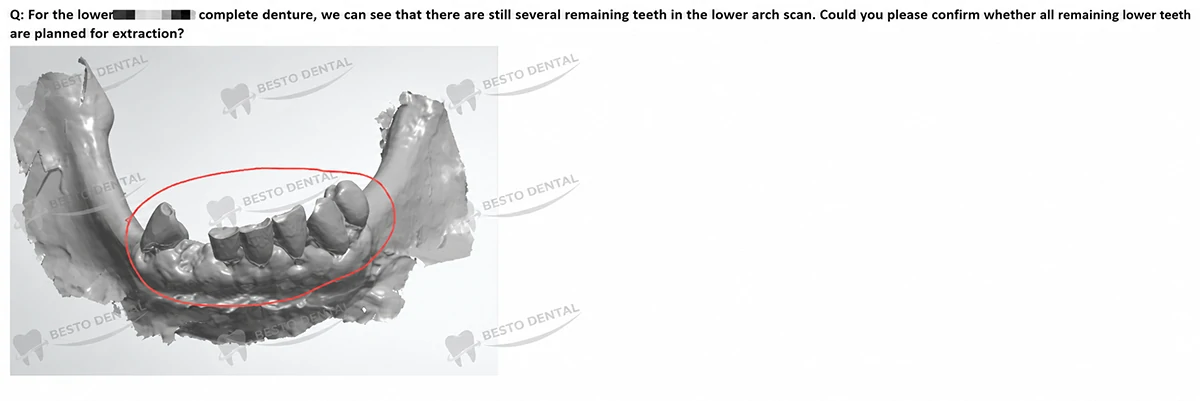
3) Are there other teeth that must be removed before the placement of a full‑arch restoration?
In most full‑arch cases, the implant treatment is performed at the same time any teeth that are too severely decayed, have lost their underlying bone support, or are compromised by periodontal disease are extracted. In a few cases, it may be possible to maintain some stable teeth to support an interim transition prosthesis during the healing phase (this is case-specific).
The basic principle is that the final full‑arch restoration should be designed on a clean, predictable foundation, typically the removal of the entire dentition in the arch.
4) What Is Passive Fit?
Passive fit means that a full-arch restoration can seat accurately and stably on all implant connections without being forced into position by tightening the screws.
Because a full-arch restoration is connected to multiple implants at the same time, any significant discrepancy between the implant positions and the restoration may create stress when the screws are tightened.
For this reason, passive fit is especially important in Full-Arch Implant Restorations. It also means that the accuracy requirements for implant position, scan body data, occlusion, soft tissue, and full-arch scanning are much higher than for a single implant crown.
5) Why Is Screw-Retained So Common in Full-Arch Restorations?
Fixed Full-Arch restorations are often well suited for a screw-retained design.
One of the biggest practical advantages is retrievability. When the dentist needs to perform repairs, check the implants, manage the screws, or provide professional maintenance, the entire restoration can be removed.
Therefore, special attention should also be paid to the screw access hole/screw channel during the design process.
If the implant angle is not ideal, the screw access hole may emerge from an undesirable position, such as the labial surface of an anterior tooth. This is also one of the reasons why MUAs, angled MUAs, or angled screw channel designs are used in Full-Arch restorations.
6) What Are Common Problems in full-arch restorations during quality inspection?
The following are some of the most common problems to pay attention to:
| Problem | Common Causes |
| Restoration does not fully seat | Implant position/scan accuracy/framework accuracy |
| Poor screw access hole position | Implant angle / restorative design |
| Incorrect occlusion | Bite registration / VDO / scan error |
| Anterior teeth are too long or too short | Insufficient smile line/lip reference |
| Excessive lip protrusion | Improper gingival contour or tooth position design |
| Difficulty with cleaning | Tissue surface designed with excessive tissue contact |
| Zirconia fracture/chipping | Material thickness/cantilever / occlusal load and other factors |
| Screw loosening | Fit/occlusion/components/torque and other factors |
| Unnatural esthetics | Tooth setup / gingival characterization/transition line |
7. Conclusion
From hybrid fixed full arch implant to All-on-4/6 to overdentures, there are various options available, all of which can be a predictable and effective solution for edentulous patients. The type of prosthesis (temporary with PMMA, permanent with zirconia, or framework with titanium) depends on every patient’s functional requirements, esthetic objectives, and budget. From digital planning to final delivery, a structured clinical workflow guarantees success. We hope this information helps you make faster and better decisions regarding full-arch implant restorations.