When your patients require implant restorations, you might find yourself wondering if a stock abutment will be enough, or if a thoroughly customised design is the right choice, particularly when your implant is angled, your gums are thin, or your patient wants a perfect anterior aesthetic? This is not always an easy choice to make, and the consequences of the wrong choice may be detrimental to soft‑tissue health, prosthesis retention, or the smile line.
This guide presents a clinically relevant step-by-step explanation of custom abutments, including materials, design considerations, manufacturing processes, and clinical indications for when and why to use custom abutments and gain meaningful benefits over prefabricated options.
After reading, you will be able to choose the best abutment material for your clinical needs, understand what clinical demands influence peri-implant soft tissue health, and understand when to use custom abutments in all clinical situations.
1. What Is a Custom Abutment?
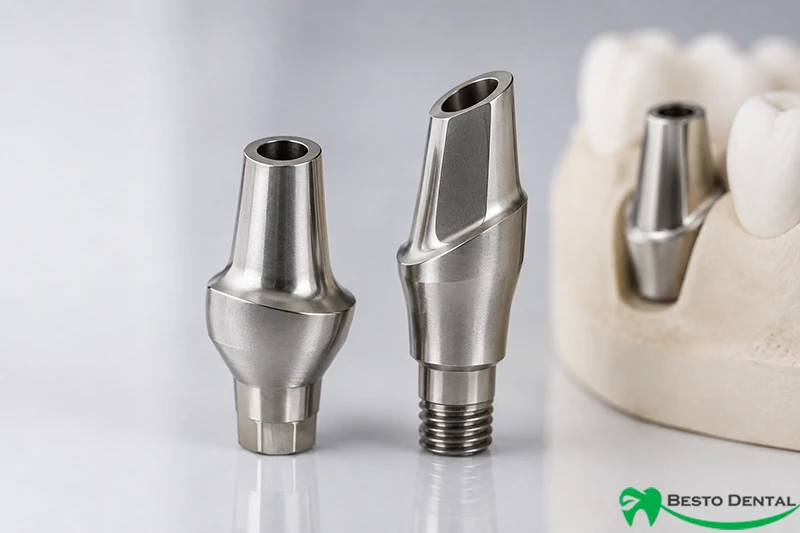
A custom abutment is a specially made connector between the dental implant and the visible part of the restoration (overdenture, bridge, or crown). It is made of biocompatible material such as titanium or zirconia, and its shape, height, angle, and emergence profile are developed according to the digital scan/impression of the implant position and surrounding gum tissue of one patient to best fit their individual anatomy.
It acts not only as a connection to transfer chewing forces from the crown to the implant, but also to direct the gums around the emerging tooth. A custom abutment is not manufactured in a standard size or shape, but is designed to fit the precise depth of the gum cuff, thickness of the soft tissue, and alignment with neighboring teeth. It is attached to the implant by a small retaining screw, and then the final crown is cemented/screwed onto the abutment. The customisation means the crown grows out of the gum at the correct angle and location, giving the most natural-looking and feeling crown possible. The abutment is primarily concealed under the crown, but its specific design will influence the overall long-term health of the surrounding gum and the success of the restoration.
The following are key benefits of a custom abutment:
- Natural gum support and aesthetics: The abutment conforms to the patient’s natural gum line contours, creating a scalloped emergence profile that helps support the gum line and avoid dark metal shadows and unsightly black triangles in between the teeth.
- Optimal crown positioning and bite alignment: When the crown can be tilted or angled depending on the situation, it minimizes minor errors made during the implant placement. This enables the final crown to bite properly against opposing teeth to distribute the biting forces evenly and to chew comfortably.
- Better soft tissue health: The exact subgingival margin of a custom abutment matches the gum cuff, with minimal gaps for bacteria to build up. This diminishes the chances of peri‑implant inflammatory tissue and enhances the effectiveness of daily cleaning.
- Better retention and stability: A larger, more uniform bonding surface for cemented crowns, or a more precisely indexed screw channel for screw-retained crowns. This will reduce the chances of loosening or debonding over time.
- Long-term mechanical reliability: The abutment is designed to fit the inner connection of the implant perfectly to evenly distribute occlusal load across the implant body. This minimizes point stresses and decreases the risk of fatigue or fracture of the screw in the long term or abutment fracture.
- Use in complex cases: It can be used when a stock abutment would not suffice, like when using narrow diameter implants, limited interocclusal space, or in cases where a number of implants are to be inserted in a common path of insertion for a bridge.
- High material quality compatibility: Both titanium and zirconia custom abutment options are available to provide metal-free, tooth coloured, or high-strength options, depending on the patient’s esthetic or strength requirements.
When a prefabricated abutment fails to meet the anatomic and/or restorative demands, then a custom abutment is used in clinical situations. It provides a more precise positioning of the implant, the gum line, and the restoration it provides, particularly in the esthetic or soft tissue portion. BestoDental will be able to create custom abutments that fit you.
2. Custom Abutment Materials
Titanium, zirconia, and hybrid zirconia and titanium are the three most common materials used to fabricate custom abutments. They are all combined with different designs and are selected according to the different clinical needs of strength, biocompatibility, and esthetics.
| Abutment Type | Material & Structural Design | Key Properties & Advantages | Indications & Cautions |
|---|---|---|---|
| Titanium | Ti‑6Al‑4V (Grade 5, α+β alloy). Machined from a single block: connection, emergence profile, and margin as one continuous part. | Excellent biocompatibility (stable TiO₂ layer). High strength (tensile >900 MPa) & good ductility. Superior corrosion resistance. Precise fit and proven long‑term reliability | Indications: Posterior teeth, non‑aesthetic single‑unit/short‑span restorations, heavy occlusal loads. Grey colour may show through thin gingiva, not ideal for anterior aesthetics. |
| Zirconia | 3Y‑TZP (yttria‑stabilized tetragonal zirconia). Fully monolithic, all zirconia, no metal component. | White/ivory colour with moderate translucency without grey shadow. Stress-induced transformation toughening. Flexural strength >1,000 MPa. Chemically stable, corrosion‑free | Indications: Anterior single crowns where aesthetics are paramount.Brittle compared to titanium; connection interface is ceramic; careful torquing required to avoid microcracks. |
| Two‑Piece Hybrid (Zirconia + Ti Base) | Zirconia (coronal/transmucosal) + Titanium alloy (connection). Two parts bonded/assembled via resin cement or mechanical retention. | Titanium base: precision fit, better fatigue resistance under cyclic loading. Zirconia portion: eliminates metal show‑through, natural gingival contour. Overcomes brittleness of pure zirconia at the interface and the colour drawback of pure titanium | Indications: Anterior aesthetic restorations requiring both safety and appearance, especially with thin gingiva.Requires careful bonding/assembly; potential interface failure if poorly fabricated. |
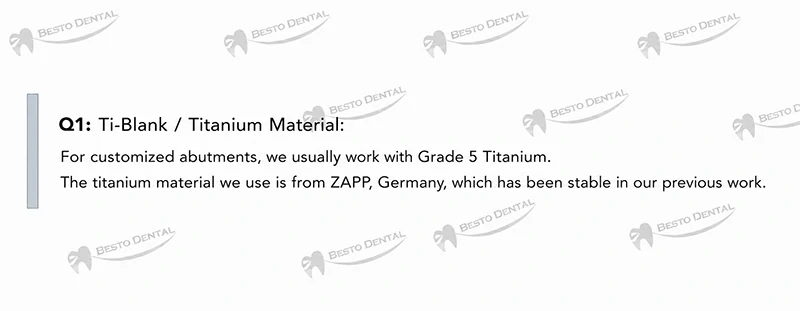
Another material is PEEK; we did not include it in the table because it is not a mainstream option and is generally used for special designs, temporary solutions, or specific restoration plans. Titanium is the most mainstream choice, and the majority of BestoDental’s customers opt for titanium abutments. We typically work with Grade 5 Titanium. The titanium material we use is from ZAPP, Germany. We also select suitable materials for our clients based on the specific circumstances of each case. Please contact us for more information.
3. Custom Abutment Design
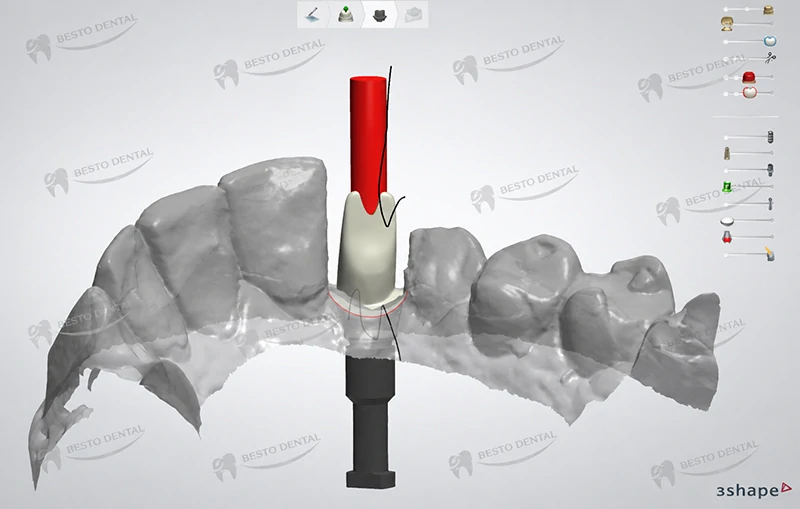
Before beginning the design, we must emphasize one crucial prerequisite: to accurately design a custom abutment, the exact implant system/implant library information must be provided so that the correct implant system can be matched. As we mentioned previously, BestoDental is compatible with most major implant brands, including Nobel Biocare, Straumann, Dentsply Sirona, Astra Tech, Zimmer Biomet, Osstem, MIS, Bicon, MegaGen, Dentium, and others.
Custom abutment design is essentially not simply about drawing an abutment. Instead, it is working backwards from the position of the implants, the gingival anatomy, the final crown morphology, and the occlusal space to design an implant abutment that is best suited for the final restoration. All of these steps can have an impact on the restoration’s completion.
We have summarized the main aspects of custom abutment design below:
| Design Aspect | Main Considerations |
| Implant Connection | Match the correct implant system, platform diameter, and connection type to ensure accurate seating and fit between the custom abutment and implant. |
| Abutment Height | Determine the height according to the available occlusal space and planned crown height, while maintaining adequate space for the crown and sufficient height for retention. |
| Emergence Profile | Design the emergence profile according to the gingival anatomy and cervical contour of the final crown, creating a smooth transition from the implant platform to the restoration. |
| Finish Line / Margin | Position the abutment margin according to the gingival level. In the anterior region, particular attention should be paid to margin depth and accessibility for removing excess cement after cementation. |
| Abutment Shape | Design the abutment based on the planned final crown rather than simply creating a cylindrical form. Mesiodistal and buccolingual restorative space should be considered. |
| Taper | Control the taper and axial wall geometry to provide an appropriate path of insertion and adequate retention for cement-retained restorations. |
| Wall Thickness | Maintain sufficient material thickness for the mechanical strength of the titanium abutment while preserving adequate space for the restorative material above it. |
| Occlusal Clearance | Reserve sufficient space according to the material requirements of the final restoration. An excessively high abutment may leave inadequate material thickness for the crown. |
| Insertion Path | For multi-unit restorations, consider the relationship between individual abutments and establish an appropriate common path of insertion. |
| Anti-rotation / Orientation | Particularly for single-unit restorations, properly utilize the implant connection and abutment geometry to provide rotational stability and correct orientation. |
For example, for a posterior implant crown, the process is not: Scan the implant → arbitrarily design a titanium post → place a crown over it.
Instead, it is closer to: Intraoral/model scan → confirm the implant position → design the final crown → work backward from the crown to determine the custom abutment design → adjust the emergence profile, margin, height, taper, and restorative space → check the occlusion and proximal space → CAM fabrication.
One particularly important concept in this process is Crown-Down Design.
For example, if the implant is positioned slightly toward the buccal side, directly designing a standard-shaped abutment along the implant axis may result in an excessively thick crown or an abnormal crown contour. With a custom abutment, CAD can be used to adjust the cervical contour, axial walls, and coronal form of the abutment, allowing the final crown to more closely reproduce the morphology of a natural tooth.
4. Custom Abutment Manufacturing Process
Once the intraoral scan and all implant information have been confirmed to be accurate, the fabrication of the custom abutment can begin. We have summarized the main manufacturing process in the table below for your reference:
| Step | Manufacturing Process | Key Operations |
| 1 | Case Data & Implant Identification | Receive scan data and confirm the implant brand, system, platform, connection type, and corresponding scan body/implant library. |
| 2 | Implant Library Matching | Import the scan into CAD software, match the correct implant library, and determine the implant position, angulation, and connection orientation. |
| 3 | Custom Abutment CAD Design | Design the emergence profile, gingival height, margin position, abutment height, taper, crown support, and screw access channel according to the clinical space. |
| 4 | CNC Milling | Select the compatible Ti-Blank / pre-milled blank and mill the custom abutment according to the CAD design. Grade 5 titanium is commonly used. |
| 5 | Finishing & Fit Inspection | Remove milling burrs, finish or polish the required surfaces, and inspect the implant connection, screw channel, dimensions, margins, and seating. |
| 6 | Crown Fabrication & Final QC | Fabricate the final crown and check fit, contacts, occlusion, emergence profile, screw access, and overall restoration before delivery. |
5. Clinical Applications of Custom Abutments
The clinical applications of custom abutments are relatively straightforward. They are not limited to any particular type of case. Instead, custom abutments are typically used when stock abutments cannot adequately accommodate the implant position, soft tissue anatomy, or requirements of the final restoration, providing a more suitable restorative foundation through individualized design.
| Clinical Application | Why Use a Custom Abutment? |
| Single Implant Crown | The most typical use. The abutment can be designed to optimize retention, restorative space, and crown form depending on where the individual tooth is located, the gingival contour, and crown morphology. |
| Anterior Esthetic Restorations | The emergence profile and margin position can be individually designed to better support the gingival tissue and cervical contour of the final crown. For cases with high esthetic demands, zirconia or zirconia with a Ti-base may also be considered. |
| Posterior Implant Restorations | When the implant position, available crown height space, or soft tissue conditions are not well suited to a stock abutment, a custom titanium abutment can provide a more appropriate abutment height, shape, and restorative space. |
| Angulated or Non-ideal Implant Position | When the implant angle or position does not fully correspond to the intended direction of the final crown, the abutment shape and path of insertion can be customized to provide a certain degree of prosthetic compensation. |
| Deep or Irregular Gingival Tissue | The margin position and emergence profile can be designed according to the actual gingival height at different sites, allowing the abutment to better adapt to the soft tissue than a stock abutment with fixed dimensions. |
| Implant Bridges | When multiple implants differ in position or angulation, custom abutments can help optimize the common path of insertion and provide appropriate restorative space for the implant-supported bridge. |
| Cement-retained Implant Restorations | The abutment height, taper, margin, and path of insertion can be designed according to the planned crown, providing a more suitable foundation for retention of cement-retained restorations. |
| Limited Restorative Space | When vertical or buccolingual space is limited, the dimensions of the custom abutment can be adjusted according to the available space while preserving adequate thickness for the restorative material. |
One of the most common applications is the use of a custom abutment when the implant is positioned less than ideally. For example, if the implant is positioned slightly buccally or lingually, or if the implant angulation does not fully align with the long axis of the final crown, directly using a stock abutment may result in:
Abnormal crown contour → uneven restorative material thickness → an unfavorable path of insertion → compromised esthetics and cleanability.
Within the available restorative space and mechanical design limitations, a custom abutment allows the abutment shape and coronal orientation to be adjusted, creating a more appropriate restorative foundation for the final crown.
6. Custom Abutment FAQs
Based on our daily communication with our customers across the globe, we’ve compiled the most common questions on custom abutments.
1) When should I choose a custom abutment instead of a stock abutment?
A custom abutment is generally preferred when a stock abutment cannot provide the appropriate emergence profile, margin position, retention, restorative space, or crown orientation. It is particularly useful for anterior esthetic cases, implants with non-ideal positions or angulations, irregular soft tissue contours, limited restorative space, and cases where greater control over the final crown shape is required.
2) What information does the dental lab need to design a custom abutment?
The lab typically needs an accurate intraoral scan or physical impression, opposing arch and bite records, the exact implant system and platform information, and the corresponding scan body or implant library information. You should also provide the planned restoration type, material, shade, and any specific requirements regarding the margin, emergence profile, or final crown design.
3) Does the choice of material (titanium vs. zirconia) affect long‑term soft tissue health?
Both are biocompatible and well‑tolerated. Zirconia may promote slightly better soft tissue attachment in some studies, but the clinical difference is minor when abutments are properly fabricated and maintained. The primary deciding factors are esthetics, strength, and gingival biotype.
4) Can I review the CAD design before milling?
Yes. For complex cases, the CAD design can be reviewed before milling. This allows you to evaluate key aspects such as the abutment height, emergence profile, margin position, restorative space, and overall relationship between the abutment and the planned final restoration before production begins.
5) Can a custom abutment be adjusted intraorally after delivery?
Major modifications (e.g., altering emergence profile, margin, or height) are not recommended—they risk compromising the implant‑abutment interface. Minor occlusal adjustments and polishing are acceptable. For Ti‑base bonded restorations, any substantial change should be done in the lab before cementation. Therefore, when outsourcing cases, it is essential to strictly control the quality of the laboratory.
6) What should I check when trying in a custom abutment?
During try-in, first confirm that the custom abutment is completely seated and correctly oriented on the implant. Check the fit at the implant-abutment connection, the relationship between the emergence profile and surrounding soft tissue, margin accessibility, and the available space for the final restoration.
For cement-retained restorations, also check the abutment height, path of insertion, and clearance for the crown. If the abutment does not seat completely, it should not be forced into position or tightened before the cause of the interference has been identified.
7. Conclusion
The custom abutment is a fundamental component of implant dentistry that plays an important role in esthetic, functional, and biological results. In this guide, we have discussed their clinical benefits, material properties, fabrication process, and the common applications. With either titanium or zirconia, or a two-piece abutment design, careful consideration of every patient’s anatomy and restorative objective is necessary to choose the appropriate abutment. Finally, a well-designed custom abutment not only allows for good soft tissue health but also for long-term prosthetic success.