Deciding whether to provide a standard partial denture or a flexible partial denture for a patient with missing anterior teeth is a common dilemma; what exactly are the differences between the two? We wrote this article to address these questions.
This guide covers the material properties, structure, material families, case types, and clinical restrictions of flexible dentures, and provides practical guidelines for selecting appropriate materials.
By the end of this guide, you will know how flexible dentures are designed, how to choose between different material and clasp options, which cases are suitable for flexible dentures, and what information you should provide when sending a case to the dental laboratory.
1. What are Flexible Dentures?
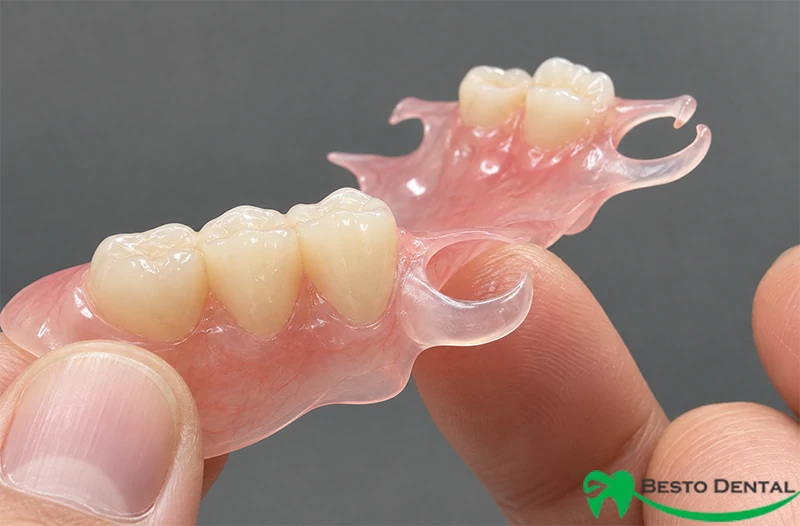
Flexible dentures are removable dental appliances produced of semi-rigid thermoplastic polymers that conform to the natural micro-movements of the oral mucosa during function. A flexible denture is made with a material that is inherently flexible, or elastic, and can fit onto undercuts of the residual ridge without trauma to the supporting tissue caused by the rigid base material and metal clasps used in conventional acrylic dentures. The base is translucent with a gum color to give a natural appearance as the underlying mucosa passes through. From a practical standpoint, the denture flexes when inserted and removed, and moves when the tissues move during chewing, but does not resist the movements. This natural adaptation helps to decrease localized stresses to the abutment teeth and to the ridge, which can make this type of prosthesis more comfortable for the patient who has reported discomfort from rigid implant overhangs.
The clinical benefits of flexible dentures are directly related to the material properties and design of flexible dentures.
- Aesthetic clasping without metal: The flexible base fits into the interdental areas and hugs undercuts with thin translucent extensions that match the gums. No metal clasps show, especially when it comes to patients with high smile lines.
- Minimized abutment tooth lateral loading: Elastic clasps absorb lateral loading forces instead of transmitting them directly to the abutment teeth. This will reduce the risks of loosening and/or fracture in periodontally unstable teeth, as opposed to the action of rigid metal clasps as levers.
- No residual monomer: the main sensitizer in conventional acrylic resins is used in thermoplastic polymers. Indeed, patients with a known acrylic allergy and chronic burning in their mucous membranes typically don’t react to the flexible acrylic.
- Impact resistance and unbreakable performance: Polyamide thermoplastics can also be highly impact resistant and unbreakable compared to acrylic resin. The base is used to support the denture rather than to fracture as it happens with rigid plates, so they are good for patients who tend to drop their dentures or who have lower palatal vaults where rigid plates tend to break.
- Minimal tooth preparation: No preparation of the abutment teeth is needed for the placement of a clasp; the flexible material is able to fit into the natural undercuts of the teeth.
- Comfort during functional movements: The prosthesis moves slightly with the mucosa during chewing and speech, reducing the localized pressure points that commonly cause sore spots with rigid bases. This is particularly noticeable in extension base cases where tissue-borne and tooth-borne support coexist.
- Color stability and translucency: The gum colored base maintains its translucent appearance over time, allowing the natural tissue tone to contribute to the overall aesthetic result. This is a distinct advantage over opaque acrylic bases that can appear artificial in highly aesthetic zones.
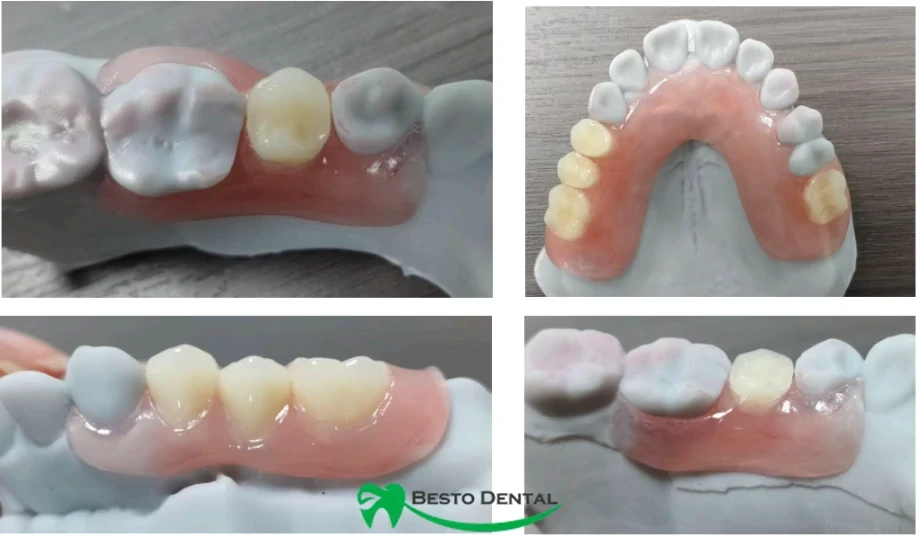
In clinical practice, flexible dentures are primarily used for partial edentulism where aesthetics, patient comfort, or material intolerance are the main concerns. They are less frequently prescribed for complete arches, as the absence of rigid palatal support limits load distribution and stability. The decision to use a flexible material should always be based on a careful assessment of the specific clinical context and the patient’s individual needs.
2. Structures of Flexible Dentures
The flexible denture integrates three core components: artificial teeth, a flexible resin base, and integral flexible clasps, into a seamless, metal‑free restorative system.
1) Flexible Resin Base
The base is the main body of a flexible denture, which is produced by injection moulding using thermoplastic resins like polyamide (nylon), polycarbonate, polyester, polypropylene, etc. It is in direct contact with oral soft tissues and has three main roles: to restore lost soft tissue contours, to provide support for the artificial teeth, and to transmit/distribute occlusal forces.
The flexible base offers excellent elasticity, good biocompatibility, and a translucent quality that blends naturally with the oral mucosa, achieving the aesthetic “invisible” effect. Structurally, it approximates a U‑shaped dental arch form, and owing to its flexibility, it can be fabricated thinner than conventional hard bases while maintaining adequate strength.
2) Artificial Teeth
Artificial teeth are the functional units that replace missing natural teeth, responsible for mastication and aesthetic restoration.
No chemical bond forms between the acrylic resin artificial teeth and the flexible base resin. Therefore, retention relies entirely on mechanical interlocking; retentive holes (T‑shaped or spherical cavities) are prepared on the tissue surface of the artificial teeth. During injection moulding, the base resin flows into these holes and, upon cooling, locks the teeth firmly into the base.
| Aspect | Detail |
|---|---|
| Retention mechanism | Mechanical interlocking (no chemical bond) |
| Preparation | T‑shaped or spherical cavities on the tissue surface |
| Processing | Base resin flows into holes during injection moulding |
| Outcome | Teeth are securely locked into the base for long‑term use |
3) Flexible Clasps
Clasps provide retention and stability for flexible dentures. Flexible clasps are formed integrally from the same elastic resin as the base, without any metallic components.
They extend from the base to engage the undercut areas of remaining natural teeth. Due to the material’s elasticity, flexible clasps can enter deeper undercuts (recommended ~0.50 mm) than metal clasps, while imposing less lateral stress on abutment teeth.
Immersing the clasp area in hot water softens the material, allowing the practitioner to bend it with pliers to modify retention force as needed.
| Clasp Type | Description |
|---|---|
| Main clasp | Covers parts of the proximal and gingival areas of the tooth; provides retention and stability |
| Circumferential clasp | Used for isolated teeth (not in contact with adjacent teeth); encircles the entire crown surface for good retention |
| Combination clasp | Combines circumferential and main clasp features |
| Continuous circumferential clasp | A circumferential design involving multiple remaining teeth |
3. Materials of Flexible Dentures
Flexible denture materials are all thermoplastic polymers and are processed by injection molding (rather than the conventional compression packing method). When we receive cases, the prescription form often lists “Valplast Flexible Denture,” which is very common.
Valplast refers to a well-known brand and material system used to make flexible partial dentures. Some clients even use “Valplast” as a colloquial term for flexible dentures, but strictly speaking, the two cannot be fully equated because flexible dentures can also be made from thermoplastic materials of other brands. In clinical practice, four main material families are commonly used:
| Material | Preferred indications | Key limitations/precautions |
|---|---|---|
| Acetal resin | Routine removable partial dentures where aesthetics and comfort are top priorities; no frequent relining anticipated. | Excellent flexibility and retention, but does not bond to acrylic – repairs are nearly impossible. |
| Polycarbonate | Anterior aesthetic cases requiring high translucency and natural appearance. | Limited long‑term resistance to ageing (hydrolysis); inform patients about this drawback. |
| Polypropylene | Patients exceptionally sensitive to prosthesis weight (e.g., extensive tooth loss or extensive palatal coverage). | Ultra‑low density reduces foreign‑body sensation, but use is strictly limited to low‑occlusal‑force situations. |
| Polyester | Prostheses subject to heavier occlusal loads or long‑term use (e.g., distal‑extension cases); also preferred when a thermoplastic elastomer is needed for implant‑supported frameworks (though PEEK/PEKK are generally recommended for high‑load cases). | Superior tear strength and elastic recovery, but higher processing demands and cost. |
All flexible denture materials are essentially non‑repairable. They are also not capable of bonding with reline materials, and a denture that does not fit the patient’s mouth nearly always needs a whole new denture. When frequent adjustments or rebases are expected (such as immediate dentures, progressive ridge resorption, or advanced periodontal disease), a conventional acrylic prosthesis may be more practical and economical in the long run, but is less esthetic.
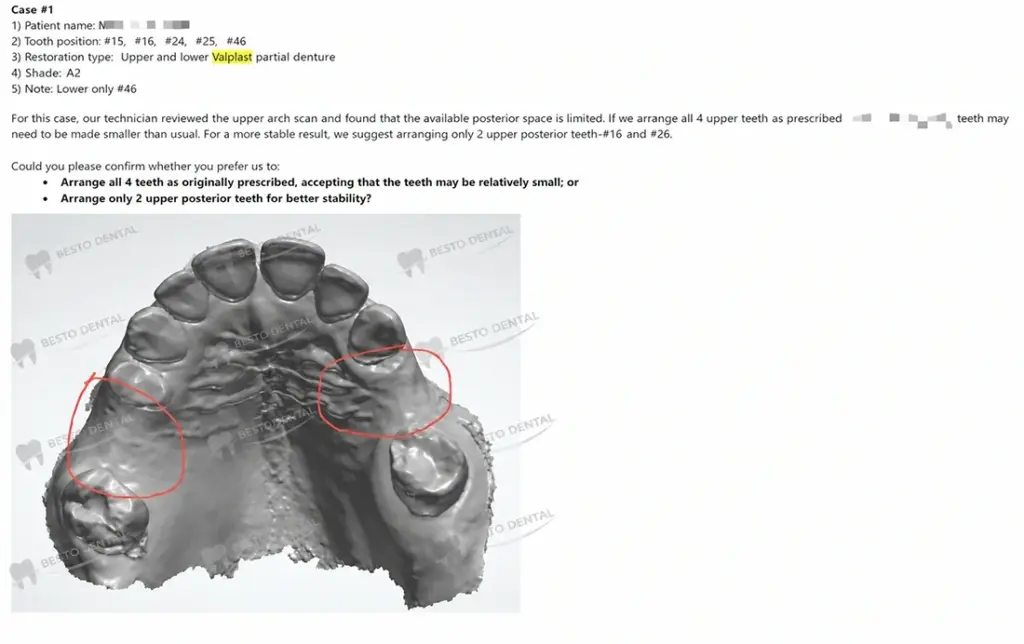
BestoDental has gained a wealth of knowledge in flexible dentures, and we are more concerned with long-term clinical feedback than pre-set lab parameters, as the difference in materials and handling conditions can be more determining. When reviewing cases, if we find a discrepancy between the patient’s actual condition and the doctor’s fabrication specifications, we consult the client and offer our professional recommendations to ensure the best possible outcome.
4. Types of Flexible Dentures
Based on structural characteristics, flexible dentures can be divided into the following six types, with their material and component combinations summarised in the table below:
| Type | English | Structural Characteristics |
|---|---|---|
| Full Flexible Partial Denture | Full Flexible Partial Denture | Both the base and clasps are made of flexible material |
| Unilateral Flexible Partial | Unilateral Flexible Partial | Replaces missing teeth on one side only; small in size |
| Bilateral Flexible Partial | Bilateral Flexible Partial | Spans across both left and right sides to replace bilateral defects |
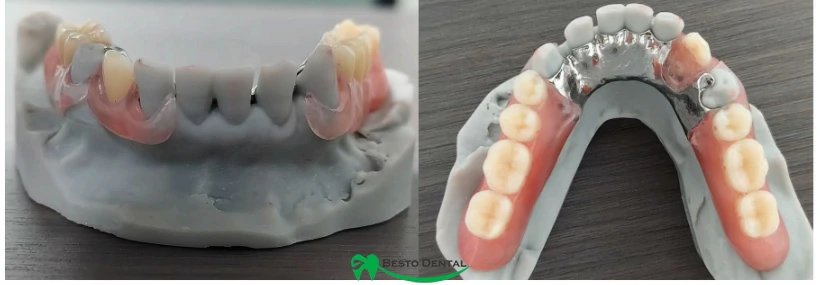
| Flexible Base + Metal Framework | Flexible + Metal Framework | Metal provides support and rigidity; flexible resin improves aesthetics and retention |
| Flexible Clasp Partial | Flexible Clasp Partial | Emphasises the use of gingival‑coloured flexible clasps for aesthetic retention |
| Transitional Flexible Denture | Transitional Flexible Denture | Short‑term use after extractions, during implant treatment, etc. |
These six categories cover common scenarios, ranging from flexible to hybrid designs, and from permanent to temporary restorations. In practice, from our empirical perspective, not all types are equally manageable. The following two types warrant particular attention.
One type is Bilateral Flexible Partial. A frequent question is why this design feels loose or causes abutment soreness despite adequate undercuts. Success depends less on undercuts than on ridge quality and the health of the abutment and surrounding tissues. With a firm ridge and stable abutments, use it with enhanced base coverage. If these conditions are absent, choose the metal-framework hybrid for rigid cross-arch stabilisation.
The other type is Flexible Base + Metal Framework. A pure flexible denture bends repeatedly under occlusal load, leading to fatigue and failure. The metal framework provides rigid splinting, something pure resin cannot offer.
5. Flexible Denture Clinical Applications
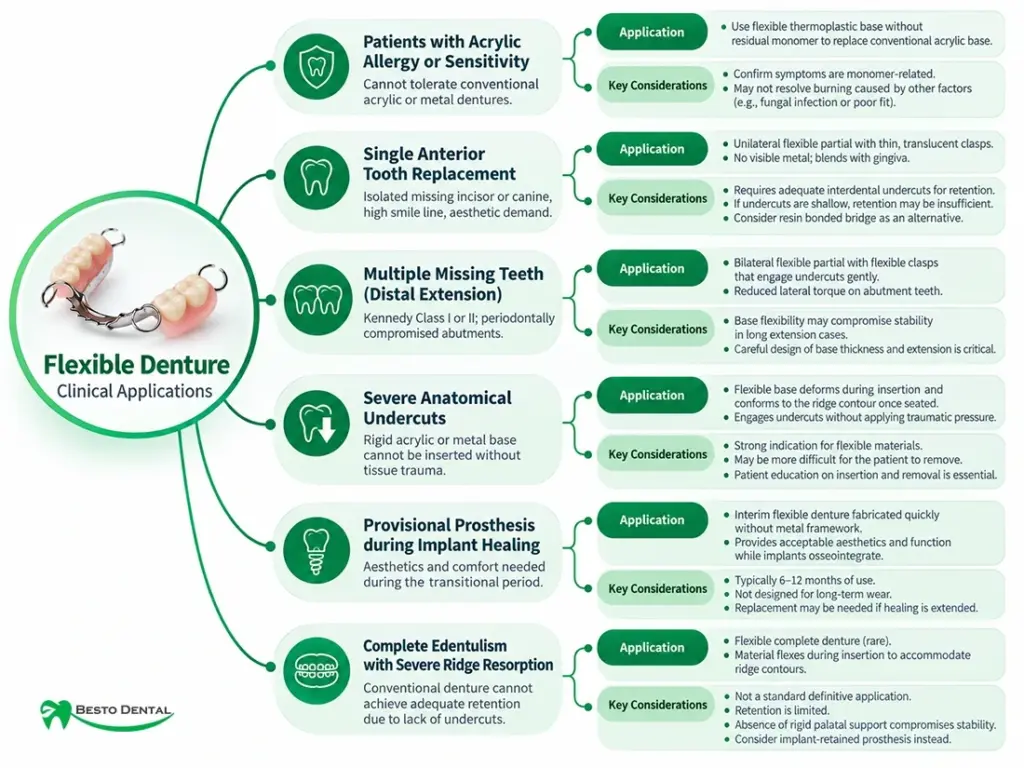
Flexible dentures are most commonly used for patients who are not able to tolerate conventional acrylic or metal dentures. There are variations between each scenario, and the requirements for the prosthesis is different, so you should know that to ensure that the prosthesis will be designed and processed correctly. If you would also like to learn about traditional acrylic partial dentures, we have written a dedicated article: Partial Denture Guide: Materials, Types, and Clinical Applications.
| Specific Clinical Situation | How the Flexible Denture Is Used | Main Considerations |
|---|---|---|
| Patient with confirmed allergy or sensitivity to acrylic monomer; persistent mucosal burning or stomatitis with conventional dentures | Flexible thermoplastic base contains no residual monomer; replaces conventional acrylic base to eliminate allergic tissue response | Confirm that the patient’s symptoms are indeed monomer-related; flexible material may not resolve burning caused by other factors such as fungal infection or ill-fitting base |
| Isolated missing tooth in the anterior region (central incisor, lateral incisor, or canine); high smile line; patient refuses metal display | Unilateral flexible partial with thin, translucent clasps that engage interdental undercuts; no metal visible; the flexible extension blends with gingival tissues | Requires adequate interdental undercuts for retention; if undercuts are shallow, retention may be insufficient; consider whether a resin-bonded bridge might be a more definitive alternative |
| Multiple missing teeth with distal extension (Kennedy Class I or II); terminal abutments are periodontally compromised and cannot tolerate rigid metal clasps | Bilateral flexible partial with flexible clasps that engage undercuts gently; reduced lateral torque on abutment teeth compared to cast metal or wrought wire clasps | Flexibility of the base may compromise stability in long extension cases; the prosthesis may flex excessively during function, causing tissue irritation; careful design of the base thickness and extension is critical |
| Patient with severe anatomical undercuts that prevent seating of a rigid acrylic or metal base; conventional denture cannot be inserted without trauma to tissues | Flexible base deforms during insertion and conforms to the ridge contour once seated; engages undercuts without applying traumatic pressure | This is one of the strongest indications for flexible materials; however, the prosthesis may be more difficult for the patient to remove; patient education on insertion and removal technique is essential |
| Patient requiring a provisional prosthesis during implant healing; aesthetics and comfort needed during the transitional period | Interim flexible denture fabricated quickly without metal framework; provides acceptable aesthetics and function while implants osseointegrate | Intended service life is typically 6 to 12 months; the prosthesis is not designed for long term wear; advise the clinician that the patient may need a replacement if the healing period is extended |
| Complete edentulism with severe ridge resorption; conventional complete denture cannot achieve adequate retention due to lack of undercuts | Flexible complete denture (rare); material flexes during insertion to accommodate ridge contours; may be used as a transitional or palliative prosthesis | This is not a standard definitive application; retention is limited; the absence of rigid palatal support compromises stability; usually indicates that an implant-retained prosthesis should be considered instead |
6. Flexible Denture FAQs
Whether it is in our everyday interactions with clients or at any consultation, we are often asked about flexible dentures. We have gathered together a few of the most frequently asked questions below to help you quickly resolve some of your concerns.
1) Can a flexible denture be relined or repaired if the fit becomes loose?
Conventional acrylic relines and repairs do not work with polyamide (nylon) flexible dentures. There are some special surface treatment methods, but they are technique sensitive and are not always durable. Most of the time, it’s not a simple reline, but a complete remake of the loose or ill-fitting flexible denture. The limitation should be explained to the patient prior to treatment.
2) Are flexible dentures more expensive than conventional acrylic or metal partials?
Yes, flexible dentures are generally more expensive than conventional acrylic partials due to higher material costs, specialized injection molding equipment, and the need for specific laboratory training. They may be comparable to or slightly less expensive than cast metal partials, depending on the laboratory. The additional cost is typically justified by the aesthetic and comfort benefits in appropriate cases.
It’s challenging to add a tooth to a polyamide flexible denture. Because it will not adhere to acrylic, new teeth can only be mechanically (e.g., pin) cemented or bonded with special bonding systems, which are typically not as durable as conventional acrylic repairs. Most laboratories recommend a complete remake, especially if the denture has been worn for several years and the fit has worn out as well.
3) Can a flexible clasp be combined with a cast metal framework?
Yes. In some cases, a cast metal framework can be combined with flexible clasps. The metal framework provides support and rigidity, while the flexible clasps can be used in areas where a less visible clasp is preferred. The final design depends on the abutment teeth, undercuts, and retention requirements.
4) Can I request a Valplast flexible denture from a dental laboratory?
Yes, if the laboratory offers genuine Valplast material. Valplast is a specific brand of flexible denture material, not a general name for all flexible dentures. If you require Valplast, make sure to specify it when submitting the case.
5) Does a flexible denture require tooth preparation or rests?
Many flexible dentures use the natural undercuts of the teeth for retention and may not require the same rest and preparation design as a cast partial denture. However, this depends on the case and the type of flexible denture being made.
6) How should the laboratory design the clasp if esthetics is important?
If esthetics is important, flexible clasps can be designed around suitable undercuts and positioned to reduce their visibility. You can also tell the laboratory which areas you would prefer the clasp to avoid or keep less visible.
7) What information should I provide when outsourcing a flexible denture case?
Provide a complete scan or impression, bite record, missing tooth positions, tooth shade, and any special design requirements. If you need a specific material, flexible clasp design, rests, or a metal framework, clearly note these in the prescription.
7.Conclusion
This guide has covered the main structures of flexible dentures. It has also explained common thermoplastic materials, different flexible denture types, and the clinical situations in which they may be considered. Practical questions such as combining flexible clasps with a metal framework, specifying Valplast, and communicating case requirements with the dental laboratory have also been discussed.
After reading this guide, you should be able to understand how flexible dentures are constructed, how their materials and designs differ, which clinical situations may be suitable, and what information should be provided when outsourcing a flexible denture case to a dental laboratory.