When outsourcing immediate dentures to a dental laboratory, retention may be one of your biggest concerns. After all, poor denture retention is one of the common reasons dentists consider changing laboratories.
In this article, we will explain what immediate dentures are, the different types and materials available, how they are fabricated, and their clinical applications. We will also take a closer look at one of the issues you may care about most: how to achieve better retention with immediate dentures.
At the end, you will be able to recognize immediate complete and partial cases, and what they require in terms of design; you will understand how the choice of base material and tooth material will impact transitional wear and subsequent conversion; and you will understand which pre-extraction records, occlusion checks, and extraction instructions will ensure that fit is maintained after surgery.
1. What Are Immediate Dentures?
Immediate dentures are removable dental prostheses that are fabricated before tooth extraction and inserted immediately after the remaining natural teeth are removed. They allow patients to avoid a period without teeth while also helping protect the extraction sites and maintain appearance and basic oral function during the initial healing period.
Before extraction, the dentist takes impressions or intraoral scans, bite records, shade information, and clinical photographs and sends them to the dental laboratory. Based on these records, the laboratory designs and fabricates the immediate denture according to the patient’s existing arch and the planned extraction sites. On the day of extraction, the denture is inserted immediately after the teeth are removed, covering the healing tissues, replacing the missing teeth, and helping protect the extraction sites during the initial healing period.
There are several advantages to immediate dentures:
- No gap in social or functional tooth replacement: No gap in social or functional tooth replacement occurs during healing.
- Tissue protection: The denture protects the areas where the teeth are being removed and helps to form a blood clot.
- More accurate tooth matching: Since the natural teeth are in place during the time the records are taken, the lab can more accurately match the shade, shape, and arrangement.
- Preserves facial contours and vertical dimension: A denture is worn immediately to help maintain vertical dimension and facial contours.
- Speech adaptation: The patient starts adapting to talking with a prosthesis immediately.
- Simple chewing function: It is possible for patients to manage soft foods as well as a liquid diet.
- Assists in preserving ridge contours: During the early phase, the denture will provide some support to the healing ridge.
Immediate dentures are generally indicated for patients whose anterior teeth are missing, those who have all of their teeth in one arch extracted, or patients with periodontal disease, decay, or trauma with multiple extractions. As healing continues, the gum and bone contour will shift, causing the denture to become loose and likely to need a reline or replacement. Immediate dentures are, therefore, normally employed as the transitional prostheses until the time comes to create a reline or replacement.
To make the difference clearer, we list the table below compares immediate and conventional dentures across the main clinical and laboratory points. If you would like to learn more about conventional complete dentures, you can check out our article: Complete Denture Guide: Types, Materials, and Fabrication Process.
| Feature | Immediate Denture | Conventional Denture |
|---|---|---|
| Fabrication timing | Before extraction | Usually after extraction and healing |
| Insertion timing | Immediately or shortly after extraction | After tissue healing |
| Natural teeth during fabrication | Usually present | For complete cases, usually no natural teeth remain |
| Ridge form | Must be predicted | Can be recorded directly after healing |
| Complete try-in | Limited | Usually possible |
| Edentulous period after extraction | Greatly reduced or avoided | A waiting period usually exists |
| Need for later adjustments | Higher | Relatively stable |
| Reline | More common | Depends on long term tissue changes |
2. Types of Immediate Dentures
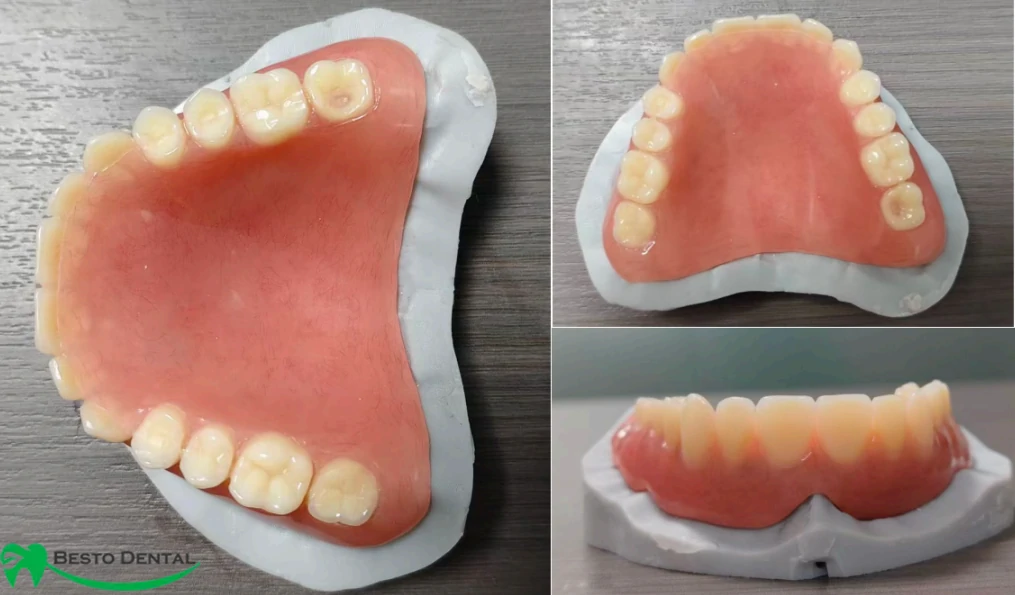
When an immediate denture case arrives at the lab, the first thing to confirm is not the material or brand, but how many natural teeth in that arch will be retained and how many will be extracted on the day of delivery. This judgment directly determines the coverage, framework design, and impression requirements. Therefore, here we classify immediate dentures by this dimension.
| Type | What It Is | Core Difference from the Other Type | What to Keep in Mind |
|---|---|---|---|
| Immediate Complete Denture | Full-arch prosthesis; all remaining teeth are extracted on the day of delivery | No natural teeth retained; tooth position and occlusion depend entirely on pre-extraction records; conventional wax try-in is usually not possible | Pre-extraction records must be complete; no reference after extraction; indicated for cases with planned full clearance |
| Immediate Partial Denture | Partial prosthesis; replaces one or more teeth and retains some natural teeth | Natural teeth are retained; design centers on abutments, clasps, and support type | Abutment stability determines design; can be tooth-supported or mucosa-supported; the position and number of retained teeth must be clear |
In immediate dentures, these two types cover the vast majority of cases. Which type is chosen does not depend on material or retention method, but on the number of teeth to be extracted and the number that can be retained. Both require clear pre-extraction records and an extraction plan, but their limiting factors differ.
Our clients sometimes ask, “Can a flipper be worn long term?” because it looks like a definitive partial denture. It is a common transitional form within Immediate Partial Denture, usually a lightweight, one-piece acrylic appliance that replaces one to three anterior teeth and can be delivered on the same day as extraction. In actual projects, if the definitive plan is a fixed restoration, a flipper can serve as a transition; if long-term use is expected, it should be handled according to the design logic of a metal-framework partial denture, rather than treated as a definitive prosthesis.
3. Materials for Immediate Dentures
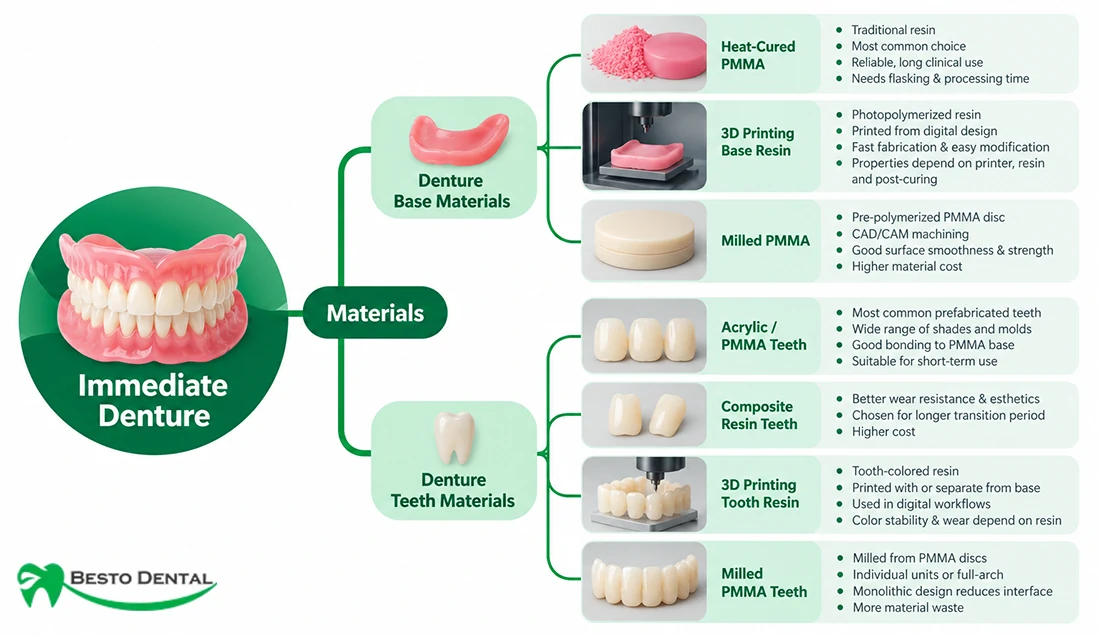
The materials used for immediate dentures are essentially the same as those used for conventional complete or partial dentures. They fall into two main components: the denture base and the denture teeth. We have covered the general material knowledge for these two components in detail in our Partial Denture Guide, so here we will focus only on the options commonly used in immediate denture cases.
Immediate Denture Base Materials:
| Material | Main Characteristics | Common Considerations |
|---|---|---|
| Heat-Cured PMMA | Traditional heat-cured resin. The most common choice in conventional processing. | Well-established and reliable. Requires flasking and processing time. Widely used when the case follows a traditional workflow. |
| 3D Printing Denture Base Resin | Photopolymerized resin printed directly from a digital design. | Commonly used for digital immediate dentures. Allows fast fabrication and easy design revision. Properties depend on the printer, resin, and post-curing protocol. |
| Milled PMMA | Pre-polymerized PMMA disc, milled with a CAD/CAM machine. | Suitable for CAD/CAM workflows. Offers good surface smoothness and mechanical properties. Higher material cost than heat-cured or printed options. |
Immediate Denture Teeth Materials:
| Material | Main Characteristics | Common Considerations |
|---|---|---|
| Acrylic / PMMA Teeth | The most common prefabricated teeth for traditional dentures. | Wide range of shades and molds. Bond reliably to heat-cured PMMA bases. A practical choice when the immediate denture is planned as a short-term transitional prosthesis. |
| Composite Resin Teeth | Better wear resistance and esthetics than standard acrylic teeth. | Often chosen when the immediate denture will be worn for a longer period before conversion. Higher cost than acrylic teeth. |
| 3D Printing Tooth Resin | Tooth-colored resin printed together with or separately from the base. | Used in digital workflows. Pairs with printed denture bases. Color stability and wear depend on the specific resin system. |
| Milled PMMA Teeth | Teeth milled from PMMA discs, either as individual units or as a full arch integrated with the base. | Used in CAD/CAM workflows. Milled monolithic designs reduce the tooth-base interface. Material waste can be significant. |
For immediate dentures that may stay in use longer, or that will be converted to a definitive prosthesis later, composite resin teeth are worth considering. They offer better wear resistance and esthetics than standard acrylic teeth. While they cost more, the extended transition period often justifies the investment.
4. Immediate Denture Fabrication Process
The fabrication of an immediate denture follows a different logic from a conventional denture because the design must account for teeth that will be removed before the patient ever wears the prosthesis.
| Stage | What Happens | What to Keep in Mind |
|---|---|---|
| Case Assessment | Case Assessment: The treatment plan will be considered by the lab, including which teeth need to be extracted, which teeth stay in the mouth, whether the position of the teeth will be maintained, and whether it will be a single or dual arch denture. | The design is determined by the extraction plan. Without the knowledge of the lab about which teeth are permanent and which are not, the design cannot be accurately carried forward. This is the most crucial information to pass on. |
| Pre-Extraction Records | While the natural teeth remain, Impressions, bite registrations, shade selection, photographs, and phonetic assessments are taken. | Fit and esthetics are directly related to the recorded quality. Not recording properly will make the design team guess where the teeth are, where the midline will be, and the vertical dimension. |
| Design & Tooth Setup | The lab will create the base to fit the existing arch, determine the positions of the teeth based on pre-extraction records, and set teeth up digitally or in wax. | Anterior tooth position is based on the natural teeth to be extracted in case of complete immediate dentures. The design should replicate the appearance of the ridge post-extraction. The role of clinical input with regard to esthetic expectations is paramount. |
| Fabrication | Depending on the flow, the denture is fabricated by heat curing, 3D printing, or milling. | The method has an impact on the properties of the material and the finishing requirements. Most printed and milled cases need less hand-finishing than those made with heat-cured cases. |
| Finishing | The base is trimmed, polished, and the occlusion is refined. | Occlusal contacts must be checked carefully, and in particular cases where the opposing arch is an immediate or existing prosthesis, complete dentures are an excellent reason for doing so. |
| Final Check | Dimensions, fit on model, tooth position, shade, and surface finish are checked before shipment. | The working cast and design file are compared with the denture. Any problem in fit or position of the tooth is noted before shipment. |
Most immediate denture problems begin in the design phase because the arch changes between records and delivery. We summarize the key checks for design, occlusion, partial cases, and lab communication in the table below.
| Area | Key risk | Required action |
|---|---|---|
| Complete immediate denture design | Tooth positions are based on current teeth, but the ridge changes after extraction | Provide clear pre-extraction photos and phonetic records; plan around planned extraction sites |
| Pre-shipment occlusion | Opposing arch may be natural teeth, an existing denture, or another immediate denture | Ensure the new occlusion is compatible; if the opposing arch is also being restored, plan both cases together |
| Partial cases with retained teeth | Base may create pressure points or food traps; clasps/rests may damage abutments during healing | Fit the base around retained teeth without pressure or gaps; engage abutments carefully |
| Lab communication | Clinician sends impressions and bite record but does not specify which teeth are removed | Always include a marked-up photograph or written extraction plan; do not make the lab guess |
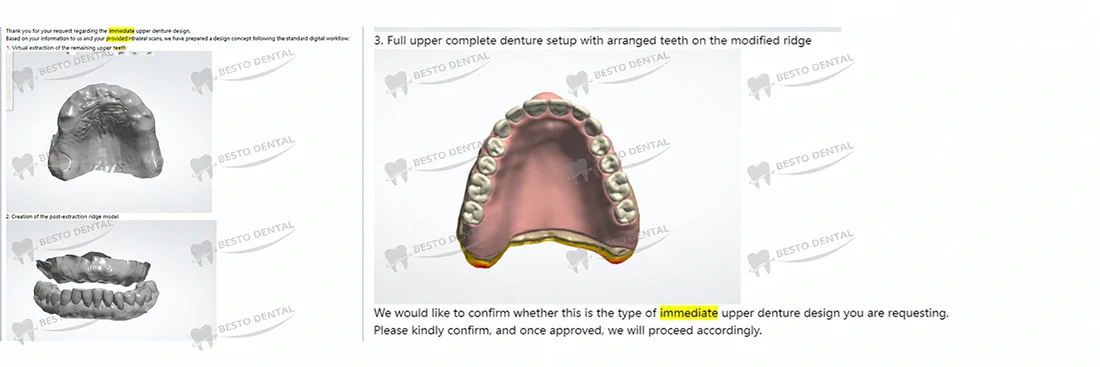
If your initial prescription does not specify the exact teeth to be extracted, BestoDental will confirm this with you before proceeding with actual fabrication. Additionally, to minimize the likelihood of future rework, BestoDental can send you the tooth alignment design for your approval.
5. Immediate Denture Clinical Applications
In the cases we work with most frequently, immediate dentures are used when teeth need to be extracted, and a prosthesis is required on the same day. The majority of immediate denture applications found in practice can be grouped under one of the following:
| Specific Clinical Situation | How the Product Is Used | Main Considerations |
|---|---|---|
| Full-mouth extraction due to advanced caries or severe periodontal disease | A complete immediate denture is made prior to extraction and placed at the time of extraction – provides esthetic and functional replacement on the day of extraction and serves as a surgical splint. | The vertical dimension and centric relation should be documented before the teeth are extracted because they cannot be accurately re-established after extraction; ridge resorption will require regular adjustments and continued reline or remake. |
| Anterior tooth loss where patients are unable to accept visible edentulism | An immediate denture is placed immediately following the extraction of missing anterior teeth and is either complete or partial, which helps to retain tooth appearance during healing. | Anterior tooth position, lip support, and shade should be documented pre-extraction; unrealistic expectations regarding retention, comfort, and esthetics must be explained pre-treatment. |
| Transition from a failing partial denture to a complete denture | Teeth extraction and immediate complete denture insertion; existing partial can be converted or used as a reference. | The clinician must determine whether or not the existing partial denture (or a new immediate denture) will require modification or if a new denture will need to be fabricated, and occlusal relationships and vertical dimension achieved by the partial denture must be assessed and maintained. |
| Multiple teeth extraction in a patient planned for implant-supported prosthesis | An Interim Immediate Denture is a temporary denture placed during the time the implant is healing and osseointegrating; it may include implant copings/attachments throughout the healing process. | Position and angulation of the implant needs to be planned prior to fabrication of the denture; a relief may be necessary on the tissue surface of the denture to prevent pressure on healing tissues or implant sites; early functional loading of the provisional needs to be avoided. |
| Edentulous mandible planned for implant overdenture using provisional implants | Two temporary mini-implants are placed in the mandible, and an immediate denture is fabricated and placed over the temporary mini-implants to provide interim denture support while healing. | Primary stability of the provisional implants should be confirmed; the denture base should be adapted to the implant bodies without compromising site healing, and the patient should be informed that the denture is a provisional one and cannot replace the definitive overdenture. |
| Extraction of periodontally compromised, non-restorable teeth in a patient with remaining sound teeth | The immediate removable partial denture is a denture that is made to replace the missing teeth immediately with a framework that can splint neighbouring teeth. | Periodontal status of remaining abutments should be monitored prior to the fabrication; abutment teeth might be restored or recontoured for the rest seats and clasps. |
| Single-arch extraction with an intact opposing arch | A complete immediate denture is fabricated for the extraction arch while preserving the occlusal relationship with the opposing natural or restored teeth | Occlusal scheme and vertical dimension need to be written with the natural teeth in place; uneven resorption could necessitate several adjustments for successful balanced occlusion. |
The immediate denture is not the final prosthesis. It will likely need relining as the ridge heals and may require modification when the definitive prosthesis is made. Clarifying this early prevents dissatisfaction if the interim denture does not achieve the fit, stability, or esthetics of the planned implant restoration.
6. Immediate Denture FAQs
In our communication with clients, questions about immediate dentures come up often. Below are the ones we hear most frequently.
1) Can an immediate denture be tried in before final fabrication?
Usually, no. A full wax try-in cannot be done for an immediate denture because the teeth planned for extraction are still in the mouth during fabrication. There is no way to seat a complete wax setup when natural teeth occupy the spaces where the denture teeth will go. In some partial cases, a limited posterior try-in may be possible before anterior extractions, but anterior tooth position is typically finalized from pre-extraction records.
2) When should the immediate denture be in place after extraction?
It should be inserted the same day as the teeth are extracted, preferably immediately after extraction. This swelling and shaping of the tissues increases the longer it goes on with no seating, which makes it even more difficult to seat and increases discomfort.
3) Will the lab be able to create an immediate denture without taking pre-extraction impressions?
No. The whole case is built on the basis of the pre-extraction impression/scan. If not, the lab doesn’t have anything in place to refer to for the arch shape, tooth placement, or tissue contours. To make a complete immediate denture, a complete record is needed.
4) May I submit a virtual impression and not a physical impression?
Yes, and that is increasingly the case. A complete design file can be provided with intraoral scans of the existing dentition and surrounding tissues and a digital bite registration. The scan should include the entire denture-bearing area, vestibules, and should clearly show the teeth to be removed.
5) If the denture is not a perfect fit on delivery day, what do you do?
Some adaptation is to be expected. The clinician may have to break pressure spots or flange chairside. The most common explanation for an ill fit is that the extraction pattern doesn’t match what was planned, or the pre-extraction records did not accurately reflect the contours of the tissue. A soft chairside reline can be done to stabilize the fit of a denture until a lab one can be made.
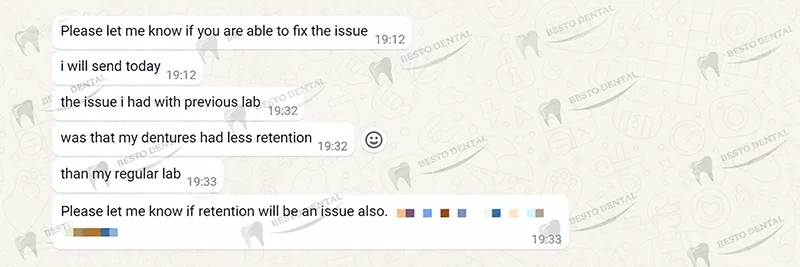
6) What should I do if the immediate denture from the laboratory has poor retention?
Poor retention can happen with immediate dentures, especially because the denture is made before extraction and the tissues change quickly after surgery. First, check the fit, border extension, occlusion, and pressure areas. Minor chairside adjustments or a temporary reline may improve retention. If the denture remains unstable, send the laboratory updated impressions or scans after the tissues have settled so the fit can be reassessed and the denture relined or remade if necessary.
Many of our clients first came to BestoDental after experiencing retention problems with their previous laboratories. Since switching to BestoDental, these clients have not reported the same retention issues with the immediate dentures we have provided.
7. Conclusion
In this guide, we covered what immediate dentures are, the main types available, commonly used materials, the laboratory fabrication process, and their typical clinical applications. We also discussed practical questions such as retention, fit, tissue changes after extraction, and when adjustment, relining, or remaking may be needed.
After reading this guide, you should have a clearer understanding of how immediate dentures are planned and fabricated, what information your laboratory needs before extraction, what to expect after insertion, and how to manage common clinical issues during the healing period.