When a patient needs a three-unit bridge to replace a missing front tooth, you might encounter a problem: how to match the restoration to the surrounding natural teeth? If a bridge appears too opaque or is the same colour as the surrounding teeth it can stand out, particularly during a smile. Multilayer Zirconia Bridges are a possible solution to this concern: They offer shade transitions that are more natural and the strength that is necessary for fixed restorations.
This guide aims to give you some idea about a multilayer zirconia bridge, its structure, types, fabrication and considerations in clinical use. You will have a comprehensive understanding of the structure, types and fabrication of a Multilayer Zirconia Dental Bridge, and when it is an ideal choice.
1. What Are Multilayer Zirconia Bridges?
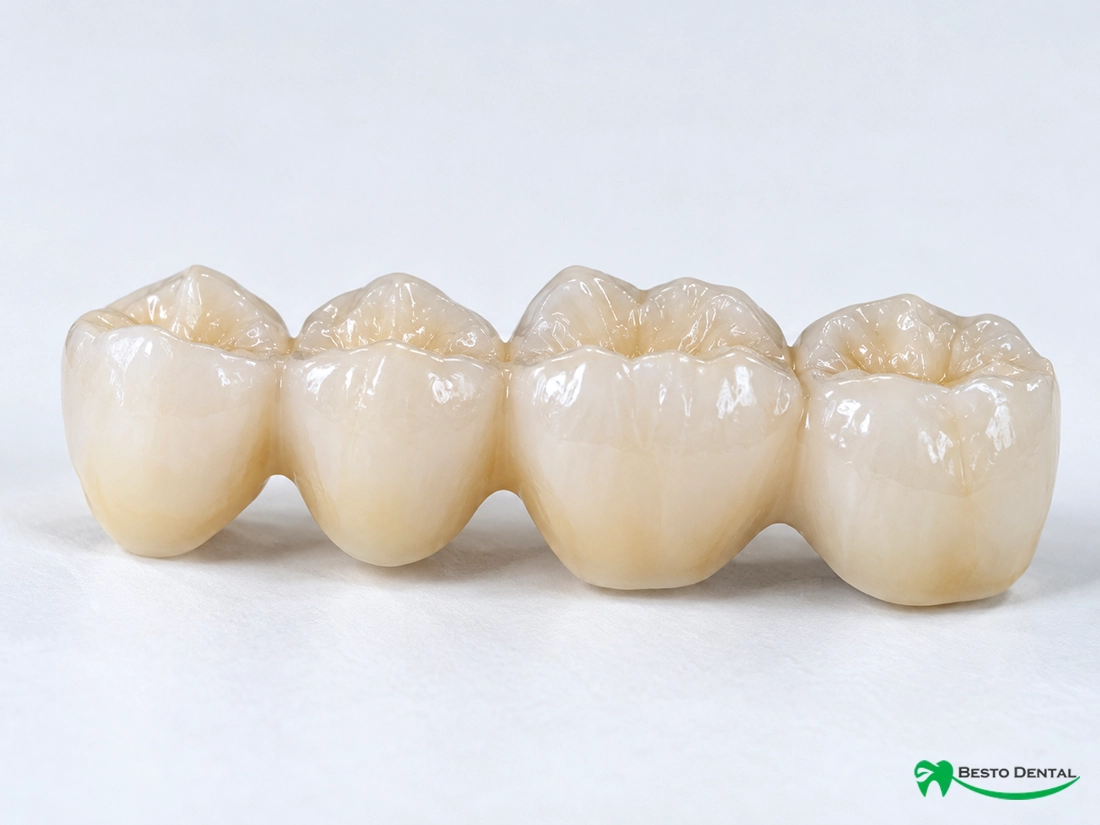
Multilayer zirconia bridge is a fixed dental bridge made of gradient-structured, multilayer zirconia material, which has been processed by CAD/CAM digital milling, sintering and surface treatment. The change is from the cervical to incisal/occlusal area. This is to help the bridge look more like a natural tooth. The cervical part is more opaque and stronger. The incisal or occlusal part is more translucent. Its main difference from monolithic and layered zirconia bridges is that the multilayer zirconia bridge uses the inherent color gradient within the zirconia material to simulate the natural tooth’s visual transition from the cervical area to the incisal edge. We covered this in detail in the multilayer zirconia guide.
It contains abutment crowns, connectors and a pontic. The abutment crowns are placed on top of the prepared teeth or implants. Pontic is used to replace the missing tooth. The connectors join the parts together. The difference is in the material. The shade and strength gradient is inherent in the material. So the bridge can look natural and stay strong at the same time.
The following are the main advantages of multi-layered zirconia bridges:
- Natural shade transition: The shade of the tooth transitions from the gum line to the biting edge. This is a tooth replica that is natural. It helps to decrease surface staining requirements.
- Higher translucency at the incisal edge: The enamel layer lets more light pass through. This helps the bridge blend with nearby teeth.
- Stronger cervical zone: The strength of the cervical layer is greater. This is where the connector is typically positioned. It’s also the place where stress levels are high.
- Better masking of dark abutments: The cervical layer is more opaque. It can hide dark preparations or metal posts better than a fully translucent material.
- Suitable for anterior and posterior use: Can be used in the front and back of the mouth. This depends on what the material is and on the case.
- Stains and cutbacks: The bridge can be stained or cut back for enhanced porcelain. This provides the lab with more choices.
- Save case in lab time: A complete contour bridge does not require porcelain layering. This saves time and helps to minimize chipping.
Common clinical include a three unit anterior bridge, a posterior bridge with a visible occlusal surface, or an implant supported bridge in the esthetic zone.
2. Types of Multilayer Zirconia Bridges
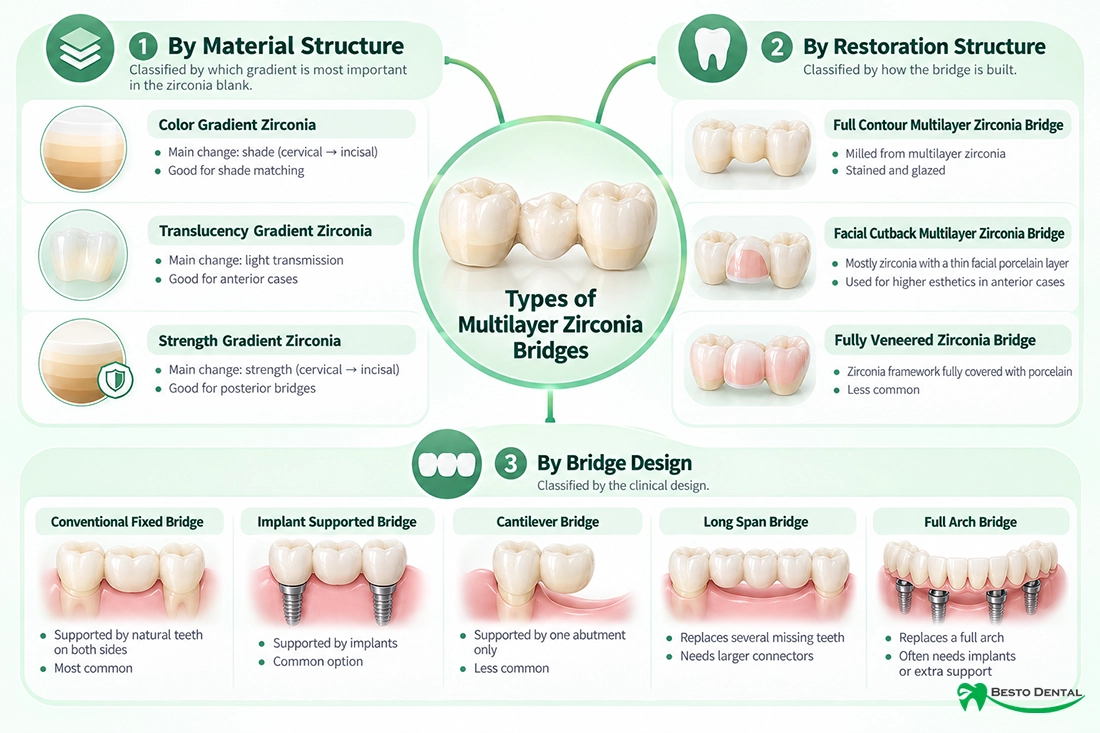
The structure of a multi-layered zirconia bridge is identical to that of a conventional dental bridge, so we will not elaborate on it here. Instead, we will examine the types of multi-layered zirconia bridges from three different dimensions.
1) By Material Structure
In terms of material structure, it essentially comes down to how the zirconia material used to craft the dental bridge is layered internally.
| Type | Main Characteristics | What to Keep in Mind |
|---|---|---|
| Color Gradient Zirconia | The main change is shade from cervical to incisal. | Good when shade matching matters most. Check strength for longer spans. |
| Translucency Gradient Zirconia | The main change is light transmission. | Good for anterior cases. Check connector strength. |
| Strength Gradient Zirconia | The main change is strength from cervical to incisal. | Good for posterior bridges. Check shade options. |
These features don’t need to be unique; they may not be unique to each type of product. For instance a multi-layered zirconia material may be colour, translucent and strong in a gradient.
2) By Restoration Structure
This classification method is primarily based on how the zirconia and the veneering porcelain are combined.
| Type | Main Characteristics | What to Keep in Mind |
|---|---|---|
| Full Contour Multilayer Zirconia Bridge | The whole bridge is milled from multilayer zirconia. It is then stained and glazed. | This is the most common type. The shade range is limited by the disc. |
| Facial Cutback Multilayer Zirconia Bridge | The bridge is mostly zirconia. A thin facial area is cut back and layered with porcelain. | Used for higher esthetics in the front. It adds a porcelain bond interface. |
| Fully Veneered Zirconia Bridge | A multilayer zirconia framework is fully covered with porcelain. | Less common. Not all multilayer materials work for full veneering. Check compatibility. |
For example:
Suppose a patient is missing one anterior tooth and requires a three-unit zirconia dental bridge.
- Monolithic: All three-tooth construction is made of zirconia.
- Partially veneered: The zirconia of the main body of the bridge is coated with the porcelain on the facial (front) surface to give it a more natural appearance.
- Fully veneered: A zirconia framework is first fabricated and then the final tooth shape is formed by adding porcelain to the outside of the framework.
The difference is the type of zirconia framework that is used with the veneering porcelain; although all three types can be used with multi-layered zirconia.
3) By Bridge Design
This classification is based on the bridge design.
| Bridge Type | What It Means | What to Keep in Mind |
|---|---|---|
| Conventional Fixed Bridge | Supported by natural teeth on both sides. | Connector size must match the span. |
| Implant Supported Bridge | Supported by implants. | Screw access can affect design and shade. |
| Cantilever Bridge | Supported by an abutment on one side only. | The single connector takes all the load. Make it larger and place it in a strong layer. |
| Long Span Bridge | Replaces several missing teeth in a row. | Needs larger connectors and careful nesting. |
| Full Arch Bridge | Replaces a full arch. | Often needs implants or extra support. |
Among these bridges, conventional fixed bridges and implant supported bridges are the most common. Cantilever bridges are less common. They need more care. Long span and full arch bridges are specialized. They need material specific connector sizes and, in some cases, extra support.
At Bestodental, we often find that clients have misconceptions about cantilever bridges. A cantilever is not just a bridge with one abutment. The connector must be larger. The pontic should reduce lateral forces.
3. Fabrication Process of Multilayer Zirconia Bridges
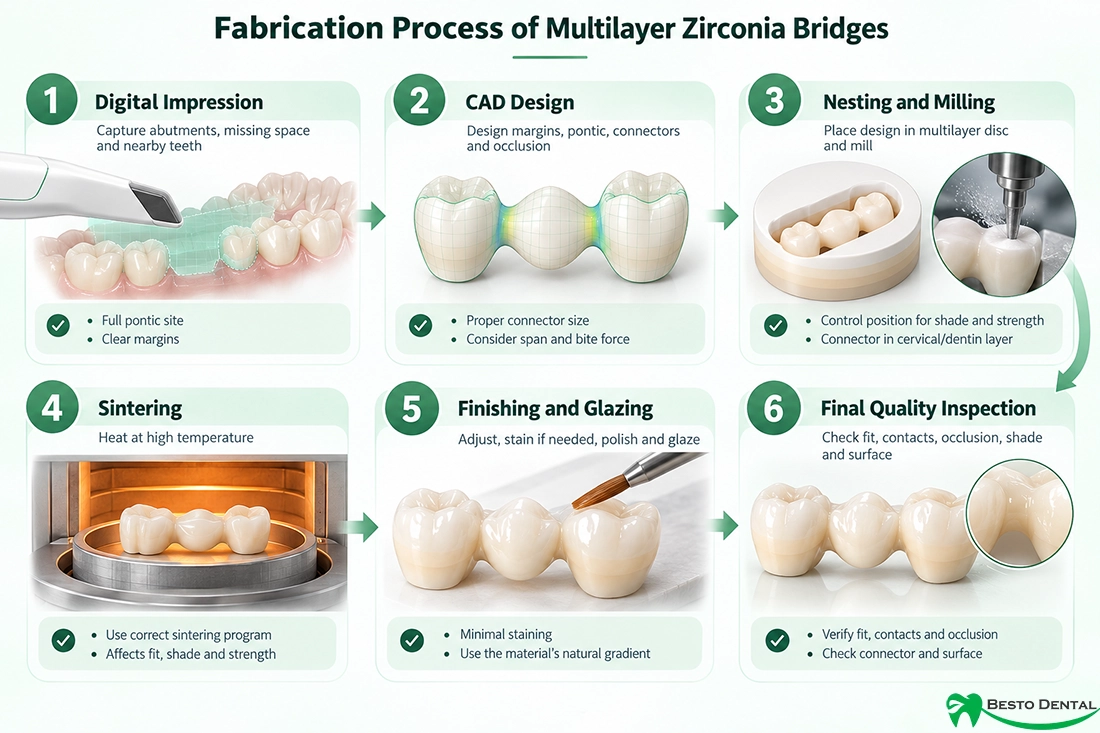
The fabrication of multi-unit zirconia bridges can be achieved entirely through a digital workflow; the main steps of this process are summarized below.
| Stage | What Happens | What to Keep in Mind |
|---|---|---|
| Digital Impression | An intraoral scan or model scan captures the abutments, the missing space, and the nearby teeth. | The scan must show the full pontic site and the margins. A poor scan can cause a remake. |
| CAD Design | The bridge is designed. This includes margins, pontic shape, connectors, and occlusion. | Connector size must meet the material minimum. The span and bite force affect this. |
| Nesting and Milling | The design is placed inside the multilayer disc. The bridge is then milled. | Nesting controls shade and strength. Put the connector in the cervical or dentin layer. Put the incisal edge in the enamel layer. |
| Sintering | The milled bridge is heated at a high temperature. | The program must match the material. Wrong programs can change fit, shade, or strength. |
| Finishing and Glazing | The bridge is adjusted, stained if needed, polished, and glazed. | Do not over stain. The material already has a gradient. Too much stain can make it look flat. |
| Final Quality Inspection | The bridge is checked for fit, contacts, occlusion, shade, and surface. | Check the connector for cracks. Keep adjustments after sintering to a minimum. |
There are some steps that are always of particular importance in the production of a multilayer zirconia bridge. One of them is nesting position. It’s because of this that a multilayer bridge is different. If the bridge is nested too far up, it may be too transparent and if it is nested too far down, it may appear opaque instead. One common error is the placement of a posterior bridge too high solely to achieve a brighter occlusal surface rendering, which will shift the connector into a weaker layer.
Another area that is important is connector design. The most common issue with zirconia bridges is that they tend to crack at the connection location, and the minimum amount of zirconia for the connection should be used. In our practice, a cantilever will need a greater connector than a standard three-unit bridge. Shape should be smooth, as sharp corners focus the stress.
Prior to delivery, we would inner inspection very aspects. The bridge is seated on the model, and the margin is checked using an explorer or fit checker. Proximal contacts are verified using shim stock or floss, and occlusal clearance is examined in centric and excursions. When magnified, cracks or thin areas in the connector are observed. The cervical to incisal shade and gradient are compared with the adjacent teeth, and we confirm that the glaze is smooth and free of pits.
4. Clinical Considerations for Multilayer Zirconia Bridges
In the cases BestoDental handle, multilayer zirconia bridges are most often used for three-unit to five-unit fixed restorations. They are common in the anterior and premolar areas. The needs change with the case. We list a summary table of clinical considerations for multilayer zirconia bridges here.
| Selection Factor | Clinical Consideration |
|---|---|
| Bridge Location | Anterior region: esthetics are a greater concern; posterior region: occlusal load is a greater concern. |
| Bridge Span | As the span increases, the demands on material and connector design generally increase. |
| Occlusal Force | Bruxism and high occlusal loads require focused assessment. |
| Connector Dimensions | Must comply with the selected material and bridge indication. |
| Available Restorative Space | Insufficient space may compromise restoration thickness and strength. |
| Abutment Shade | Dark abutments may require greater masking ability. |
| Esthetic Requirements | High esthetic demands may require additional staining or localized veneering. |
| Manufacturer Indications | Follow the specific material’s official indications and processing instructions. |
The following are two aspects worth particular consideration:
First is connector dimensions. Connectors are the stress concentration area of a zirconia bridge and a high-risk site for clinical failure. From our experience, connector design should satisfy strength first, then optimize contour. Connector dimensions should not be reduced arbitrarily for open embrasures, emergence profile, or esthetics. We would confirm with our clients the minimum connector requirements of the selected multilayer zirconia material during the CAD design stage, and ensure that all connectors in the same bridge are consistent in dimension and smoothly transitioned.
Second is the occlusal force. Chipping, fracture, and connector failure are serious risks when occlusal loads are high, and bruxism is present. Just having strength in material alone is not enough for such patients. Occlusion needs to be dealt with in a comprehensive way: adequate restorative thickness, avoiding thin walls and sharp contacts, evenly distributing occlusal contacts, a night guard, and regular follow-up.
5. Multilayer Zirconia Bridge FAQs
When considering outsourcing the production of multilayer zirconia dental bridges, you may have some questions. We have compiled a list of frequently asked questions from our clients, along with their answers, for your reference.
1) How do I choose the right shade?
Provide a shade tab match and natural light photographs (no flash) and the stump shade. Inform the lab of the desired shade, adjacent and opposing teeth, and cement color. Verify the nesting: enamel for anterior incisal edge, body for connectors, strongest for posterior functional cusps and connectors.
2) What information does the lab need from me?
Provide clear scans with proper margins, occlusion, and without holes or soft tissue interference. Include shade, stump shade, prep notes, implant system/scan body, clearance notes (occlusal notes), design requirements – sizes of connector, shape of pontic, cementation method.
3) Can the multilayer zirconia bridge be cemented like a normal bridge?
Yes. For poor retention and/or esthetic considerations use adhesive resin cement, for acceptable retention use resin modified glass ionomer. Resin bonding is a method that uses cleaning and low pressure alumina sand blasting, MDP primer, and dual cure resin cement and is not recommended for etching zirconia. The colour of the try-in and cement colour may affect the final colour.
4) Can the multilayer zirconia bridge be used with implants?
Yes, screw or cement retained. For the screw retention ensure that the implant system, scan body, Ti-base, and access angle of the screw are correct, and place the access on the lingual/palatal side or central fossa. A cleanable margin and good abutment retention for cement retention. Always bond Ti-base properly according to the manufacturer’s instructions and never use the screw by thin sections or connectors.
6. Conclusion
Multilayer zirconia bridges provide an efficient way to restore missing teeth with natural esthetics and acceptable strength. Various designs can be utilized for various clinical needs from three unit bridges to multi-unit restorations.
The key to success is proper case selection, digital design, fabrication and occlusion, fit and pontic contours. In the dental clinic or dental lab, it is important to communicate the needs of the restoration to ensure that the final bridge is both functional and esthetic. If you would like to discuss case information prior to outsourcing, please contact our customer service team for a consultation.