Your patient has more than one adjacent tooth missing, and you would like to restore those teeth with a dental bridge. But the natural teeth are not suitable for providing support for this, and an implant-supported bridge may be a possibility.
However, if you don’t have much experience with implant bridges then what? You want a natural-looking restoration which is an exact fit, can withstand daily chewing forces and will be easy for your patient to clean. So, what should you do?
In this guide, you will learn about the available structures of implant-supported zirconia bridges and some of the potential clinical applications and considerations, so you can feel confident in your next case and make a more informed decision.
1. What Are Implant-Supported Zirconia Bridges?
The fixed dental implant prosthesis is known as an implant-supported zirconia bridge. Replaces missing teeth. It is a link between a zirconia bridge and dental implants. It is not supported by natural teeth. The implants are inserted into the bone in the jaw. They mimic the tooth root. The implants are used to support the zirconia bridge. It can be placed on abutments as well. The implants are connected to the abutments.
The bridge functions as a single unit. The implants hold the bridge in place in the mouth. The zirconia framework restores the missing teeth, its shape, colour and chewing power. The bridge can be screw-retained. Can also be cement-retained. It is the implant system and clinical case based.
The benefits of a zirconia implant-supported bridge are
- Stability: The bridge is attached to the implants and can ensure stability during chewing and talking.
- Natural appearance with zirconia: Zirconia can be tinted to complement neighbouring teeth. Multilayer zirconia can also be used to create a natural color change from the gum line to the biting edge.
- Durable and wear-resistant: Zirconia is a durable ceramic and is able to withstand wear and fractures during use.
- High biocompatibility: Zirconia demonstrates excellent tolerability by the mouth tissues. Moreover, Zirconia does not cause adverse reactions such as metal sensitivity, which is common for metal alloys.
- Easy to clean: Screw-retained bridges can be removed easily, and thus they are more convenient to maintain.
- Restores chewing function: The bridge allows the chewing function to return on the missing side. It also helps for a better balance of bite.
- Supports facial appearance: Replacing missing teeth will help to hold the face up. It also contributes to developing a natural smile.
When patients are missing teeth, the dentists choose the zirconia implants in a real clinical application. Patient should have adequate bone for implants. Examples of common cases include a 2-unit bridge on 2 implants. There are other cases, such as a posterior bridge that is replacing multiple teeth. A full arch restoration is another example. The bridge is also applied in the case where the patient wants a fixed one. May not desire a removable denture.
2. Structure of Implant-Supported Zirconia Bridges
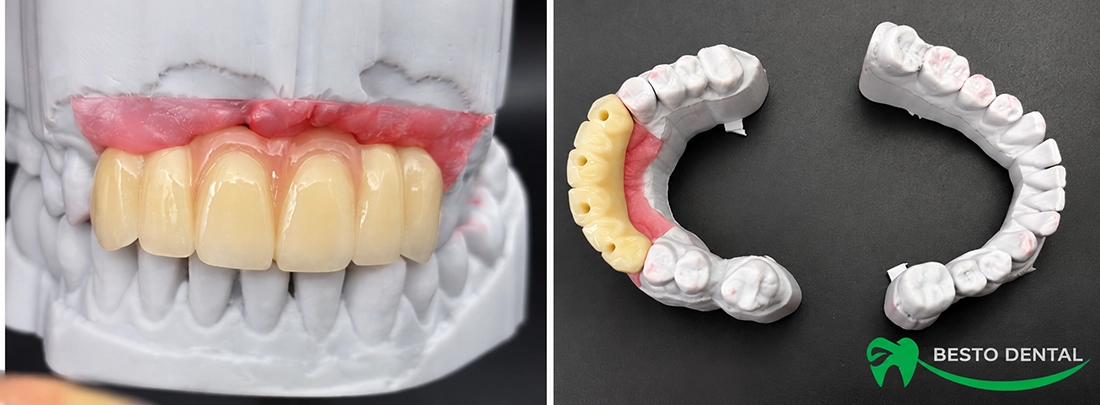
There are different components of an implant-supported zirconia bridge. The exact structure is dependent upon the implant system and the restoration design.
Dental implants: These are screwed into the jawbone. They are used to support of the bridge. The implant is usually constructed of titanium. This will then fuse with the bone.
Abutments or titanium bases: These are the section where the zirconia bridge is connected to the implant. In some cases, custom abutments are utilized. Some are made of Titanium. It is dependent on the implant system and retention system.
Zirconia bridge: The part that is visible is called a zirconia bridge. It replaces missing teeth, gives shape and colour to the tooth, chewing surface, etc. and also embodies the occlusal relationship with the opposing tooth.
Retention screws: In some screw-retained designs, these screws are used. The screws go through the bridge and into the implant or abutment. They hold the bridge in place.
In not all instances, the abutment, base, and screw are required. The real structure will vary according to the implant system and the restoration.
3. Types of Implant-Supported Zirconia Bridges
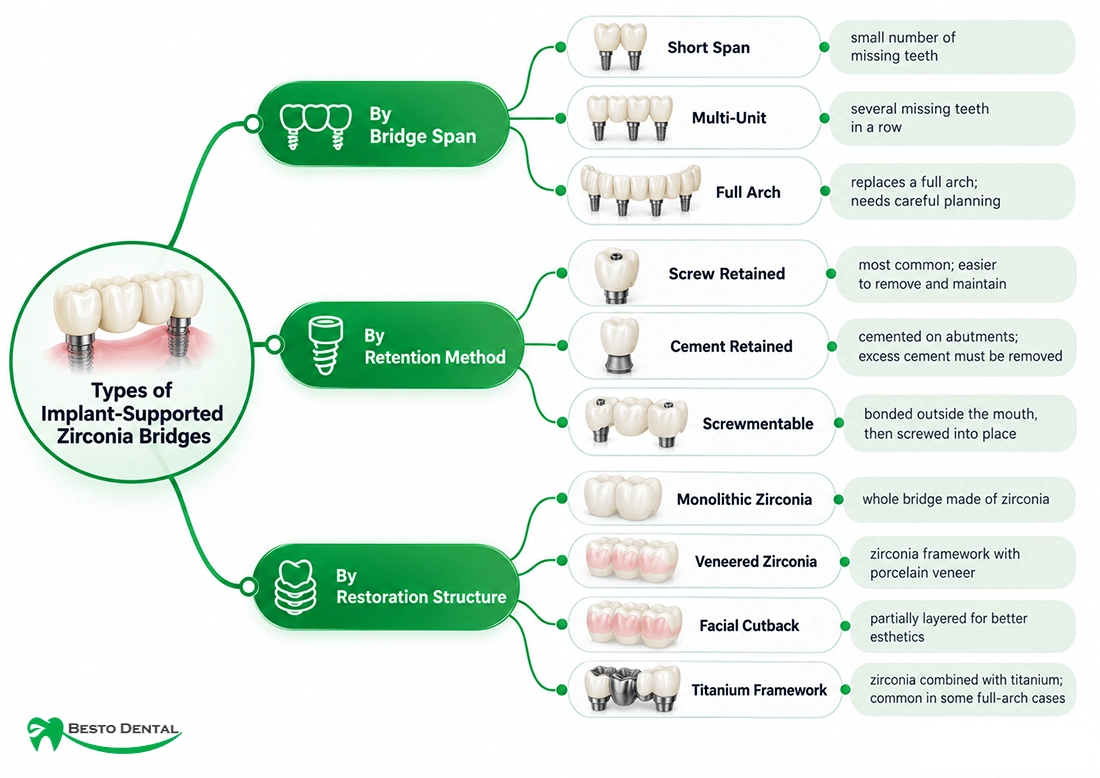
There are various types of implant-supported zirconia bridges, and its distinguishing features are span, retention method, and the design of the restoration.
1) By Bridge Span
The classification is made according to the number of missing teeth that are replaced by the bridge.
| Type | Main Characteristics | What to Keep in Mind |
|---|---|---|
| Short Span Implant Bridge | Replaces a small number of missing teeth, typically a three-unit bridge on two implants. | The design is affected by implant position and spacing. |
| Multi-Unit Implant Bridge | Replaces several missing teeth in a row. | The number and spread of implants must support the bite force. |
| Full Arch Implant Bridge | Replaces a full arch of teeth, typically supported by several implants. | Support, occlusion, cleaning, and maintenance should be carefully planned. |
The most common are short-span and multi-unit bridges. Full arch bridges are more specialized. They need more planning. They often need more support.
2) By Retention Method
This classification is based on how the bridge is fixed to the implants.
| Type | Main Characteristics | What to Keep in Mind |
|---|---|---|
| Screw-Retained Zirconia Bridge | The bridge has screw access holes. Screws hold it to the implants. | Screw hole position affects the appearance and occlusion. |
| Cement-Retained Zirconia Bridge | The bridge is cemented onto abutments. | Excess cement must be fully removed. Leftover cement can irritate tissue. |
| Screwmentable Zirconia Bridge | The bridge is bonded to the abutment outside the mouth. Then the unit is screwed into place. | It combines parts of both methods. It needs careful lab work and fit. |
Screw-retained is the most common method.
3) By Restoration Structure
This classification is based on how the zirconia restoration is built.
| Type | Main Characteristics | What to Keep in Mind |
|---|---|---|
| Monolithic Zirconia Bridge | The whole bridge is made of zirconia. | It is strong and simple. The shade range may be limited by the material. |
| Veneered Zirconia Bridge | A zirconia framework is covered with veneering porcelain. | It allows more characterization. It adds a porcelain bond interface. |
| Facial Cutback Zirconia Bridge | The bridge is mostly zirconia. The facial or incisal area is cut back and layered with porcelain. | It is used for higher esthetics. The cutback area needs careful support. |
| Zirconia Bridge with Titanium Framework | A zirconia restoration is combined with a titanium framework. | It is common in some full arch designs. The titanium adds support. |
The type that clients often ask about is the screw-retained bridge. The main question is where to place the screw access holes. This will vary, depending on the position of the implant, the bite, and the aesthetics. If the hole is in a place where you can see it, it can spoil the appearance of the image. If the hole is in a weak area, it can have an effect on strength.
4. Design of Implant-Supported Zirconia Bridges
A properly designed implant-supported zirconia bridge features a natural appearance, convenient cleaning, high strength and reliability, as well as a precise fit. To achieve these goals, here we list four key points in the case design.
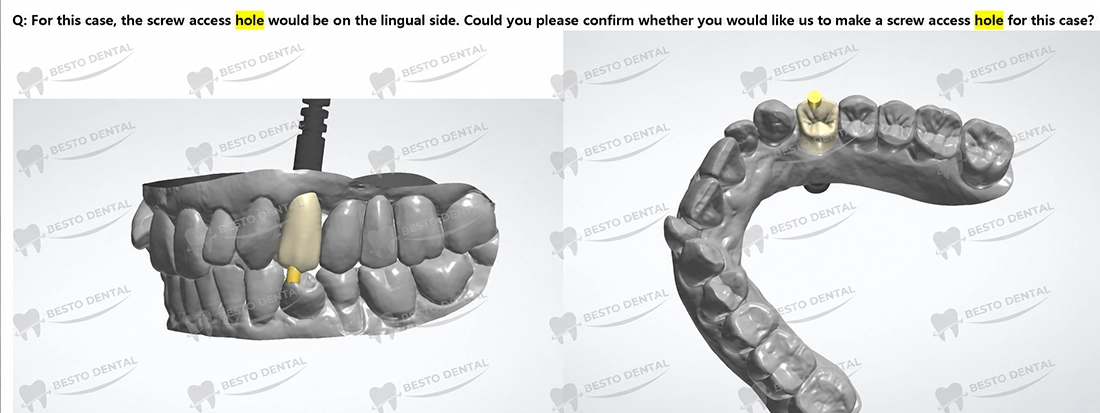
1) Screw Access Hole Position
The screw-retained zirconia bridge must be carefully designed, both in terms of its position and angle, of the screw access holes. They can affect the esthetics, occlusal, and maintenance of the restoration.
It is best to have screw access holes that the dentist can easily reach, without creating large occlusal or visible facial surfaces. If the position of the screw access hole is not certain, BestoDental will provide a design preview for confirmation prior to production and clearly mark the planned position of the screw access hole.
2) Passive Fit
Passive fit is required for multi-implant bridges. The restoration should fit snugly on the implants without excessive pressure to fit, as the improper fit of a restoration may put stress on the implants as well as on the bridge.
Fit issues may be caused by mis-scanning, model error, abutment connection, or machining tolerances.
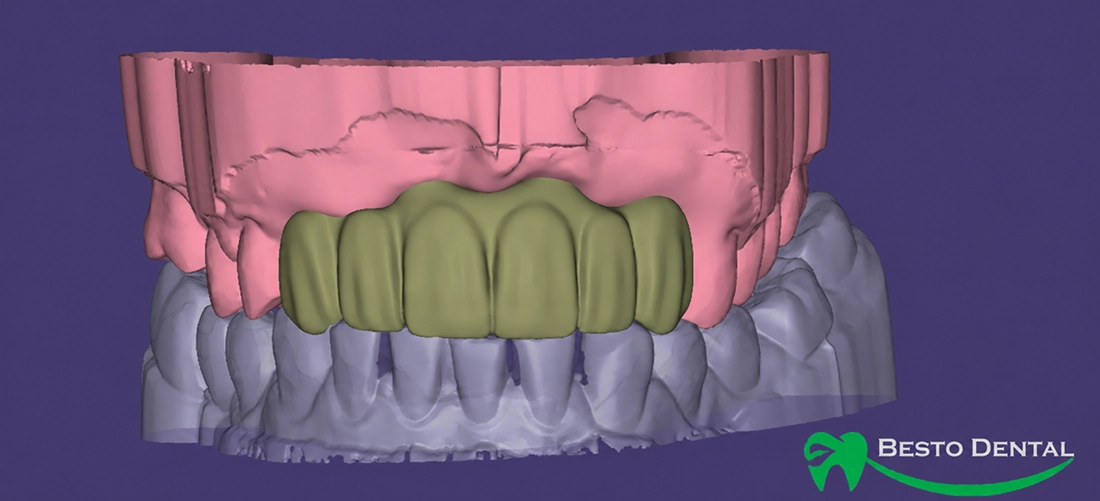
3) Pontic and Gingiva Design
The tissue-facing surface of a zirconia bridge should provide a natural appearance while supporting soft tissue health and daily cleaning. When contouring is done well, it will help to prevent excessive pressure on the gums and prevent areas of food and plaque buildup.
In the case of full arch restorations, pink artificial gingiva can be used to enhance the esthetic result. In such cases, the space between the artificial gum and the patient’s gum should be skillfully planned to give a natural appearance.
4) Occlusion Design
Whereas natural teeth have a periodontal ligament that acts as a buffer and a sensor, implants don’t. This is especially true when using zirconia bridges supported by implants.
The following factors must be taken into account when planning the bite: bridge span, opposing dentition, implant positions, and the patient’s occlusal habits. A well balanced occlusal design will ensure the biting forces are distributed more evenly and will reduce the lateral forces against the restoration.
5. Fabrication Process of Implant-Supported Zirconia Bridges
The fabrication of implant-supported zirconia bridges can be broken down into a few stages, which range from receiving digital data to the delivery of the final product.
| Stage | What Happens | What to Keep in Mind |
|---|---|---|
| Digital Scan Submission | Obtain intraoral scan files, implant scan data, bite registration, and case instructions from the dental office or lab. | The accuracy of the scan, full implant position data and the bite record is reliable, the accuracy of the following design is influenced. |
| Case Review & Implant System Confirmation | Review all files submitted and confirm the implant brand, platform, connection components, and planned restorations. | Incorrect information in the implant system can lead to connection and seating issues. |
| CAD Design | Design a bridge in dental CAD software, including the tooth anatomy and occlusal contacts, connector dimensions, and interface with the chosen implant restorative components. | The position of the implant, the amount of restorative space available, connector size, and the type of the designed prosthesis will affect its fit, structural integrity, and function. |
| Zirconia Fabrication & Quality Inspection | Mill the bridge from the selected dental zirconia, complete the necessary sintering, finish, stain, glaze, or polish as indicated. Compare the restoration to the approved design. | Surface treatment, finishing, connector geometry, and sintering shrinkage are factors to consider when it comes to dimensions, strength, and appearance. |
| Finished Restoration Delivery | Properly clean, identify, protect, and package the completed bridge for shipment with correct case details. | The finished restoration should clearly be identified, and not be damaged during handling and moving. |
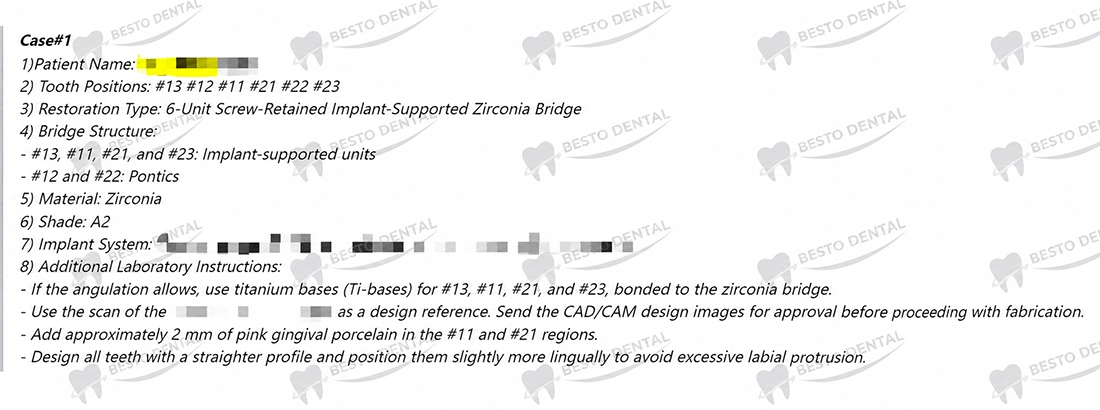
Upon receiving a case, BestoDental analyzes the scan data, quantity of restoration materials needed, and data associated with the implant system to make sure that the restoration can be fabricated and that the restoration materials are compatible with the implant system.
We recommend that dentists provide the Implant System Brand, Model, and Connection Platform when submitting a case. This helps reduce the time required for subsequent back-and-forth communication and confirmation, thereby improving case processing efficiency. We also covered this in detail in our article Zirconia Dental Implants Guide.
The final checks are based on the fit of the bridge, margins, proximal and occlusal contacts, screw-access hole location, shade, and surface finish. The design is also checked for adequate space for cleaning under the bridge.
Once BestoDental has finished the fabrication process and passed quality control, we arrange international shipping to send the completed dental bridge to the client’s address.
6. Clinical Applications for Implant-Supported Zirconia Bridges
Usually, when more than one tooth is missing in a single section of the teeth, or the entire tooth arch is missing, the implant-supported zirconia bridges are used. The design and fabrication needs will vary from case to case based on the clinical needs.
| Specific Clinical Situation | How the Product Is Used | Main Considerations |
|---|---|---|
| Two or more missing teeth in a row | A short span implant bridge is used. Two implants often support a three-unit bridge. | Check implant position, number, and spacing. |
| Missing posterior teeth | A posterior implant bridge restores chewing on the back teeth. | Check bite force and the space for the restoration. |
| Missing anterior teeth | An anterior implant bridge restores front teeth. | Focus on gum shape, color, and smile line. |
| Several missing teeth in different areas | A multi-unit implant bridge connects the implants into one restoration. | Check how the implants share the load. |
| Full arch missing teeth | A full arch fixed implant bridge replaces all teeth in one arch. | Check implant support, occlusion, cleaning, and maintenance. |
Special care must be taken in the area of aesthetics with anterior implant bridges. It may be challenging to achieve a natural appearance if the implant placement is irregular or the gum lines. It is based on clear clinical photos and accurate shade information, pink gingival porcelain or zirconia makes the gum line better. Pre-production design review helps to avoid aesthetic issues and reworks.
7. Implant-Supported Zirconia Bridge FAQs
When we work with clients, we have seen that a number of their considerations are similar to the following listed issues, which are gathered for your reference.
1) Can an implant-supported zirconia bridge be used for one missing tooth?
When there is one missing tooth, it is typically recommended to use an implant-supported zirconia crown. Zirconia Bridges are used more often to replace a greater number of missing teeth. It is based on the location of the implant, space, and treatment plan.
2) Is zirconia strong enough for a full-arch bridge?
Yes. The high strength zirconia can be employed for full-arch implant restorations. However, it is not sufficient if the thickness, distribution, passive fit and balanced occlusion is not enough. In some instances, it may require additional support in the form of a titanium framework.
3) Can the bridge be removed by the dentist?
Yes, if it will be screw-retained. The dentist will be able to remove it to clean, treat, repair or maintain it. Cement-retained bridges are more challenging to retrieve and can be damaged in the retrieval process. Full-arch restorations are frequently retained with screws.
4) What if the implant brand is unknown?
For production the brand and type of connection and platform size must be verified. Fitting problems, which may occur in case of a wrongly fitted part. The dentist should verify the patient’s implant records or look for the implant system prior to sending the case to the lab.
5) How are screw access holes hidden?
Typically, screw access holes will be located on the occlusal surface of posterior teeth or the lingual surface of anterior teeth. Once in place, they are capped with composite resin. When planning the holes, it is important to plan them in a way that does not expose the holes on the visible surfaces, which is achieved by proper digital planning.
6) How to Reduce Remakes Caused by Implant System Mismatches?
One common reason for remakes of implant-supported zirconia bridges is inaccurate or incomplete implant system information. When a case involves a less common implant brand that is not widely used by Chinese dental laboratories, identifying compatible components can take considerable time. Incorrect implant models, platform sizes, or connection details may also lead to fitting problems and remakes.
To reduce these risks, we recommend using widely implant systems such as Straumann, Nobel Biocare, Dentsply Sirona, Osstem, Hiossen, or Zimmer Biomet whenever clinically appropriate. If you use a less common implant system, please provide the corresponding implant library or compatible CAD database when submitting your case.
Most importantly, always specify the exact implant brand, model, connection type, and platform diameter rather than providing general or approximate information. Clear and accurate implant details help your dental laboratory identify the correct components, reduce unnecessary communication, and minimize the risk of remakes.
8. Conclusion
Implant-supported zirconia bridges offer a reliable fixed restoration option for patients with multiple missing teeth, combining natural-looking esthetics with the strength needed for daily function. Understanding the different bridge structures, retention methods, and clinical applications can help you choose the most suitable restoration for each case.
Successful outcomes also depend on accurate implant information and clear communication with your dental laboratory. Providing the exact implant brand, model, platform size, and compatible CAD library when necessary can help prevent component mismatches, reduce remakes, and avoid unnecessary production delays.
At BestoDental, we support dental clinics and laboratories with customized implant-supported zirconia bridges, digital design, and careful quality control. Whether you need a short-span bridge, a multi-unit restoration, or a full-arch solution, our team is ready to assist with your cases. Contact us to discuss your restoration requirements.