A full-arch zirconia bridge may look perfect in the CAD design, but what happens when you tries to seat it and discovers that it doesn’t fit properly?
For dental clinics and laboratories, this is more than a minor inconvenience. Inaccurate implant scans, insufficient restorative space, poorly designed connectors, or milling discrepancies can lead to chairside adjustments, remakes, and unexpected treatment delays.
In this guide, we’ll explore the materials, key design considerations, and clinical applications of full-arch zirconia bridges, helping dentists and dental laboratories make more informed decisions and avoid common restoration challenges.
1. What Are Full-Arch Zirconia Bridges?
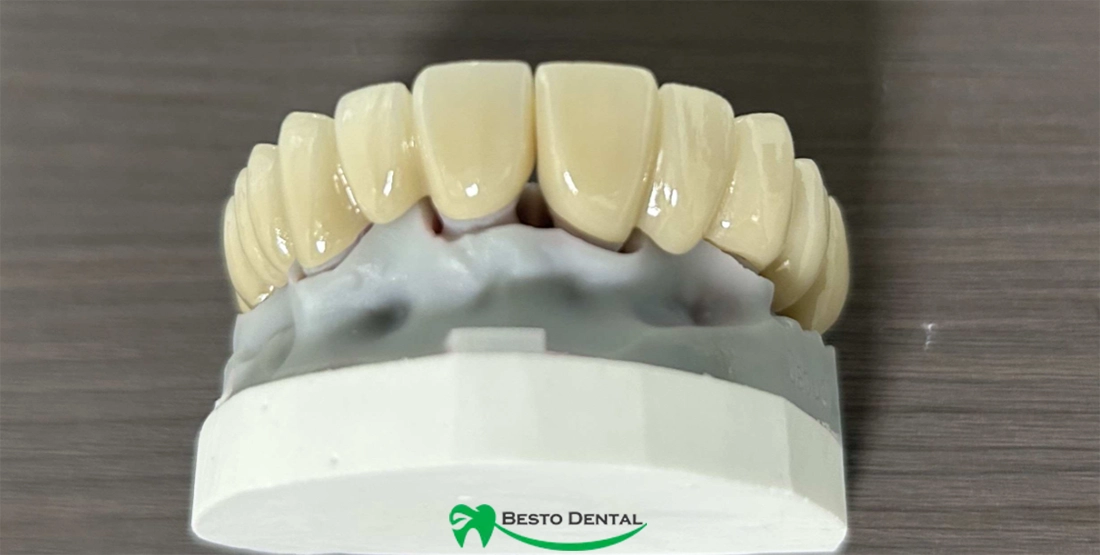
A full-arch zirconia dental bridge refers to an implant-supported, fixed restoration that replaces an entire upper or lower arch of teeth. The visible tooth form and the structural body are milled from zirconia, and the prosthesis covers two posterior areas without support from the natural teeth between them.
Thus, the placement of the implants is made first; then multi-unit abutments or titanium bases are attached, and the zirconia bridge is placed and fixed with the prosthetic screws. Zirconia is used to support the occlusal loading, to form the shape of the tooth, and in many designs, to recreate the gingival contour. Screws are not blocked and can be retrieved, maintained, or repaired, if necessary, without destroying the prosthesis.
Unlike a denture or hybrid acrylic prosthesis, the entire arch is a solid block. No acrylic base, soft tissue support, or denture flange. The prosthesis is fixed, and the patient only cleans under the prosthesis.
Let’s take a look at the benefits:
- Low veneer chipping risk in monolithic designs: When the functional surface and the occlusal surface are in monolithic zirconia (no layered Feldspathic Porcelain), veneer chipping is the most common complication of bilayer systems and is significantly reduced.
- High framework fracture resistance: Full-arch frameworks have a high degree of resistance against catastrophic fracture that cannot be obtained by other ceramic systems due to the high framework fracture resistance of zirconia.
- Screw retrievability: This means that the prosthesis can be removed for hygiene, screw tightening, or repair without cutting off the screw from the prosthesis. It is precisely this reason that the current recommendation is for screw retention over cementation in full-arch fixed prostheses.
- Rigid splinting across the arch: Several implants in the same unit are strutting across the arch, thus contributing to a reduction in the load on each implant.
- Material stability and wear resistance: Zirconia will not dissolve or break away in the mouth as will some resin materials, and the polished surface will aid in repelling plaque if well cared for.
- Gingival customization without separate acrylic base: Pink porcelain/tooth/ zirconia can be used to restore the soft tissue contour of the missing gums and to restore the labial support, without adding additional acrylic base to the prosthesis.
The clinical application of zirconia full-arch bridges is most commonly in edentulous or near-edentulous patients who desire a fixed, nonremovable prosthesis; the clinical applications of this treatment are discussed later in more detail. They are not preferred for patients with severe uncontrolled bruxism, unless it is possible to control the forces of occlusion and the thickness of the prostheses, and they should not be used instead of careful planning of the implant when the distribution of implants is not favorable.
2. Structure of Full-Arch Zirconia Bridges
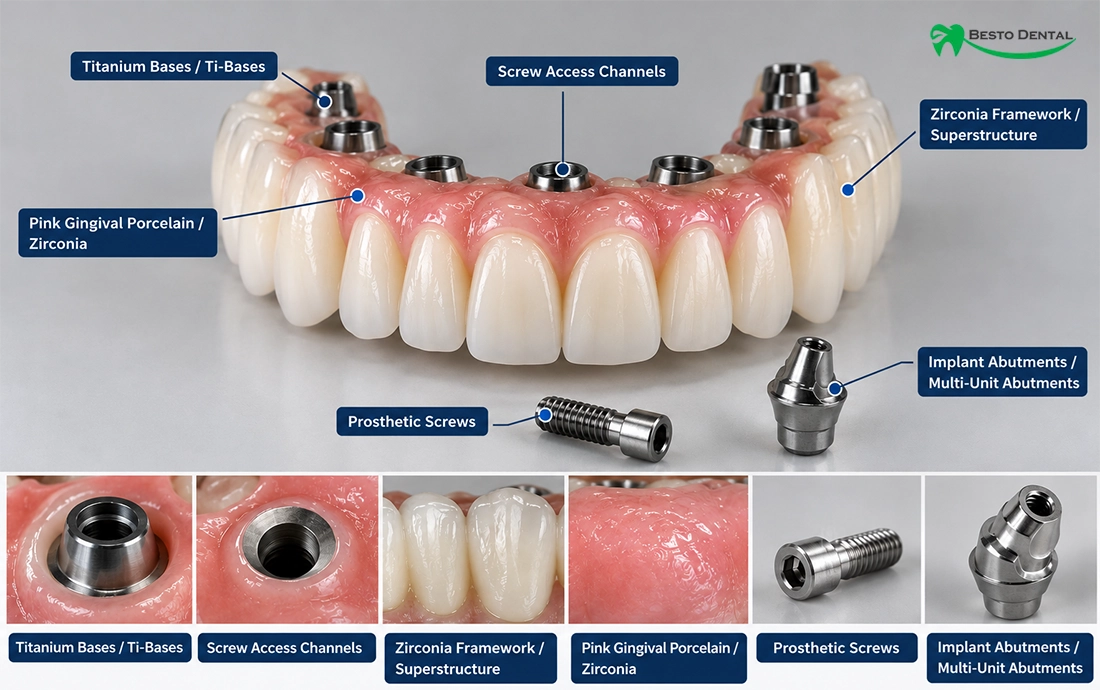
A full-arch zirconia bridge is an integrated unit composed of the zirconia body, connection interface (to the implants), and the screw access system.
| Component | What It Is | Main Function |
|---|---|---|
| Zirconia framework / superstructure | The milled zirconia body that is used for making teeth and the connecting framework | Supports the occlusal loading, shapes the dental arches and the morphology of the teeth, and creates structural continuity of the prosthesis |
| Titanium bases / Ti-bases | A prefabricated zirconia insert on the intaglio surface, which is made of titanium | Creates the screw-retained connection between the zirconia prosthesis and the abutment or implant platform |
| Multi-unit abutments | Abutments that attach to the implants which offer a common restorative platform and screw access | Aligns any angulation differences and sets up a stable and interchangeable implant/prosthesis relationship |
| Prosthetic screws | The screws that go through the prosthesis and connect it with the abutment or implant | Keeps the prosthesis and allows it to be retrieved for maintenance |
| Screw access channels | The milled channels through the zirconia that give access to the screw heads | Allow to screw, unscrew, and re-screw without any injury to the prosthesis |
| Pink gingival porcelain / pink zirconia | A ceramic or zirconia that has been applied or milled in the gingival area | Replaces missing soft tissue contour and provides labial support in cases with ridge resorption |
Not every full-arch zirconia bridge will have all of the aforementioned components, such as an artificial gingiva; in addition, the titanium connecting structures could differ.
3. Materials Used for Full-Arch Zirconia Bridges
Full-arch zirconia bridge materials show significant differences between the material approaches and between the different material grades and generations of monolithic zirconia. Below is a brief overview of the main characteristics and some common considerations of these three material approaches.
| Material approach | Main characteristics | Common considerations |
|---|---|---|
| Monolithic zirconia | High flexural strength, no porcelain veneer on functional surfaces, can be milled with the anatomical occlusal detail | The aesthetic characterisation is more dependent on the selection of the staining and multilayer blanks, and the thickness and design of connectors still dictate fracture resistance |
| Layered / veneered zirconia | Core zirconia with a porcelain veneer; wider shades and translucency for anterior display areas | The weak link is the veneer, with a significantly higher chipping rate than monolithic, and prosthetic space reduction is correlated with fractures |
| Titanium-zirconia hybrid | Titanium provides the implant interface or a supporting bar; zirconia provides the tooth and gingival form | The bonding between the titanium and zirconia needs to be established, and the design and fabrication of the titanium part increases the complexity, as does the controlled fit between the components |
4. Key Design Considerations for Full-Arch Zirconia Bridges
Undoubtedly, the design of a full-arch zirconia bridge is more complex than that of a single-crown implant-supported zirconia restoration. Below, we outline several key considerations to help you make more accurate clinical judgments when planning full-arch zirconia bridge cases.
| No. | Design Consideration | Core Knowledge |
|---|---|---|
| 1 | Passive Fit | A bridge across multiple implants should be as passive as possible; that is, there should be no additional stress from a wrong connection. |
| 2 | Restorative Space | A too-thin zirconia, titanium bases, and connections in respect to dimensional space should not be performed. |
| 3 | Occlusal Design | Lateral guidance and load distribution should reduce the stresses that act on the prosthesis in an appropriate manner to design an occlusal contact. |
| 4 | Cantilever Design | Be sure to maintain the distal cantilever to minimize bending moments on the implant and bridge. |
| 5 | Gingival Contour | Calculate the need for artificial gingiva, taking into account soft or hard tissue defects, particularly esthetic and lip support requirements. |
| 6 | Hygiene Accessibility | The underside of the bridge should be easy to access to get to patients with instruments like water flossers and floss threaders. |
| 7 | Screw Access Channels | The screw holes should be located on the appropriate occlusal or lingual surface, if possible, taking into account the strength of the material. |
| 8 | Implant Position & Angulation | The position, number, angulation, and distribution of implants impact the bridge structure, screw channels, and the force design. |
All these factors are interdependent and must be considered in the digital design stage: The position of the implant will define the position of the screw channel, the space available for the restoration will define the thickness of the material, the occlusal scheme will define the size of the connector and the length of the cantilever, and the hygiene accessibility will define the profile of the emergence and the shape of the intaglio.
5. Fabrication Process of Full-Arch Zirconia Bridges
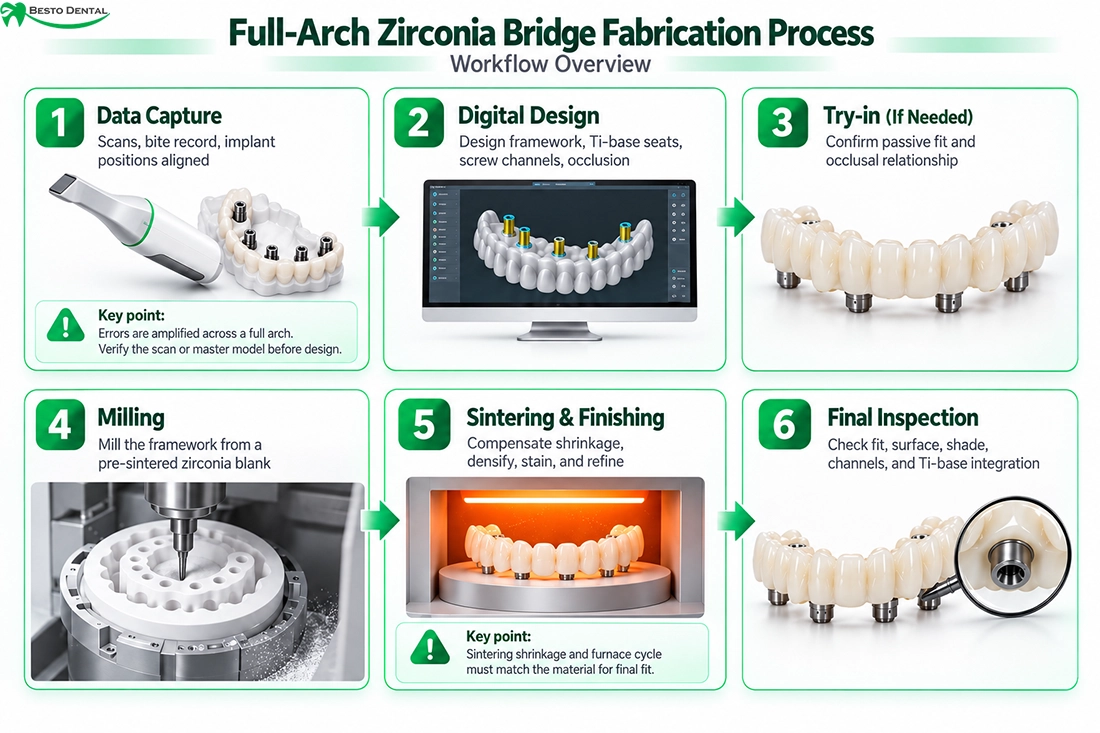
A full-arch zirconia bridge is made with a sequence of stages that each constrains the next. The key stages can be briefly described as follows:
| Stage | What happens | What to keep in mind |
|---|---|---|
| Data capture | Upper and lower scans, bite record, implant position data, and restorative system information are collected and aligned | Accurate full-arch scan requires specific verification and may not be accurate enough for the rigid framework with multiple implants |
| Digital design | The zirconia framework, base seats of titanium, screw channels, occlusal scheme, and gingival contour are designed in the CAD | The design must balance the position of the implant, the space for the restoration, the passive fit, occlusion, and space for hygiene access |
| Try-in (when indicated) | A trial framework or verification jig is used to confirm fit and occlusal relationships before final finishing | To detect a fit discrepancy, you will need to do that at this point, not after sintering |
| Milling | Screw channels and titanium base receptacles for the zirconia framework are milled from the green blank | Milling accuracy and the condition of the green zirconia influence the final fit after sintering |
| Sintering, staining, and finishing | Final density is attained by sintering the milled framework, and the material should be stained or characterized as required | Sintering shrinkage is substantial and must be compensated in the CAD design; records of sintering should be maintained and should be traceable |
| Final inspection | Dimensions, fit, surface, colour, screw channel patency, and titanium base integration are checked | Not a generic “quality check”; the specific interfaces and functional surfaces are what matter |
As one of the laboratories with more than 10 years of experience in the dental laboratory sector, we at BestoDental have experienced several occasions where inaccurate scan data was obtained due to wrong placement of scan bodies, thus causing fitting issues with the restorations in question.
Thus, making sure that the scan bodies are completely and properly seated during the intraoral scanning process is vital in order to achieve proper implant placement and fit of the restoration.
Also, when using other implant systems other than the standard Neodent, Straumann, and Nobel Biocare, please specify the full information about the implants you are using including their brand name, type, platform, dimensions, and the appropriate implant library file.
Furthermore, milling accuracy is very important as well for obtaining the right fit of the implant restorations. The best thing is to double-check the equipment settings prior to milling.
Last but not least, BestoDental checks for the final quality of the implant restorations, ensuring the fit and proper seating of the restorations along with verifying that the prosthetic screws match the implant system.
6. Clinical Applications for Full-Arch Zirconia Bridges
The most common situation in full-arch cases that are zirconia-driven is an edentulous arch or a partially edentulous arch that is about to become edentulous, but presents with various treatment details for each patient and is therefore treated in a different manner and with different prosthesis design. We summarized some common clinical applications for your reference.
| Specific clinical situation | How the product is used | Main considerations |
|---|---|---|
| Complete edentulism | Function and fixed tooth support over an implant-supported arch are restored with a screw-retained full-arch zirconia bridge | Implant number and distribution are mandatory; passive fit and hygiene access are mandatory and not negotiable, as the prosthesis will not be removable for cleaning |
| Terminal dentition | After extraction and implant placement are planned, a full-arch zirconia bridge can be used as the definitive prosthesis following an appropriate provisional phase | Improper planning of and provision for a transition to a fixed prosthesis necessitates verified positions of implants and a stable occlusal plan, and the final design should not be determined until the tissue reaction and implant integration are verified |
| Severe tooth loss with remaining teeth | If a fixed reconstruction is not possible with the remaining teeth, and a full-arch implant reconstruction is selected, zirconia may be a consideration | The remaining teeth and their strategic importance should be evaluated; it is not just “remove all and restore,” and the prosthetic space and lip support after tooth removal should be planned |
| Existing denture patients seeking a fixed alternative | For patients who are seeking to improve the function of a removable prosthesis to a fixed one, a full-arch zirconia bridge might be a viable solution | Implant feasibility, bone volume, and the patient’s ability to clean under a fixed prosthesis are the deciding factors; the desire for “fixed” is not by itself an indication |
| Significant bone and gingival loss | Pink porcelain or pink zirconia can be added in to make up for any missing soft tissue and to restore labial support | Pink porcelain changes the intaglio contour and can reduce hygiene access; the aesthetic benefit must be balanced against cleanability and the thickness of the zirconia in the gingival zone |
| Bruxism | It is possible to use a full-arch zirconia bridge; however, this is not a blanket indication | Bruxism is associated with chipping, and a protective night guard is recommended after delivery to minimize the risk of fractures and screw loosening due to material thickness, occlusal scheme, and cantilever design; a strict review is required |
7. Full-Arch Zirconia Bridge FAQs
By now, we believe you have gained a good understanding of full-arch zirconia bridges. Here we have compiled several frequently asked questions from clients and provided consolidated answers.
1)Does the number of implants change the design?
Yes. Passive fit depends on the number and distribution of implants and on the angulation of the screw canals. The number and distribution of implants determine if it is possible to achieve a passive fit, and where the screw canals can be placed in the implant, which also affects the distribution of occlusal load. If the design is successful for six implants with good anterior-posterior distribution, this is not necessarily a design that will be successful for four implants with a different anterior-posterior distribution.
2) How much restorative space is enough for a full-arch zirconia bridge?
Not a single number applies to all designs, as the requirement will depend on the dimensions of the connector, the scheme of occlusion and the height of the base of the titanium. What’s important is that there have been reports of fractures in zirconia complete-arch prostheses that are less than the space of the material itself and the interface.
3) How can passive fit of a full-arch zirconia bridge be confirmed before design?
Passive fit should be verified using an intraoral verification jig, a verified cast, or a validated digital scan to ensure multiple implants fit without stress. In case of discrepancy found during verification, the cast or scan should not be verified as is but corrected before design and then incorporated into the zirconia. Zirconia is not pliable and will not adjust when seating to accommodate a poor working model.
4) Can pink porcelain be added later if the gingival result is unsatisfactory?
Pink porcelain is added into the design and manufacturing of the definitive prosthesis. It’s not a straightforward chair-side addition. The use of a pink zone must be decided prior to the zirconia milling since it will impact the intaglio contour, the restorative space, and the thickness distribution of the prosthesis.
8. Conclusion
Full-arch zirconia bridges offer an excellent combination of strength, aesthetics, and durability for implant-supported restorations. However, long-term success depends on more than material selection. Accurate implant scanning, proper restorative space, well-planned occlusion, precise milling, and reliable passive fit all play essential roles.
A successful full-arch zirconia bridge begins with accurate clinical data and ends with precise laboratory execution. At BestoDental, we work closely with dental professionals to turn complex full-arch cases into predictable restorative outcomes. If you have a specific case that requires evaluation, please feel free to contact us.